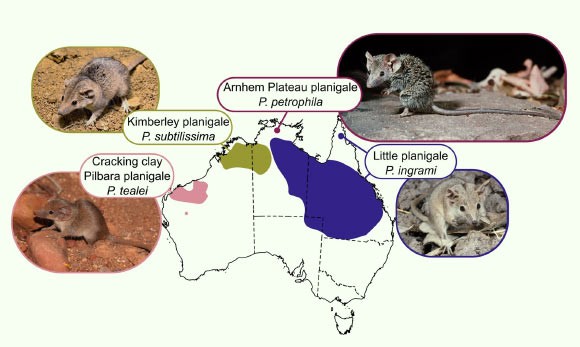
Scientists in Australia have dismantled a long-held assumption. What was thought to be a single, widespread planigale is actually four distinct species. One is brand new. It lives on the rocky slopes of Kakadu National Park.
Planigales are small. Really small. Mostly they eat insects. Their skulls are flattened, a shape that lets them slip into crevices like shadows. They live across Australia and New Guinea. We recognize nine species now.
Planigale ingrami holds a specific record. It is the world’s smallest marsupial. Adults average 4.2 grams. The smallest found weighs 2.6 grams. That’s barely more than a nickel. The head-body length? 5.7 cm.
But ingrami wasn’t alone in that label. A team led by Dr. Linette Umbrello of the Western Australian Museum dug into the “species complex.” She used genetic data and museum skins to separate them. The team looked at DNA from over 222 individuals. They measured skulls and body shapes from collections across Australia.
Museums are underrated. They hold secrets.
“We used samples from museums across Australia as invaluable resources… that allowed us to recognize species that we would never be able to detect in the field,” Dr. Umbrello said.
They called it integrative taxonomy. A fancy term for checking both DNA and body shape. The result was a split. Three unique lineages emerged.
One got an old name back. Planigale subtilissima was restored for the planigales of the Kimberley. It had been lumped with ingrami before but was actually separate. Another label, the subspecies P. i. brunnea, was merged back into P. ingrami. Simple cleanup.
Then there was the surprise. A completely new species.
The long-tailed newcomer
They named it Planigale petrophila. The Arnhem Plateau planigile. It stands out.
Most planigales stick to cracked clay in the lowlands. This one prefers rock. It favors escarpments. It’s larger than its relatives too. But the real standout feature is the tail. It is longer than its body.
“P. petrophila is the longest-tailed congener to date (8.05 to 9.19 centimetres).”
Only three specimens exist. All found within roughly 12 kilometers of each other in Kakadu. The most recent catch was in 2004 nothing since.
Is it threatened?
Probably. Dr. Andrew Baker from the Queensland Museum called it “scarcity.” Given that northern Australia’s native mammals have crashed in number, a creature known from only three samples needs attention. Urgently.
The researchers are calling for a conservation assessment. Now. Before we find out it’s too late. P. petrophila is the only planigale known to overlap with P. maculata in that area. But they don’t share the same ground. One stays on the plateau. The other sticks to the drains and lowlands.
Good taxonomy helps save species. If we can’t name it properly, we can’t manage it. We can’t protect what we don’t understand.
The study was published in the Zoological Journal of the Linne Society. Three skins. A long tail. And a warning sign blinking red for Australian marsupials. We’ll have to see what they find next.