It happens five hundred years before anyone touches a single stone at Stonehenge.
People in Britain are building things. But not with rock. They are using wood.
Stonehenge is the big one we all know. It sits on Salisbury Plain, a confusing pile of sarsens and bluestones that took centuries to finish between 3100 and 1600 BC. Some of those standing stones, erected around 2500 BC, aim precisely at where the sun rises during the summer solstice.
Classic. Obvious to everyone today. But what came before?
“We have now, for the first time… actual proof that these people were capable capturing the movement of the sun.”
– Phil Harding, Wessex Archaeology
Phil Harding says they now have that proof. Not in stone. In earth. And wood.
The Ministry’s Mistake
Bulford. It’s a village northeast of Stonehenge. The UK Ministry of Defence wants to house five thousand army personnel there. Before the bulldozers arrive, archaeologists need to look.
Wessex Archaeology digs from 2015 to 2017.
They find a mess of pits. Lots of grooved ware pottery inside them. Pottery made by late Neolithic people. Radiocarbon dates cluster tight—forty different dates all pointing to roughly 2950 BC.
“It’s a short burst,” Harding notes.
Maybe a decade?
Susan Greaney at the University of exeter calls it an important Middle Neolithic settlement. Even she wasn’t on the dig team and she’s impressed.
Then the team sees two odd pits.
Most pits have straight sides. These taper down. Wide at the top—1.2 meters. Narrow at the bottom—only 0.5 meters. No pottery here. Just chalk rubble stuffing the space.
Postholes.
They held timbers. Tall ones, upright and stabilized by the rubble. One even held ash tree charcoal.
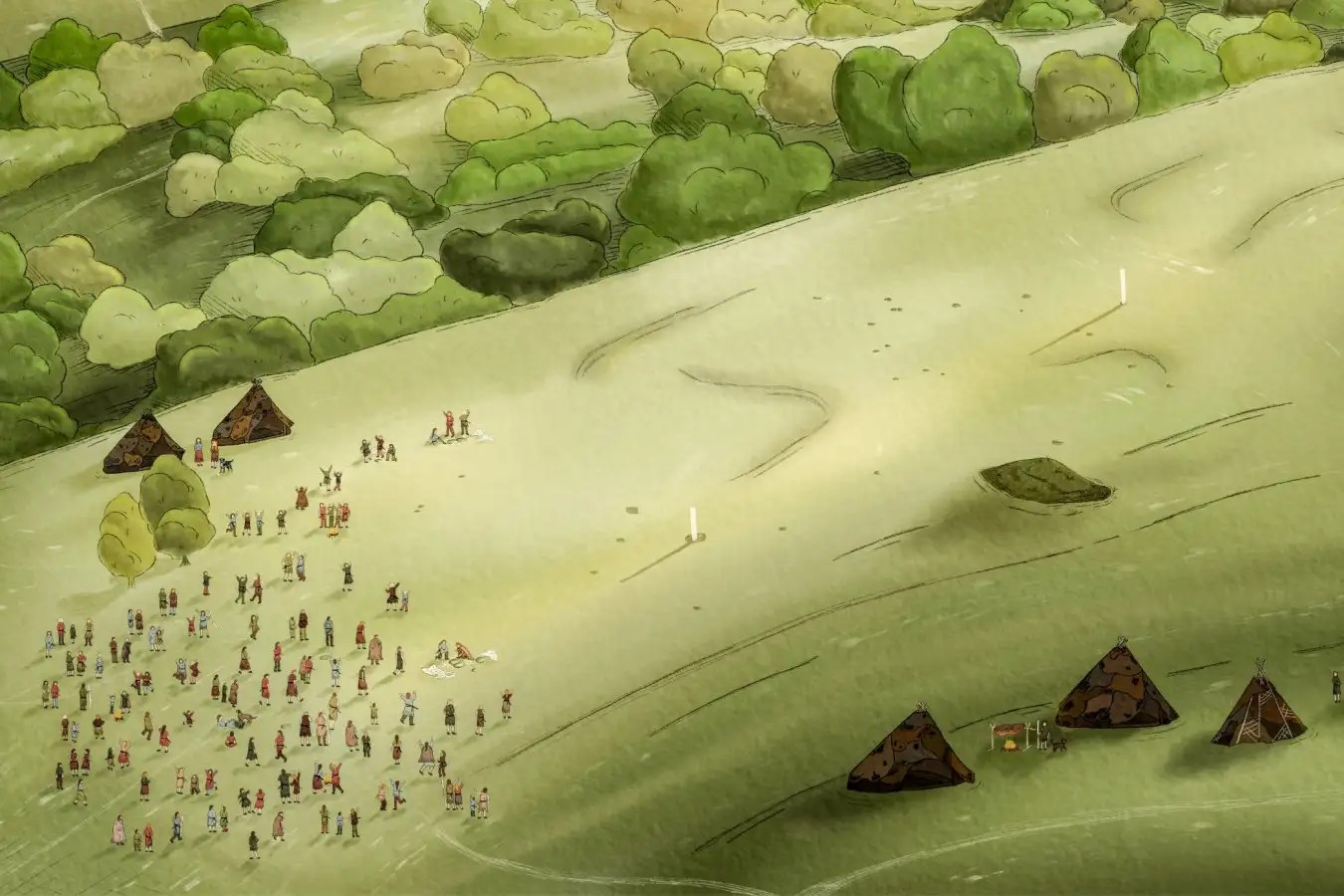
The posts are 120 meters apart. Harding draws a line through them. It points north-east.
Forty-eight point one degrees.
He gets excited. Like, really excited. That line matches the midsummer sunrise.
Bang On Target
To be sure, Wessex hires Fabio Silva. A skyscape archaeologist from Stone x Sky.
Silva builds a 3D map. He digitally deletes the modern buildings. He runs the data for where the sun used to sit in the sky 5,000 years ago.
The postholes line up with the solstice sunrise.
Well, almost.
It is one degree off. Silva doesn’t flinch. Wooden posts aren’t mathematical needles. They could have been fifty centimeters wide.
If you account for the bulk of the timber, the alignment is “bang on.”
The odds of random chance? Less than 0.5%.
“You have to take that [width] into account… in which case the alignment is bang on.”
Is perfect precision necessary for a ritual? Maybe not.
A. César González-Garcia thinks a rough orientation works just fine. There’s a broad interest in the sky among these people. It shows.
Matt Leivers points to even older sites. Larkhill, for example. An enclosure from 3700 BC. Way before Bulford. Way before Stonehenge.
The entrance faces northeast. You stand there at midsummer. Look at Sidbury Hill, the highest point on the horizon. The sun rises dead ahead.
Humans have been tracking the light for a long time. Timber monuments dot the landscape with similar alignments, Greaney notes. Bulford just adds another dot to the map. An earlier one.
Stonehenge isn’t the first thought. It’s the loudest. The timber prototype came first, quiet and rotting underground while the stones waited to be quarried.
The wood is gone. Only the holes remain, filled with chalk. But for a decade or two, the line held true.
Then what happened?