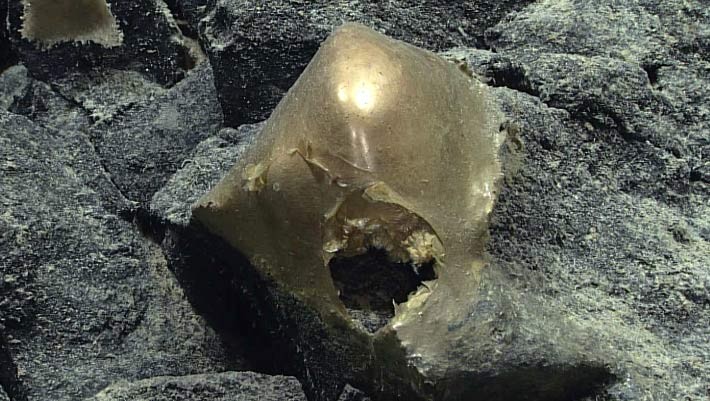
For a long time, a mysterious, softball-sized golden object resting two miles beneath the surface of the Gulf of Alaska baffled marine biologists. Found clinging to a rock in the pitch-black depths, the object’s smooth, metallic sheen and strange shape led to endless speculation: Was it a giant egg? A strange sponge? Or perhaps something entirely unknown to science?
New research led by the Smithsonian National Museum of Natural History has finally provided an answer. The “golden orb” was not a living creature in its own right, but rather a biological remnant of a rare and enigmatic deep-sea anemone known as Relicanthus daphneae .
From Mystery to Microhabitat
The object was first discovered on August 30, 2023, by the remotely operated vehicle Deep Discoverer. Located southwest of the Walker Seamount, the 10 cm (4-inch) golden sphere appeared strikingly out of place among the glass sponges of the seafloor.
Initial inspections by scientists, including lead author Dr. Steven Auscavitch, yielded puzzling results. The object lacked the standard anatomical features of an animal—such as a mouth, gut, or muscle tissue. Instead, it appeared to be a loose collection of fibrous material encased in a smooth, layered surface.
The breakthrough came through two specific lines of investigation:
– Microscopic Analysis: Researchers found the surface was covered in specialized stinging structures characteristic of Hexacorallia (a group containing sea anemones and stony corals).
– Genetic Testing: DNA analysis confirmed the specimen was linked to Relicanthus daphneae, a large, rarely seen anemone species.
Understanding the “Golden Remnant”
The study concludes that the orb was actually a cuticle —a protective outer layer—that the anemone had secreted to attach itself to the rock substrate. Rather than being a single organism, the orb represents a unique microhabitat : a tiny ecosystem of microbes living on and beneath the discarded tissue of the anemone.
This discovery sheds light on the biology of Relicanthus daphneae, an animal that can grow up to 30 cm (12 inches) across with long, flowing tentacles. While these anemones are thought to be found globally, they are rarely encountered by scientists.
Why do they leave these “orbs” behind?
While the exact reason for this secretion remains a mystery, scientists have proposed a few possibilities:
– Attachment: The cuticle serves as a biological “glue” to anchor the animal to rocks or sponges.
– Reproduction: It may be related to pedal laceration, a form of asexual reproduction where an organism breaks off pieces of its base to create new individuals.
– Movement: The anemone may leave behind trails of this golden material as it crawls across the seafloor.
The Importance of Deep-Sea Exploration
This discovery highlights a broader truth about oceanography: much of the Earth’s biodiversity remains unmapped and poorly understood. The “golden orb” was only identified because its unusual appearance prompted scientists to investigate it rigorously rather than dismissing it as debris.
The findings, published on the bioRxiv preprint server, emphasize that even a single, seemingly strange object can unlock vital information about the complex life cycles of deep-sea organisms.
The discovery of the golden orb underscores how much of the deep sea remains a mystery, proving that even “biological leftovers” can reveal the secrets of rare and elusive species.
Conclusion: The mysterious golden orb is a discarded biological cuticle from the rare anemone Relicanthus daphneae, serving as both a remnant of the animal and a unique habitat for microbial life.