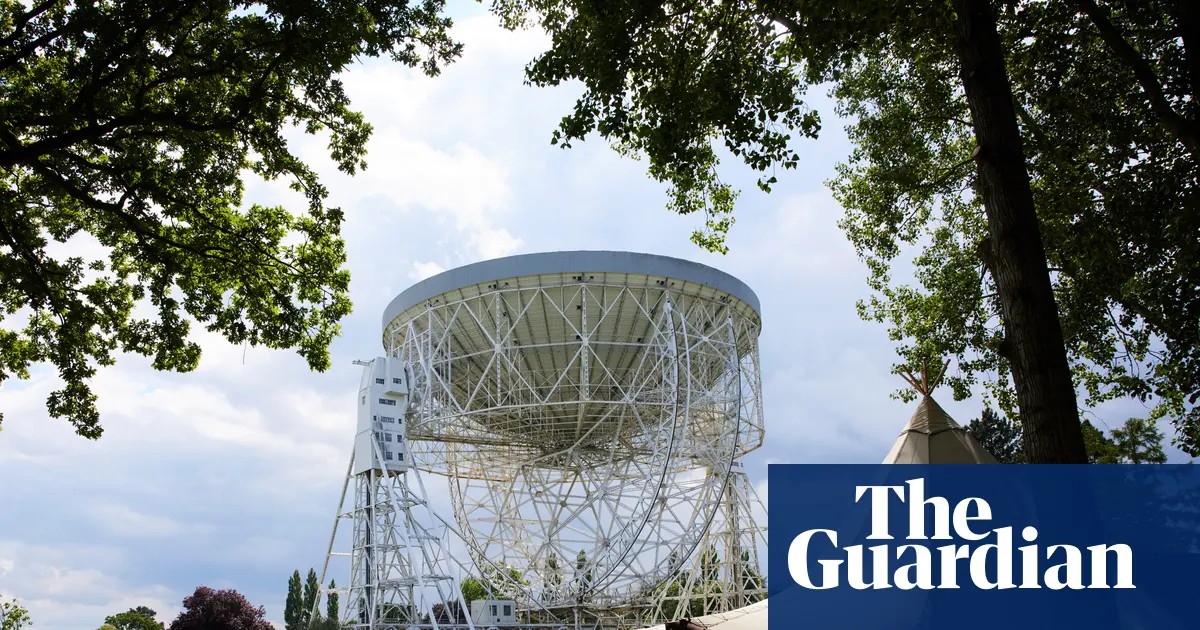
The future of Jodrell Bank is hanging by a thread. Or rather, by a budget line.
The observatory, home to the iconic Grade I-listed Lovell radio telescope, faces imminent closure. UK Research and Innovation (UKRI) announced Monday that it will not renew the funding agreement for the e-Merlin network when it expires in March 2028.
This isn’t a minor trim. This is a withdrawal of support that could end scientific operations at the hub of the UK’s national radio astronomy network entirely.
Without alternative funding, observations at Jodrell Bank will cease.
The science involved is nothing short of fundamental. Astronomers there study the afterglow of the Big Bang. They map galaxies. They track star formation and probe black holes. They look for planets outside our solar system. All of that hinges on one decision in a boardroom somewhere in London.
Prof Catherine Heymans, Scotland’s Astronomer Royal, didn’t mince words. She called the move “devastating.” To see a world-leading facility cut after decades of spectacular discovery science? It’s hard to swallow.
Why is this happening now?
You might ask why a government would do this. The answer lies in the books, not the stars.
UKRI has an annual budget nearing £10bn. That sounds like a lot until you look at the cost overruns. Electricity costs have soared. Staff salaries are rising. And international collaborations? They’re bleeding cash due to high foreign exchange rates. The CERN laboratory near Geneva, for instance, is a prime example of these financial pressures.
The Science and Technology Facilities Council (STFC) — which funds the observatory — needs to make substantial savings. So, it’s cutting what it sees as less “priority” projects.
Brian Cox, the University of Manchester professor and TV scientist, was stunned. He criticized the timing.
These cuts are a legacy of “hasty and ill-considered” decisions by the previous UKRI leadership. A government department that no longer exists. Cox is astonished that UKRI is still ploughing ahead rather than working with the new Andy Burnham government to find a solution.
He calls them “devastating and irreversible.”
Who gets hurt?
It’s not just the famous dish. The ripple effect is massive.
Jodrell Bank threatens 28 direct jobs at the observatory. But that’s just the tip of the iceberg. Nearly 3,000 researchers use the facility. If the data stops, their work stops.
Prof Simon Garrington, associate director at Jodrell Bank, said staff were shocked. Withdrawing funding from e-Merlin pulls the rug out completely.
He’s looking for loopholes. He hopes new uses for the telescope — tracking satellites and space debris — might attract alternative funding. It’s a long shot. But what’s the alternative?
Other cuts announced Monday hit even harder:
- A 20% cut to the Rubin Observatory in Chile. This facility began work last month. It’s capturing the largest astronomical movie of all time.
- A 45% cut to the Next-Generation Transit Survey. It searches for Earth-like solar systems.
- Complete removal of funding for future instruments on the Extremely Large Telescope (ELT). This telescope searches for life elsewhere in the universe.
- UK withdrawal from the Event Horizon Telescope. That’s the project that imaged the black hole at the heart of our Milky Way.
The bigger picture for UK science
The Royal Astronomical Society’s president, Prof Jim Wild, warned that this threatens the country’s scientific future. We are at a time when technological innovation is key to national prospects. Discarding globally significant observatories insults the inspiration of future astronomers.
Sue Ferns from the Prospect trade union framed it as a tragedy for the North West of England. Jodrell Bank underpins the UK’s research capabilities. Closing it undermines the mission to become a science superpower.
“This is just the tip of the iceberg,” Ferns said. A programme of cuts set to devastate public sector science. She urged the new government to reconsider before irreparable harm is done, especially given their focus on regional growth.
UKRI isn’t backing down.
A spokesperson for STFC claimed a “rigorous prioritisation process.” They focused on areas delivering the greatest long-term capability and value. They insist they are focusing investment on the next generation of world-leading radio astronomy.
So, which generation is that?
If Jodrell Bank goes dark in 2028, the “next generation” will have to find its data somewhere else. Or maybe, like so many of these projects, they’ll just have to find it online.
The telescope still points up. The question is whether anyone is left listening.