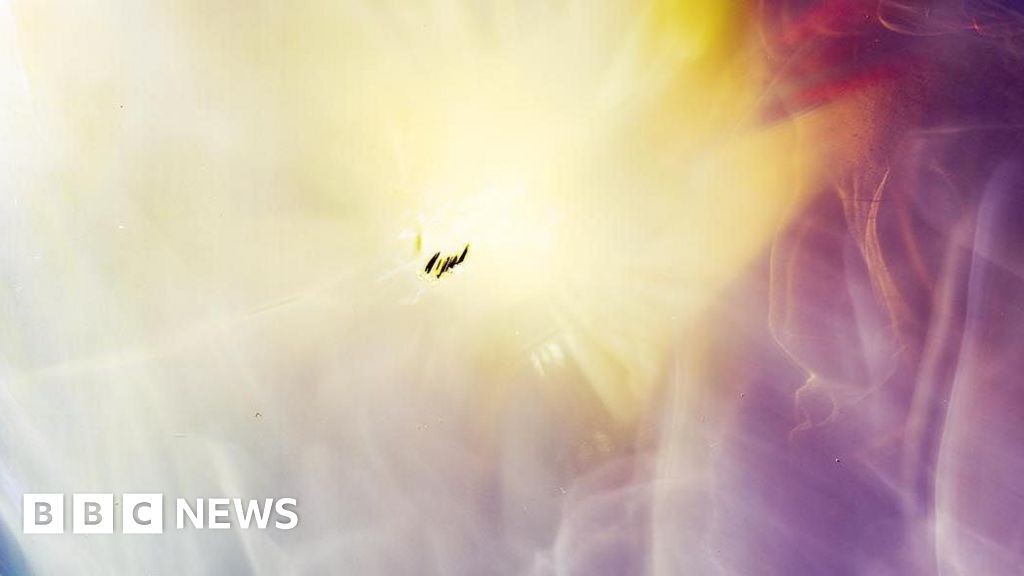
In an unconventional experiment that blurs the line between photography and physics, Tom Liggett, a photography student at Arts University Bournemouth, has successfully captured images created not by light, but by cosmic radiation.
By sending photographic film into the upper reaches of the atmosphere via helium balloons, Liggett has developed a technique that produces unique, abstract patterns formed by high-energy particles—a process he believes is a world first.
The Experiment: Photography Without a Camera
The most striking aspect of Liggett’s process is the absence of traditional photographic equipment. There is no lens, no shutter, and no camera body. Instead, the “imaging” process relies on the raw interaction between radiation and chemistry.
The method is deceptively simple:
1. Preparation: A sheet of blank photographic negative film is sealed inside a protective plastic bag.
2. Ascent: A helium balloon carries the package to the edge of space, reaching altitudes of approximately 121,000 feet —roughly three times higher than the cruising altitude of a commercial airliner.
3. Exposure: At this height, above the protective shield of the ozone layer, the film is bombarded by intense radiation.
4. Descent: Once the balloon reaches its limit and bursts, the package falls back to Earth, tracked by a GPS device.
5. Development: The film is retrieved and developed in a darkroom, revealing the patterns left behind by the cosmic rays.
“A lot of people think when I say these things that there’s a camera involved taking the image. There is nothing. It’s literally just a plastic bag and a sheet of film inside it.”
From X-Rays to the Cosmos
For most photographers, radiation is a nuisance to be avoided. High-energy waves, such as those used in airport X-ray scanners, can fog or ruin undeveloped film. Liggett, however, turned this technical challenge into a creative medium.
His journey began with controlled experiments using dental and hospital X-rays to see how different types of radiation affected the film’s emulsion. This research provided the foundation for his leap into the stratosphere.
Through his findings, Liggett and his team have deduced that the patterns are likely caused by UVC radiation. Because the film travels above the ozone layer—the Earth’s natural filter for much of this radiation—the film is exposed to unfiltered, high-energy waves that do not reach the ground.
Why This Matters
This project is more than just a photographic curiosity; it represents a unique intersection of art and atmospheric science. While traditional photography captures the world as our eyes see it, Liggett’s method captures a reality that is otherwise invisible to humans.
By utilizing the atmosphere as a giant, unplanned darkroom, he is documenting the high-energy environment of our planet’s upper edge, turning “interference” into intentional art.
Conclusion: Through a daring combination of high-altitude ballooning and chemical experimentation, Tom Liggett has transformed cosmic radiation from a photographic hazard into a tool for creating entirely new forms of visual art.