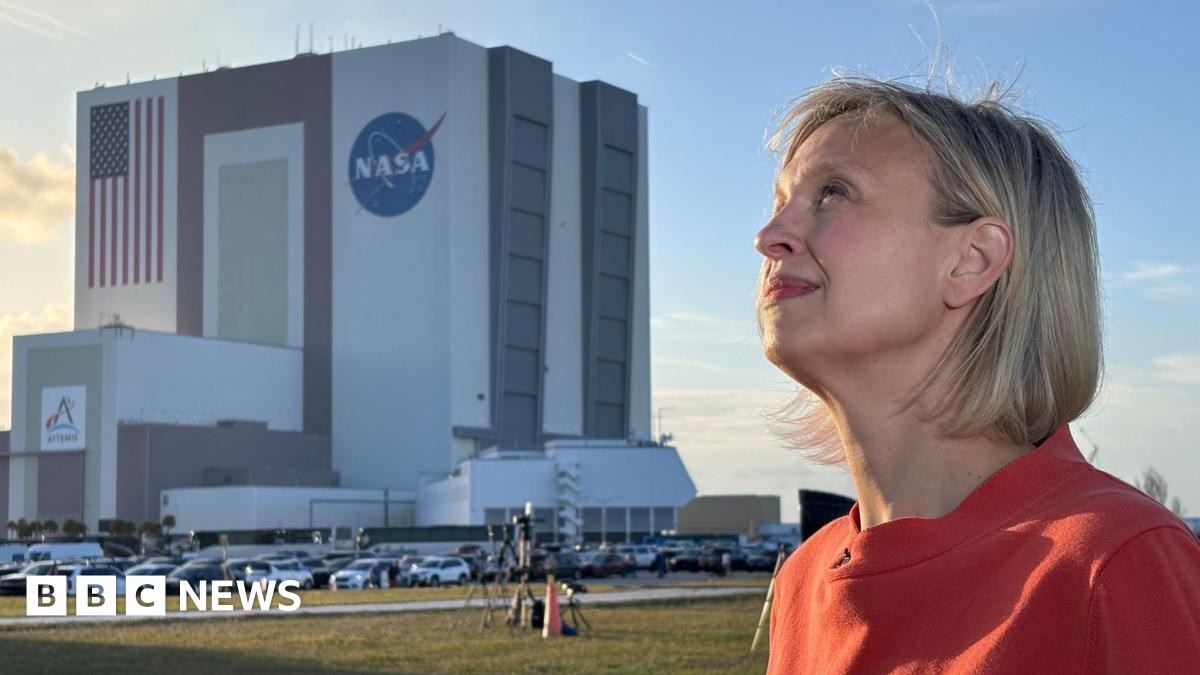
Four people went to the moon. They came back. That was it? No. That’s the summary, sure, but it misses the texture of the last ten days. I’ve been tracking NASA’s Artemis II from liftoff to splashdown, and frankly, the astronauts stayed calmer than I did.
Astronauts are the calmest people on launch day. Me, not so much.
The rocket fired at Kennedy Space Center in Florida. The noise. The white brightness. You can’t look away. Then the sound hits you seconds later. It passes through your chest. Standing next to colleagues Alison Francis and Kevin Church watching that 98-meter column of fire shoot four humans toward the moon feels less like news coverage and more like witnessing a religious event. I just couldn’t grasp the physics of it. Four people. Strapped in. Alone.
Reid Wiseman. Victor Glover. Christina Koch. Jeremy Hansen.
When they finally broke orbit, Glover looked down. “Planet Earth,” he said, “you look beautiful.”
Then they fired their engine and turned away. 250,000 miles to go.
Life inside a minibus
You think space travel involves private quarters. It doesn’t. They lived, worked, ate, and slept in a volume roughly the size of a minibus. No privacy for each other. None for the millions of us watching live streams of them floating around.
And then there was the toilet.
The Universal Waste Management System. A $23 million plumbing fixture with issues. Not with number ones initially. The solid waste, or number two, was “go” status. Number ones? Collapsible contingency devices. Bags with funnels. Intimate details revealed during a briefing where journalists asked specifically about bodily functions. You do not want to ask these questions when the camera is rolling, but we did.
Back at Johnson Space Center in Houston. Mission control is quiet. Focused. This was a test flight. First humans on the rocket. First on the spacecraft. Risks were real. Engineers watched data streams like hawks.
The emotional payload
The moon got bigger in their windows. Features appeared on the surface. The crew saw a bright crater. They named it after Reid’s late wife, Carroll.
Everyone cried. Onboard, the four astronauts hugged Reid. On the ground in Houston, the mission control floor broke. The BBC team, usually stoic, couldn’t help it. Every NASA official we spoke to, from engineers to Administrator Jared Isaacman, cared deeply about these four.
Isaacman wants more. Not just a nostalgia trip. The Apollo legacy is heavy here. Messages from Charlie Duke and a pre-recorded video from Jim Lovell played for the crew. Why go back? The US has been there before. The price tag? $93 billion. Critics say send rovers. Orbiters. Machines do it cheaper. Safer.
Isaacman disagrees. He told me exploration is human DNA. He plans a 2028 landing. A moon base. Eventually Mars. Machines can’t do it all.
Riding a fireball
They set the record. Past Apollo 13. Further than humans had ever been. 252,759 miles. They took thousands of photos. Audio descriptions of a bleakly beautiful landscape passing below.
Then they came home.
This part was scary. Re-entry. Victor Glover described it as riding a fireball. The capsule hit atmospheric friction. Temperatures reached half that of the sun’s surface. White-hot plasma surrounded them.
Mission control went silent for six minutes. The communications black out. Anxiety is the wrong word. Terror. When the dot appeared in the ocean and Wiseman’s voice crackled through, “Houston, We have you loud and clear,” the room exploded. Parachutes opened. Splashdown in the Pacific.
The calm atmosphere shattered. Celebrations everywhere. The friends were home.
Family forged in vacuum
I spoke to them near the end of the voyage. What will they miss most?
Christina Koch didn’t hesitate. Camaraderie. The crew is now family.
They launched relatively unknown. Now, Wiseman, Glover, Koch, and Hansen are household names. Kevin, Alison, and I sat in the front row while history unfolded. People are hungry for this. Not the technical specs. The humanity of it. For ten days, millions of people weren’t on Earth. They were there with them.
Isaacman has his ambitious plans. Other nations are watching. The infrastructure will come. The next steps will happen.
Will we all go back for more? Probably. The appetite is insatiable. And the view? Well, you have to see it for yourself.