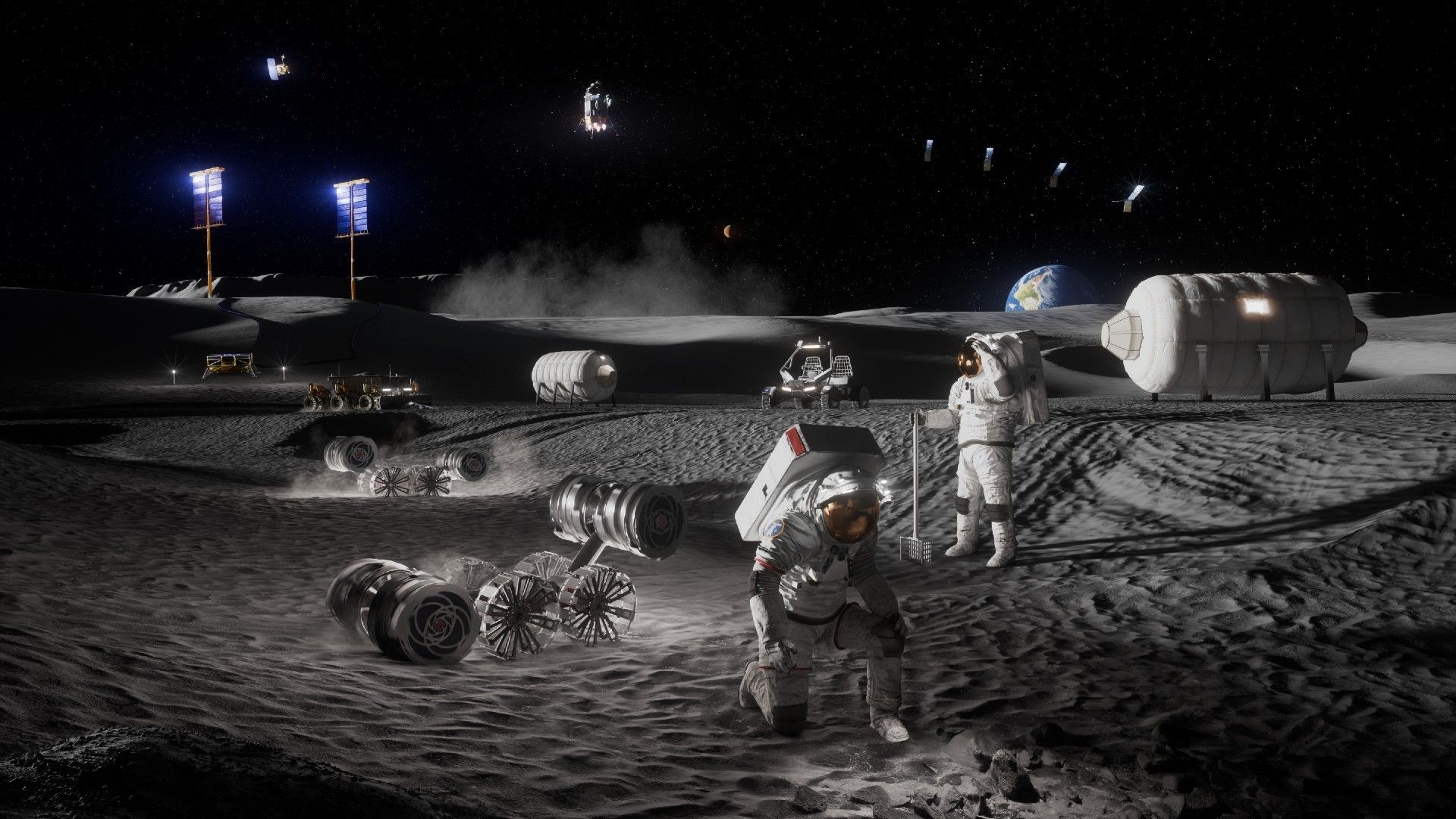
NASA dropped the first real bricks in its lunar outpost pile on Tuesday.
Three uncrewed missions are heading to the moon later this year. They aren’t the final product. Just the foundation.
“America returns to the moon again,” NASA Administrator Jared Isaacman declared at a press conference. “And this time to stay.”
It’s a catchy slogan. Golden Age of lunar exploration, they call it.
The agency has been promising a sustainable presence since the Artemis program launched in 2019, back in 2017 concepts. But things got concrete recently. In March, NASA announced a $20 billion plan. Not just a flag planting. A base. A hub for research. A staging ground for Mars.
The Moon Base will be humanity’s first outpost on another world.
Program manager Carlos García-Galán painted a picture of scale. He wants a settlement hundreds of square miles wide. Near the south pole. A sprawling city of assets, all pointing toward permanence.
Sounds ambitious. Maybe too ambitious?
Let’s look at the first three steps.
- Moon Base I : Launches as early as Fall 2026. It’s about data. Thruster interactions. Better tracking for orbiting ships.
- Moon Base II : Also this year. It brings the wheels. Lunar rovers. Mobility systems.
- Moon Base III : Same window. A mixed bag of payloads from NASA and partners. Studying how the surface changes. How materials break down.
These are Phase I missions. Phase II starts in 2029, aiming for semi-permanent structures. Phase III follows in 2032. Sustained human life.
Jeff Bezos gets a slice of the pie. Blue Origin wins the contract for the first mission. Their Blue Moon Mark 1 Endurance lander carries the cargo. Bezos netted $468 million from this round alone.
But pause for a second.
Many experts are raising eyebrows. The timeline? Aggressive. The technology? Largely untested.
Look at the other winners. Astrobotic. Intuitive Machines. Both failed at sending payloads before. Axiom Space was chosen as a rover partner. Their space suits already delayed Artemis. You put faith in companies with scratchy track records. You call it innovation. They call it risk.
The political pressure is palpable.
China is moving fast. Their roadmap targets landing astronauts by 2030. A September 2025 report from the Commercial Space Federation warned of an overtaking in the new space race.
Artemis II went well. Artemis I is behind schedule. And way over budget. We were supposed to land humans by 2024 now aiming for 2028.
Simeon Barber, a lunar scientist at The Open University, said it bluntly. He doesn’t think it would be a surprise if China gets there first.
“It sounds to me like NASA feels they have to say they’ve got plans.” He sees a lot of political drive here. Not just science.
Isaacman remains buoyant. He posted on X about innovation and inspiration. About the next step to Mars.
The Golden Age has begun. Or at least the billing season.