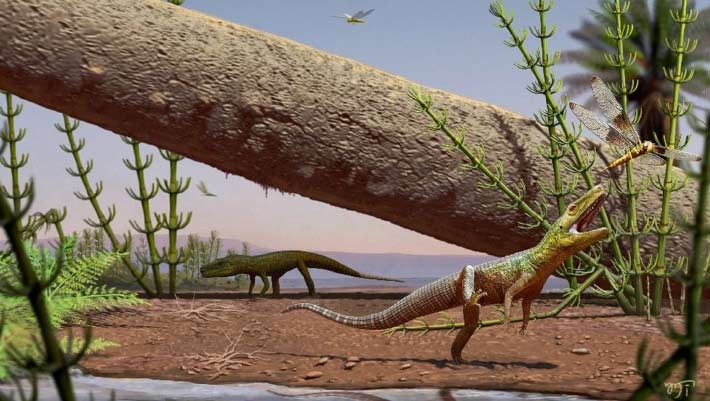
Paleontologists found a ghost. Well. Bones. A new species of reptile. It lived 240 million years back in Brazil.
This thing? It was an archosauriform.
The Middle Triassic. Earth was healing. The Permian mass extinction had just finished wiping out most of everything, and life was starting to figure out who gets to run the planet. This reptile stepped onto that recovering stage.
A Distant Relative
Here is the weird part.
Silescelida acristated is not a dinosaur. It’s not quite a crocodile. It is something in between. Or rather, before both. It likely belonged to the Euparkeriidae. A family name you won’t see in textbooks. Mostly because it is poorly understood. Mostly because we have very little evidence.
Maurício Garcia from Universidade Federal de Santa Maria ran the study. He points out that this entire group rests on the shoulders of Euparkeria capensis.
Found in South Africa in 1912? 1913. Yes.
That one famous fossil has carried the weight of the Euparkeriidae for over a century. Until now, it was the only definite member.
“Other putative euparkeriads come essentially from China and Europe,” Garcia said. “And yet here is one in South America.”
Fragments of a Predator
What did they actually find?
A left shoulder blade. A right hip bone. A left thighbone. That is it. The thigh bone is nearly 17 centimeters long. That’s the whole skeleton we have.
Is it enough? Apparently.
They compared the measurements. Looked at the structure. The picture is clear enough.
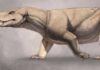
This was an agile predator. Lizard-like limbs. Built for speed. It likely stalked prey with long legs. No bulky armor. Just movement and hunger.
It helps us map where these creatures actually lived. Previously, the map was small. Now, it covers half a continent more. South America wasn’t just a bystander. It was central. The early evolution of the lineage that led to T-Rex and saltwater crocs? It happened here too.
Why It Matters
Why care about a three-bone fossil?
Because these animals are the missing link. Or the step just before the link. Euparkeriads are placed just outside true Archosauria. They show us what the ancestral body plan looked like.
If you want to understand how crocs and dinos came to be, you have to look at the cousins who almost made it. Who adapted differently.
Garcia notes that this confirms the eucrocopodan lineage was active in the Triassic of Brazil. A first record. The deposits there matter more than we thought.
The paper hit Scientific Reports on June 10.
The earth is old. Our record of it is sparse. But sometimes three bones change the story. We are still finding who lived here.
What else are we missing?
M.S. Garcia et al., A new eucrocopodan eucrocopodan from the Middle Triassic of Brazil. Sci Rep.