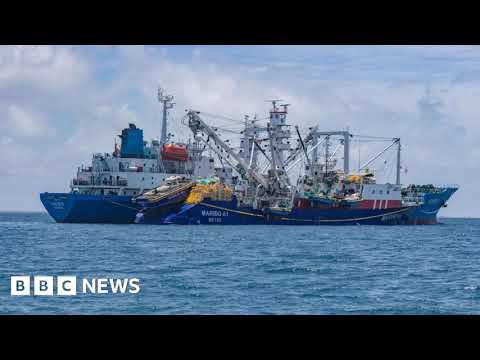
For the nation of Kiribati, the ocean is not just a landscape—it is the country’s entire economic foundation. While the nation’s landmass is roughly the size of New York City, its Exclusive Economic Zone (EEZ) is a maritime giant, spanning over 3.4 million square kilometers. This vast territory provides access to some of the world’s most abundant tuna stocks, making the fishing industry the lifeblood of the nation.
However, this reliance on the sea has created a profound vulnerability. As climate change alters ocean temperatures, the very resource that sustains Kiribati is beginning to migrate, threatening both the national budget and local food security.
A Nation Built on Fishing Licenses
Kiribati possesses a unique economic profile characterized by extreme specialization. Unlike many nations that can lean on agriculture or manufacturing, Kiribati has almost no land-based resources to exploit.
The economic math is stark:
– Revenue Dependency: Fishing licenses sold to foreign fleets (primarily from Japan, China, the US, and the EU) account for roughly 70% of government revenue.
– GDP Impact: This income represents approximately two-fifths of the country’s entire GDP.
– Global Significance: The Western Central Pacific is a global powerhouse; experts estimate that more than half of the tuna found in supermarket cans worldwide originates from this region.
In 2024 alone, Kiribati generated $137 million from these licenses. For a nation where the highest point of land is often just two meters above sea level, this revenue is the “critical financial lifeline” required to fund public services and infrastructure.
The Migration Risk: Moving Toward Cooler Waters
The threat is not necessarily that the tuna will disappear, but that they will move. Tuna are highly sensitive to temperature changes, reacting to shifts as small as one-tenth of a degree Celsius.
As warming waters move through the Pacific, scientific models suggest a massive eastward migration. Tuna are expected to flee Kiribati’s waters in search of cooler temperatures, moving toward the east. This shift creates a dual crisis:
- Economic Volatility: If tuna leave the EEZ, foreign fleets will no longer need to pay Kiribati for access. Preliminary models suggest the country could lose more than $10 million in annual fees by 2050 under high-emission scenarios.
- Food Insecurity: Local populations rely heavily on fish for protein. The average person in Kiribati consumes roughly 100kg of fish per year, dwarfing the consumption rates of the US (9kg) or Japan (22kg). A decline in local stocks forces a reliance on expensive, less nutritious imported foods.
Seeking Resilience in a Changing Ocean
The situation presents a race against time. While high-emission scenarios pose a catastrophic risk, “best-case” models suggest that lower global emissions could stabilize tuna biomass within the EEZ. However, even in these optimistic scenarios, local fishermen are still expected to see a decrease in their daily catches.
To combat these shifts, several strategic initiatives are underway:
- The Green Climate Fund (GCF): A $156.8 million project is currently helping 14 Pacific territories strengthen food security and develop better warning systems to predict tuna redistribution.
- Economic Diversification: Kiribati is working to reduce its “tuna trap” by exploring new revenue streams, including tourism, renewable energy, and leveraging its offshore sovereign wealth fund.
- Data-Driven Adaptation: By improving maritime intelligence, the goal is to allow the government to anticipate economic shocks before they occur.
“Kiribati retains grounds for optimism and strategic opportunity,” says Hemant Mandal, GCF director for Asia and the Pacific.
Despite these efforts, the reality remains unchanged: for a nation with no land to fall back on, the movement of a single fish species could dictate the future of its sovereignty.
Conclusion: Kiribati’s extreme economic dependence on tuna makes it a frontline victim of climate change. As warming oceans drive fish stocks eastward, the nation must rapidly diversify its economy and bolster food security to survive a shifting maritime landscape.