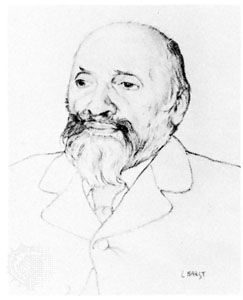
Mily Balakirev was the kind of guy who didn’t just write music. He dictated it. Born in Nizhny Novgorod in late December 1836 (or early January 1837 by the new calendar), this Russian composer grew up to become the dynamic, often despotic leader of a nationalist group that changed orchestral music forever. He died in St. Petersburg in May 1910, leaving behind a legacy that was equal parts brilliant and tyrannical.
His early education came from his mother, but his real musical education started when he studied with Alexander Dubuque and Karl Eisrich. Eisrich was the music director for A.D. Ulibishev, a wealthy landowner who published famous books on Mozart and Beethoven. Balakirev got full access to Ulibishev’s massive music library. At just fifteen, he started composing. He even got to rehearse the local theatre orchestra.
By 1853, he was studying mathematics at the University of Kazan. That’s where he wrote his piano concerto, which he finished in 1856. He made his concert pianist debut in Kronshtadt in December 1855. After that, he was everywhere. He performed often. He composed the Overture on Russian Themes and music for King Lear between 1858 and 1861.
He also became a mentor. Early on, he guided two young composers: César Cui and Modest Mussorgsky.
The Formation of “The Five”
By 1861 and 1862, his circle expanded. Nikolay Rimsky-Korsakov and Aleksandr Borodin joined his disciples. This group became known as The Five. In 1862, Balakirev joined the Free School of Music. This school was opened specifically to oppose the St. Petersburg Conservatory. He soon became its principal concert conductor.
During the 1860s, Balakirev was at the peak of his power. He wasn’t just teaching. He was collecting folk songs up and down the Volga River. He used those melodies in his Second Overture on Russian Themes, which eventually evolved into the symphonic poem Russia.
He spent his summers in the Caucasus. Why? To gather themes and inspiration. This trip yielded two major works: the brilliant piano fantasy Islamey (1869) and the symphonic poem Tamara (1867–82).
He also published the works of composer Mikhail Glinka. He went to Prague to produce them. For a brief time, from 1867 to 1869, he conducted the symphony concerts for the Russian Music Society.
A Despot’s Decline
Balakirev had a problem. He was despotic. He was tactless. This attitude made him innumerable enemies. Even his friends and young disciples started to resent his tutelage.
Then, personal and artistic misfortunes hit. From 1872 to 1876, he withdrew almost completely from the world of music. He took a job as a railway clerk. It was a strange pivot for a former musical giant.
He had gone through a period of acute depression ten years earlier. Now, he faced a more severe crisis. When he emerged from it, he was a totally changed man. He became a bigoted and superstitious Orthodox Christian.
He didn’t disappear entirely. He gradually returned to the music world. He resumed the directorship of the Free School. From 1883 to 1894, he served as the director of the imperial chapel.
He also started composing again. He completed a symphony he had abandoned years before. He wrote new pieces. His Piano Sonata came in 1905. His Symphony No. 2 arrived in 1908. He also wrote several piano pieces and songs.
The last decade of his life? Almost complete retirement.
The Lasting Influence
It is often said that Balakirev set the course for Russian orchestral music and lyrical song in the second half of the 19th century. Some argue he did more than Glinka.
He developed an idiom and a technique. He imposed this on his disciples. Above all, he influenced Rimsky-Korsakov and Borodin. He even impacted Pyotr Ilyich Tchaikovsky, to some extent. He did this not just by example. He did it through constant, autocratic supervision of their earlier works.
His music is superbly colourful. It is imaginative. But his creative personality stalled after 1871. His later work just sounded like the idiom of his youth.
He was a massive figure. A controlling one. A brilliant one. The question remains whether his music would have sounded the same without his heavy hand. Or if he simply burned out too fast.