It’s easy to forget that the night sky is a map, not just a picture. For centuries, sailors have relied on exactly 57 stars to find their way across featureless oceans. One of them is Bellatrix. It’s the 26th brightest star in the entire sky. It’s the third brightest in Orion. And it’s the first star in the hunter’s pattern to crest the eastern horizon.
This timing isn’t random. It’s why Arab astronomers called it Al Najīd, meaning “the leader.” In Western traditions, the name comes from the Latin for “female warrior.” You’ll also hear it called the Amazon Star. Some cultures along the Amazon River didn’t see a warrior at all. They saw a young boy in a canoe. The star next to it, Betelgeuse, was the old man watching over him.
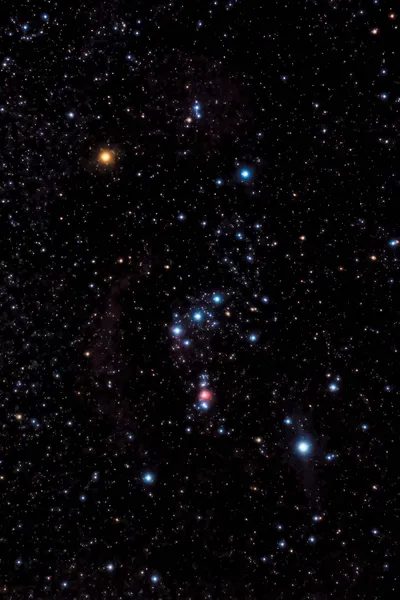
Bellatrix sits on the left shoulder of Orion. If you’re in the Northern Hemisphere, that’s your left. In the Southern Hemisphere, it’s on the right. Orion is special because the celestial equator cuts right through it. This geometry means you can see the hunter from almost anywhere on Earth. It’s a universal landmark.
What Makes Bellatrix So Bright?
Bellatrix is a blue-white star. It’s hot. It’s massive. And it’s loud in terms of energy. Its light output is roughly 4,000 times greater than that of our Sun. That kind of luminosity doesn’t come from a star that’s hanging around doing nothing.
The star is moving away from us. Its radial velocity is about 18 kilometers per second. That’s fast, but in cosmic terms, it’s steady. Bellatrix is about 250 light-years from Earth. When you look at it, you’re seeing light that left the star a quarter of a millennium ago. Back then, the Ming Dynasty was still ruling China.
Around Bellatrix, there’s a faint glow. It’s nebulosity. The star’s intense radiation illuminates the surrounding gas and dust. It’s a subtle halo, visible only under the right conditions. But it hints at a larger story. Bellatrix isn’t alone.
The Orion OB1 Association
Astronomers group stars by how they move and where they’re born. Bellatrix is part of a cluster called the Orion OB1 Association. These aren’t tight clusters like the Pleiades. They’re loose groups. Stars here share a common origin and are moving in roughly the same direction.
The stars in this group are young. Really young. They’re less than 10 million years old. Compare that to our Sun, which is 4.6 billion years old. Bellatrix is a newborn in stellar terms. It’s likely to burn out long before the Sun does.
Other famous stars in Orion belong to this same family. The three belt stars—Alnitak, Alnilam, and Mintaka—are in the group. So is Saiph, at the hunter’s southwest knee. They all formed together. They’re still drifting together. But gravity is weak here. Over millions of years, they’ll drift apart.
Why does this matter? Because it tells us how stars are born. The Orion Nebula is a stellar nursery. The youngest stars in the association are right there