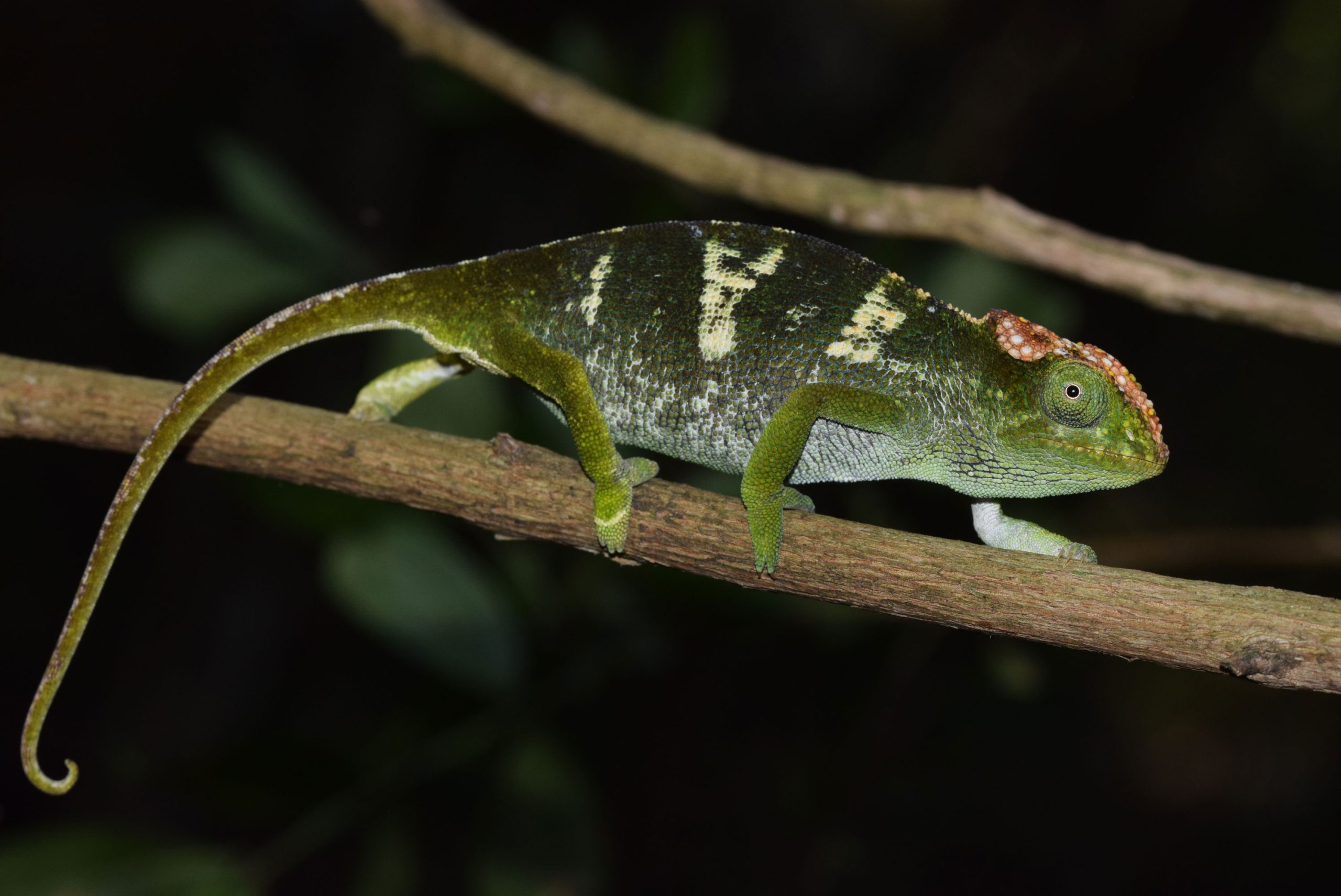
Four new chameleons exist right now, and they live nowhere else on Earth.
They inhabit the isolated rainforests of Mozambique. These forests sit high on granite mountains. The savanna below is dry. The peaks are not. They catch clouds. They trap rain. The result is a cool, damp ecosystem hidden above the haze.
This isolation is the key. It creates what scientists call “sky islands.” Each peak is a separate world.
New surveys confirm that each of these mountains hosts a unique chameleon species. They are part of the Sylvan Chameleon genus, Nadzikambia. Four of these are new to science.
How DNA Revealed Cryptic Chameleon Species
The scientists involved are Professor Krystal A. Tolley from North-West University and Dr. Werner Conradie from the Iziko South African Museum. They described these animals in the journal Vertebrate Zoology.
Before this study, northern Mozambique’s mountains were poorly mapped. Even remote African landscapes had better records. Why the gap? Logistics. Danger. Lack of funding.
Tolley and Conradie wanted to know if these forests held distinct reptile species. They suspected long-term separation had driven evolution. Time is a powerful diver.
They traveled to the peaks. They collected samples. They measured bodies. Then came the lab work.
They used the General Lineage Species Concept. This method looks at multiple lines of evidence. Not just looks. DNA matters more here.
They sequenced four genes from the chameleons. They compared the genetic patterns. The results were clear.
At first glance, the lizards look similar. Green. Scaly. Camouflage masters. Their genes tell a different story. A phylogenetic tree reconstructed from this DNA grouped the animals strictly by mountain.
Chameleons from Mount Namuli do not breed with those from Mount Chiperone. They haven’t mixed in millions of years. Similarity here is an illusion. It reflects adaptation to similar environments, not shared ancestry.
“In the same way, African and Asian elephants… are distinct species that have evolved similar bodyforms for similar lifestyles.”
— Dr. Werner Conradie
The Names Behind the New Discoveries
The naming convention is deliberate. It honors people. It flags danger. It connects local culture to global science.
Nadzikambia goodallae lives on Mount Ribáuè. It honors Jane Goodall. Her work with chimpanzees changed how we view animal behavior. It also inspired global conservation.
Goodall spent decades in forests before she became a celebrity. She watched life. She documented ecosystems. She saw how species interact.
Anna Rathmann, Executive Director of the Jane Goodalls Institute USA, called the naming a “fitting tribute.” It highlights the need to protect these forests. For everyone. Including us.
Nadzikambia franklinae is from Mount Namuli. It names Rosalind Franklin. She helped determine the structure of DNA. Without her work, the genetic methods used to spot these cryptic species might not exist. Science builds on previous science.
Nadzikambia evanescens comes from Mount Inago. Evanescens means “vanishing.” The name is a warning. The habitat is shrinking. These species might disappear before we even find them.
The fourth species is Nadzikambia nubila. Found on Mount Chiperone, beside a stream. Its name refers to the “Ciperoni.” Locals use this term for the thick cloud cover that causes orographic rainfall. Moist air rises over the mountain. It cools. It rains. Nubilus is Latin for cloudy. The name describes the weather that keeps the forest alive.
Why Community Protection Saves Sky Island Species
Tropical forests are vanishing globally. Africa is no exception. Agriculture clears land. Forests burn.
Mozambique’s sky islands are small. They are fragile. One mistake wipes out a unique lineage.
But this study offers a different path. Community involvement works.
Mount Chiperone is sacred to local people. Cultural beliefs protect its flora and fauna. Respect for the land preserves it.
On Mount Mabu, over ten years of community-based conservation has maintained the forest. These two peaks held the most intact habitats during the research.
Does conservation conflict with livelihoods? Not always. When residents get support. When cultural values align with environmental goals. Everyone benefits.
Isolated ecosystems thrive when locals have a stake in their protection. It is not just about saving animals. It is about saving the conditions that allow them to survive.
The four new chameleons are real. They are hidden. They are in danger. But they are also proof that careful study and local stewardship can keep rare things alive.
The forests remain. The mountains stand. But how long?
The answer depends on what happens next.