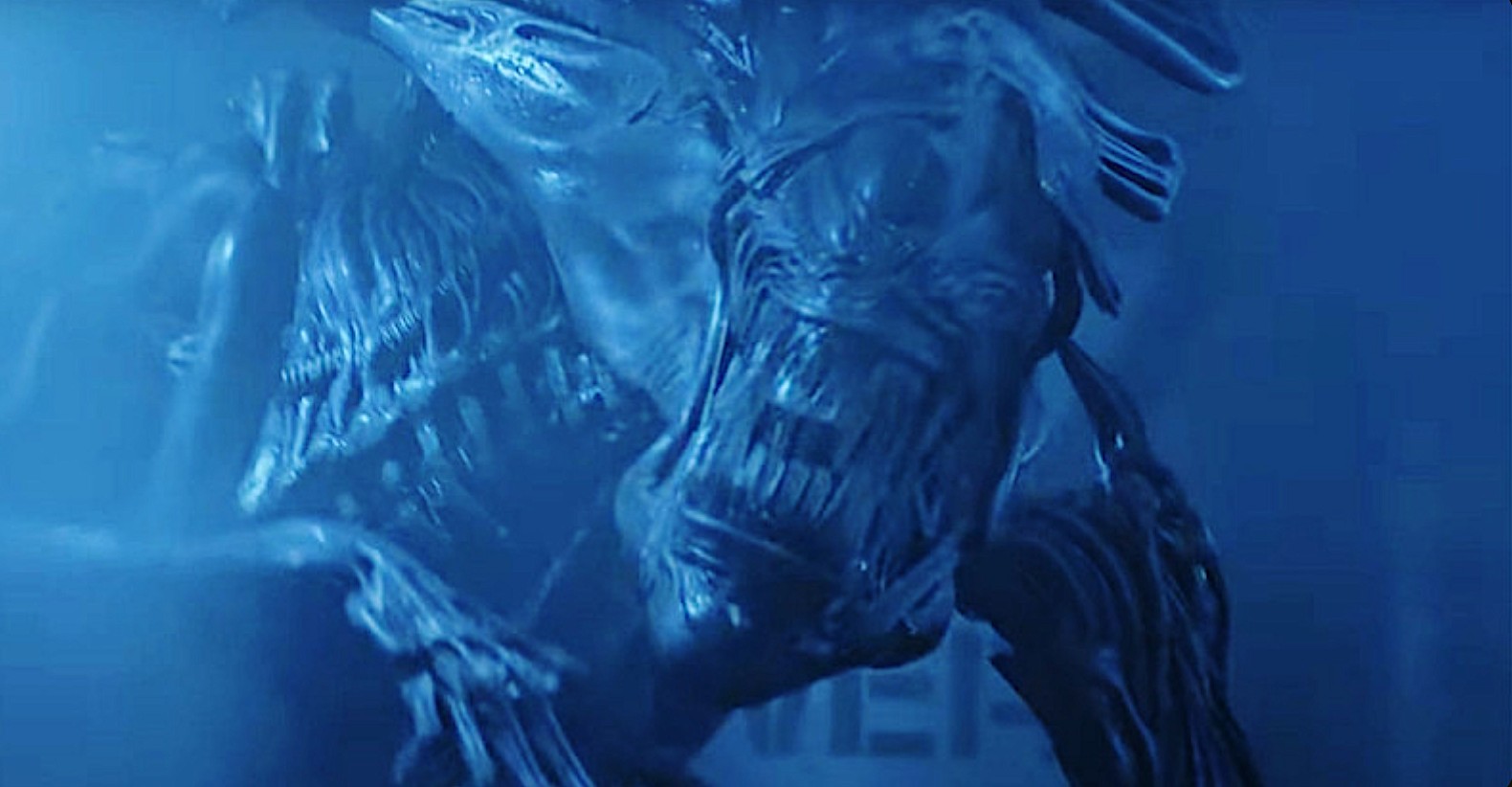
James Cameron knew what he wanted for the sequel. A military assault on a hive. More xenomorphs. Bigger stakes. But mostly? He needed a Queen.
When James Cameron greenlit Aliens, the target date was aggressive. The location? Pinewood Studios in England. The crew? The same garage-band legends from Stan Winston’s shop who built the T-800 endoskeleton four years prior. They had a year to build a 14-foot hydraulic monster from scratch. No CGI crutches. No second guesses.
The result was a masterclass in physical puppetry that still holds up against modern VFX. But getting there meant freezing at night, praying the propane heaters worked, and figuring out how to hide ten guys inside one insect.
Here is how the Alien Queen came to life, forty years later.
The birth of the hive mother concept
Cameron didn’t just want another bug. He wanted a matriarch. A ruler. His screenplay called for “a massive silhouette in the mist,” glowering over her eggs like an insect-Buddha. Six limbs. Fanged horror. Distended abdomen.
Stan Winston’s team, led by Shane Mahan, Lindsay MacGowan, Alec Gillis, Tom Woodruff Jr., and John Rosengrant, took this from drawing to flesh. They started in Southern California, back when prototypes meant sketching by eye and pouring silicone with bare hands.
“It was a proof of concept,” Mahan explains.
They wrapped a flailing prototype in black plastic bags. The press called it the “garbage bag test.” It looked like trash. It moved like death. It worked.
Then they moved to England.
Constructing a 14-foot beast at Pinewood
Pinewood Studios in the mid-80s wasn’t a glitzy production lot. It was cold. The warehouses lacked insulation. Giant propane jet heaters would flicker on, bake you to a crisp, then die, leaving the crew shivering again.
Lindsay MacGowan remembers it fondly, despite the chill.
“We were young and goofy,” he says. He’d skip college to fly to the UK and hang with the “rock ‘n’ roll Americans.” There was a cultural clash, sure—reserved English crew meeting the loud, brash Americans from California. But the chemistry was instant.
MacGowan saw Mahan and the Winston gang as brothers. Legends, but approachable ones.
The work was relentless. Four months. That was the window.
- Life-casting actors for morphed humans.
- Sculpting xenomorph warriors.
- Building eggs that hatched with visceral wetness.
- Crafting the Queen herself.
Mahan had started at Stan’s during the first Terminator. He saw Cameron’s concept art for Sigourney Weaver’s Power Loader and recognized the aesthetic immediately.
“I knew exactly what it was,” Mahan says. “An alien of that world.”
But they had no memory of the original film’s production team. Only H.R. Giger’s ghost remained in their minds. They had to live up to a shadow.
Inside the hydraulic mechanics
The Alien Queen wasn’t just a shell. It was an engineering marvel of articulated parts. Fiberglass. Foam rubber. Plastic. Hydraulics.
It required a army to operate.
- Two stunt performers lived in the torso, breathing and sweating.
- Ground crew pulled the legs and arms with cables.
- Puppeteers manipulated the head and mouth independently.
Count the bodies: Nine to ten people per take. All of them hidden.
This is where Cameron’s directing eye saved them. In the famous dropship fight scene, the chaos is blinding. Smoke. Blood. Lasers firing.
Cameron framed shots to obscure the support devices. No crane poles visible. No rod removal needed later in post-production. This was 1986; if you saw a cable, you failed.
“Directors today… don’t have any idea how to do that.”
Mahan argues this framing is the magic. Cameron designed the action to play to the puppet’s strengths, hiding its limitations through pure kinetic energy. The Queen lunges, she hisses, she drools. And for a brief, terrifying second, the audience believes two guys in a fiberglass suit are actually an extraterrestrial goddess of slaughter.
Personality over performance
Stan Winston didn’t build props. He built actors.
This was his rule. Every creature, whether a terminator or a xenomorph, needed a soul. Not necessarily a nice one. But a defined one.
Mahan points to the original Alien ’s creature. Its personality was apathy. It didn’t care if you lived. It just consumed. That indifference was the trait.
The Queen was different. She was protective. Maternal. Territorial.
The performers had to sell that emotion. A twitch of the head. A slow turn toward a threat. The way her cowl expanded over her skull.
“We were always taught these are characters.”
Winston drilled this into the young team. You aren’t building effects. You’re casting actors who happen to look like nightmares from space. This philosophy bled into their future work. From Jurassic Park to Predator 2, this crew carried the weight of believable motion.
Where did the original Queen go?
Here’s the kicker. The movie won Academy Awards. It changed sci-fi forever. The physical prop? It rotted.
After production, the full-size Queen sat in storage containers at Pinewood for decades. Exposed to the damp English air. Fiberglass degrades. Foam disintegrates.
“Jim has one in his museum,” Mahan notes, referring to Cameron. “Bob Burns did have a head.”
But the body? Lost to time.
“A lot of it was put into… and it sat and rotted.”
Mahan has tried to recover pieces. He’s seen bits in private collections. But a complete, screen-used Queen? You’re not going to find it sitting in a climate-controlled garage. It fell apart because it was made with the best materials of the era. Materials that have long since turned to dust.
Materials then versus Alien: Romulus today
We’re not stuck in 1986, technically. We’re talking to Mahan and MacGowan in 2024, right after their work on Fede Álvarez ‘s Alien: Romulus.
The tech gap is massive.
- Back then: Clear urethane painted to look like translucent skin.
- Now: Translucent silicones that stretch, bend, and react to light realistically. Lightweight 3D-printed skeletons.
“When we did Romulus, Lindsay and I had not touched the franchise since Aliens,” Mahan reflects.
The sensory memories flooded back. The smell of curing rubber. The sound of the hydraulic pumps. The feeling of standing on the soundstage while Sigourney Weaver screamed.
They didn’t use a computer to tell them what to do. They used their hands. Their eyes. Their experience.
And maybe that’s why the original still feels heavier. Heavier in presence. Heavier in weight. Heavier in the way it filled a frame with pure, unadulterated biological dread.
Did they improve? Technically, yes.
Did they recapture that exact alchemy? You’d have to watch them both. Side by side. Without a safety net of pixels to hide the mistakes. Just guys. Rubber. And a whole lot of hope.