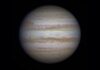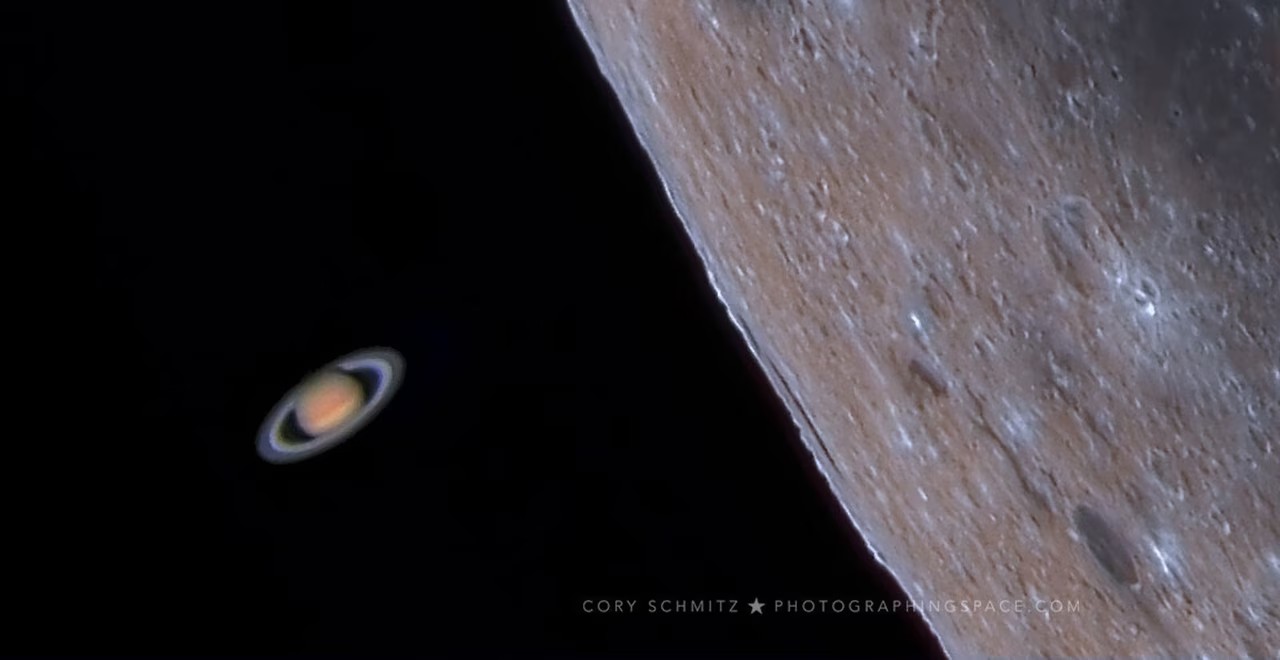
The summer sky is usually all about the steady glow of steady stars, but Tuesday night into Wednesday morning offers something far more chaotic. Between 2:44 a.m. and 6:38 a.m., the Moon is going to eat Saturn.
This isn’t a casual pass. It’s a total occultation. The giant planet will slip behind Earth’s satellite and disappear completely for just under four hours. If you’re an amateur astronomer who’s tired of staring at static constellations, this is your chance to watch celestial mechanics play out in real time.
You need to look South. Specifically, toward the constellation Aquarius. Keep an eye out for the star Phi Aquarii (phi Aquarii ). Saturn will be hanging out just slightly below it. Under clear, dark skies, the planet shines bright enough to see with the naked eye at a magnitude of -8.9. But why wait for the occultation to notice it?
Because the real show happens when it’s gone.
How to catch the Saturn-Lunar occultation
The event is defined by two critical moments: immersion and emersion. Immersion is when Saturn dives behind the lunar limb. Emersion is its dramatic return. During past events, capturing the exact moment the planet’s disk vanishes or reappears has yielded spectacular images. This time, the geometry is tight.
But there’s a catch. The rings won’t be part of the spectacle. Due to the planet’s rotation during the event, the rings are likely tilted in a way that makes them invisible to most observers. You’re watching the planet itself. Bare.
“The passage of Saturn in the axis of the Moon offered during previous occultations spectacular shots.”
This makes timing everything. If you’re in the northern regions, you might be looking at clouds. Weather is a fickle partner for astronomers. The Paris basin, for instance, is forecasted to see clouds, possibly even showers. Don’t bet your night on clear skies if you’re there. Find a spot with a southern horizon and hope the wind keeps the clouds moving north.
Why this matters for sky watchers
You might wonder if binoculars or a telescope are worth the hassle. Yes.
While the naked eye can catch the general drift of the Moon past Saturn, optical aid changes the experience entirely. Binoculars add detail. They make the lunar edge sharper. You start to notice the craters along the terminator, the way the light hits the planet. A telescope takes it further, allowing you to track the disappearance with precision.
This specific alignment is rare. For observers in France, the next time Saturn will be occulted by the Moon isn’t until January 2025. That’s a long gap. It suggests that this August window is a limited opportunity for local sky watchers to witness the mechanics of the solar system without needing to travel.
The physics behind it is simple. The Moon moves faster than Saturn across the sky because it orbits Earth, while Saturn orbits the Sun. Sometimes their paths cross. When they do, and the alignment is perfect, one hides the other. It’s a reminder that space isn’t static. It’s a moving clockwork.
The stars will still be there after Saturn returns. But for those four hours, the sky holds
The Real-World Impact of Scientific Breakthroughs
You might scroll past headlines about new quantum processors or CRISPR gene edits without thinking much of them. They seem far removed from daily life. But the gap between a lab bench and your kitchen table is shrinking faster than you’d expect.
Consider how quickly mRNA technology moved from theoretical research to pandemic response. That wasn’t luck. It was decades of foundational work finally meeting urgent need. The same pattern repeats. Often quietly.
Why This Matters Beyond the Lab
The real question isn’t just what scientists are discovering. It’s how it changes your life next year. Or five years from now.
Take fusion energy. It sounds like science fiction. But recent breakthroughs in sustained ignition are shifting it from “maybe someday” to “possibly this decade.” What does that mean for you? Cheaper electricity. Cleaner grids. Less reliance on volatile fuel markets.
Or look at AI-driven drug discovery. Traditional drug development takes over a decade. New algorithms can simulate molecular interactions in days. This doesn’t just speed things up. It opens doors to treatments for rare diseases that were previously too costly to pursue.
Where the Money and Minds Are Heading
Funding flows where impact is visible. Right now, that means:
- Quantum Computing: Moving from error-prone prototypes to fault-tolerant systems. The race is on for practical applications in cryptography and material science.
- Biotech: Gene editing tools are becoming more precise. Think targeted cancer therapies that spare healthy cells, not just blunt instruments.
- Clean Energy: Not just solar panels. We’re seeing advances in solid-state batteries and hydrogen storage that could solve intermittency issues.
How to Stay Ahead of the Curve
You don’t need a PhD to follow these trends. But you do need to know where to look.
Subscribe to specialized newsletters. Follow university press releases, not just tech blogs. Most major discoveries are announced through academic institutions first. The media often misses the nuance until later.
Also, pay attention to patents. They’re early indicators of what’s coming. A surge in patent filings for perovskite solar cells, for example, signals a shift toward cheaper, more efficient photovoltaics.
The Human Element
Behind every breakthrough is a team of people. Researchers who failed a hundred times before succeeding once. Engineers who tweaked a design until it worked. Funders who took a risk on unproven ideas.
Science isn’t a linear path. It’s messy. It’s incremental. It’s full of dead ends. But when it clicks, the ripple effect is massive.
What’s Next?
The next big shift won’t come from one single invention. It’ll come from convergence. Quantum computing accelerating material discovery. AI optimizing energy grids. Biotech enabling personalized medicine at scale.
These fields are no longer silos. They’re overlapping circles. And the intersections are where the most exciting stuff happens.
So keep an eye on where these disciplines meet. That’s where the future is being built. Right now. In labs you’ve probably never heard of.