Quasars are among the most luminous objects in the known universe. They are found in the cores of distant galaxies and are powered by supermassive black holes. Gas spirals into these black holes at high speeds. The friction generates enormous amounts of light. Some quasars outshine every star in their home galaxy. This brightness allows astronomers to see them from billions of light-years away.
What Exactly Is a Quasar?
A quasar is a compact region at the center of a galaxy. It emits massive amounts of energy. This energy comes from accretion. Matter falls into a supermassive black hole. The process releases more energy than nuclear fusion. This makes quasars incredibly bright. They are point-like sources of light. Early telescopes could not resolve them. They looked like stars. Hence the name “quasi-stellar radio source.” Today we know they are not stars. They are active galactic nuclei.
How Were Quasars Discovered?
Quasars were first identified in the 1960s. Astronomers used radio telescopes to detect strong emissions. These sources did not match any known stars. Their spectra showed large redshifts. This indicated they were very far away. The redshift implied huge distances. Yet they were bright. This was puzzling. How can something so far be so bright? The answer lay in the black hole. The energy output was immense.
Why Are Quasars Important?
Quasars help us understand the early universe. They exist at great distances. Light from quasars takes billions of years to reach us. We see them as they were in the past. This provides a snapshot of the young universe. Quasars also reveal the growth of black holes. They show how galaxies evolve. The interaction between black holes and their host galaxies is key. Quasars are markers of this process.
Where Can We Find Quasars?
Quasars are found in the centers of galaxies. They are scattered across the sky. Telescopes like Hubble and James Webb detect them. They are visible in deep space surveys. Their locations help map the universe. Quasars are not near our Milky Way. They are distant. The closest known quasar is still far away. It lies billions of light-years from Earth.
Which Quasars Are the Brightest?
Some quasars are exceptionally bright. They can outshine their entire host galaxy. This makes them visible even at extreme distances. The brightest quasars have luminosities of trillions of suns. They are among the most distant objects observed. Their brightness allows detailed study. Astronomers can analyze their spectra. This reveals the composition of their surroundings.
How Do Quasars Affect Their Host Galaxies?
Quasars influence their host galaxies. The energy output can drive gas out of the galaxy. This can stop star formation. Quasars regulate galaxy growth. They are part of a feedback loop. Black holes and galaxies co-evolve. The study of quasars helps us understand this relationship. It is a key area of modern astronomy.
The Future of Quasar Research
New telescopes are improving our view. The James Webb Space Telescope detects fainter quasars. It sees further back in time. This allows
Why Quasars Look Like Stars (But Aren’t)
The name comes from a bit of astronomical confusion. In the 1950s, researchers scanned the sky for radio signals. Most sources lined up with normal galaxies. A few didn’t.
These outliers sat near the plane of the Milky Way. They looked like faint blue stars. Some had fuzzy halos. Telescopes couldn’t tell them apart from regular stars at first glance.
So they got a clumsy name. Quasi-stellar radio sources. Shortened to quasar by 1964.
The label stuck. It described what they looked like. Not what they were.
The Mystery of the Blue Halos
Those fuzzy halos weren’t just visual noise. They hinted at something bigger. Something brighter.
Quasars are powered by supermassive black holes. They sit at the centers of distant galaxies. The light we see is the accretion disk. The halo is the host galaxy. But early telescopes saw just the bright core.
It looked like a star. It acted like a star. It wasn’t.
How We Figured It Out
Once astronomers realized quasars weren’t stars, they looked closer. Redshift measurements showed they were incredibly far away. If they were that bright at that distance, they had to be unimaginably energetic.
The name was a misnomer. The object was a galaxy’s heart. But the term “quasar” endured. It’s easier than saying “ultra-luminous active galactic nucleus.”
We still use the old name. For the blue star that wasn’t a star.
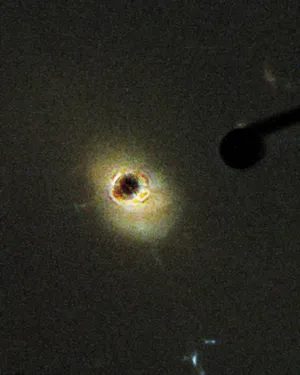
The Redshift Mystery and the Scale of Quasars
The optical spectra of these strange, star-like objects didn’t make sense. Emission lines appeared at wavelengths that didn’t match any known celestial source. It was a puzzle that stumped astronomers until Maarten Schmidt, a Dutch-American astronomer, cracked it in 1963. He realized the pattern in 3C 273—the brightest known quasar—was actually hydrogen atoms stretched by cosmic expansion. The redshift was 0.158. That meant every wavelength was 1.158 times longer than a lab measurement.
Apply Hubble’s law, and you get a distance of over two billion light-years. That’s far. Bright galaxy clusters existed at similar distances. But 3C 273? It outshone the brightest individual galaxies in those clusters by a factor of 100. Nothing so bright had ever been seen so far away.
The Density Problem
Continuing observations brought an even weirder surprise. Quasar brightness fluctuated wildly on timescales as short as a few days. Physics dictates that an object cannot change speed faster than light can cross it. So, the total size of a quasar had to be no larger than a few light-days.
Compact. Luminous. Impossible.
If something is that small and that bright, the internal radiation pressure should blow it apart. The only thing stopping a self-destructive explosion is gravity. To hold itself together against its own glare, a quasar must be massive. At least a million solar masses. This is the Eddington limit, named for Arthur Eddington. It’s the tipping point where outward radiation pressure balances inward gravitational pull.
So astronomers faced a conundrum. How does an object the size of our solar system weigh a million stars and outshine a galaxy of 100 billion stars?
Accretion and the End of Controversy
The answer arrived quickly after Schmidt’s discovery. Independently, Russian astronomers Yakov Zel’dovich and Igor Novikov, plus Austrian-American Edwin Salpeter, proposed the same solution: accretion by gravity onto supermassive black holes.
Some astronomers hated it. The idea of such high luminosity in such a small space was unpalatable. They proposed alternatives. These theories argued that quasars weren’t actually at those huge distances. Their redshifts weren’t cosmological. These alternative interpretations have since been discredited. A few adherents remain, but they are outliers.
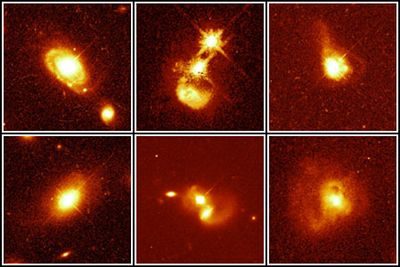
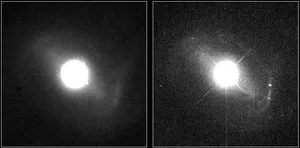
The redshift controversy ended in the early 1980s. American astronomer Todd Boroson and Canadian-American John Beverly Oke proved it. They showed that the fuzzy halos surrounding some quasars were just starlight from the host galaxy. And those galaxies? They were at high redshifts. The distance was real.
From Radio Sources to QSOs
By 1965, it became clear that quasars were just the tip of the iceberg. They were part of a larger population of unusually blue sources. Most were weaker radio sources, too faint for early surveys. This broader group shared all quasar properties except extreme radio luminosity. They were named quasi-stellar objects, or QSOs.
Since the 1980s, astronomers have viewed QSOs as the high-luminosity variety of an even larger class: active galactic nuclei, or AGNs. The lower-luminosity versions are Seyfert galaxies, named after Carl K. Seyfert, who first identified them in 1943.
Finding Quasars Efficiently
The first quasars were found as radio sources. But astronomers quickly realized they could find them faster by looking for objects bluer than normal stars. The method is straightforward. Photograph large areas of the sky through two or three different colored filters. Compare the images. Find the unusually blue objects. Verify with spectroscopy.
This remains the primary technique. It has evolved, of course. Film gave way to electronic charge-coupled devices (CCDs). Surveys extended into infrared wavelengths. Multiple filters now isolate quasars at different redshifts in various combinations.
There are other ways, too. Searches for starlike sources with irregular brightness variations. X-ray surveys from space. High levels of X-ray emission are considered a sure indicator of an accreting black-hole system.
Physical Structure of Quasars
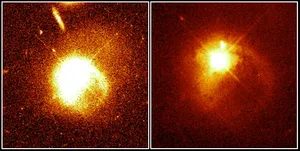
Think about the sheer scale of the engine at the heart of a quasar. We are talking about a black hole with a mass ranging from one million to several billion times that of our Sun. These monsters sit quietly at the center of many large galaxies. But when they eat, they shine.
In roughly 5 to 10 percent of these galaxies, things get chaotic. Gas falls into the black hole’s deep gravity well. It picks up speed. It piles up. The friction and heat turn this infalling matter into incandescence, forming a rapidly rotating accretion disk just outside the event horizon.
There is a hard ceiling on how fast a black hole can eat. It’s called the Eddington limit. If a black hole accretes matter too quickly, the resulting heat creates so much outward radiation pressure that it blows the incoming gas away. The feeding stops. Nature enforces a speed limit on gluttony.
So, what makes a nucleus “active”? Most large galaxies—90 to 95 percent of them—are currently quiet. They aren’t quasars. An active galactic nucleus is different because its black hole is actively consuming. It devours a few solar masses of matter every single year. If it’s eating at about 1 percent or more of that Eddington rate, the energy output is staggering. We’re talking about a total luminosity of roughly 10^39 watts. Compare that to the Sun’s modest 4 × 10^26 watts. The math is brutal.
The Anatomy of a Quasar
Beyond the black hole and the glowing disk, quasars have a complicated interior. Just beyond the accretion disk, you find clouds of gas moving at insane velocities. These clouds orbit the inner structure, absorbing high-energy radiation from the disk. They reprocess it, emitting broad spectral lines of hydrogen and other ionized atoms. These lines are the fingerprint of a quasar.
Further out, still mostly in the plane of the accretion disk, lie dust-laden gas clouds. They can obscure the quasar itself, hiding the central engine from view depending on your angle.
Then there are the jets. Some quasars shoot out highly collimated beams of plasma along the rotation axis. These jets move at speeds approaching the speed of light. They emit radiation across X-ray, radio, and sometimes optical wavelengths. It’s a cosmic lighthouse, sweeping beams of energy across the universe.
Why Orientation Matters
This complex structure means the appearance of a quasar depends entirely on your point of view. Specifically, it depends on the angle of the accretion disk’s rotation axis relative to your line of sight.
If you look down the barrel of the jet, you see something very different than if you look at the disk edge-on. The accretion disk, the emission-line clouds, and the jets become more or less prominent based on this geometry. We observe a wide variety of phenomena, but physically, many of these sources are similar. We just see them at different angles.
Evolution of quasars
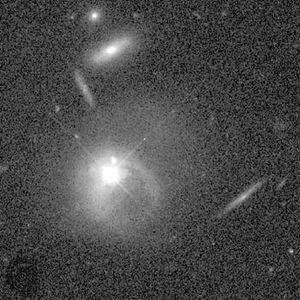
Why We See More Quasars in the Early Universe
The universe wasn’t always this quiet. When we look out into the deep cosmos, we are looking back in time. Because light takes time to reach us, objects at greater distances are seen as they were billions of years ago. This is why the number density of quasars jumps dramatically with redshift. It’s not just that there are more of them far away. It’s that they were simply more common in the past.
This trend peaks when the universe was about three billion years old. That’s roughly ten billion years after the big bang. Before that, the population was still building up. The most distant quasars we know of formed less than a billion years after the start of everything.
The Episodic Nature of Black Hole Feasting
Individual quasars aren’t permanent fixtures. They appear when central black holes start eating gas at a furious rate. This often happens after a galaxy merger. The black hole grows. It shines. But it doesn’t last.
Quasar activity is episodic. A single episode might last around a million years. The total lifetime? About ten million years. That’s a blink in cosmic time. Eventually, the feeding stops. The black hole goes dormant. It hides in the center of a massive galaxy, waiting.
This life cycle moves fastest for the heaviest black holes. They burn bright and die young. Less massive black holes take their time. Today, the active galactic nuclei (AGN) we see are mostly low-luminosity Seyfert galaxies with smaller black holes. The giants are already asleep.
How Black Holes Control Their Hosts
There is a tight relationship between the mass of a black hole and the mass of its host galaxy. It’s strange because the black hole is tiny compared to the galaxy. It makes up only about 0.1 percent of the total mass. Yet, it holds the keys to the galaxy’s future.
During the quasar phase, the black hole releases intense radiation. It drives mass outflows. It shoots out jets. These forces heat up the interstellar medium. They can even blow the gas entirely out of the galaxy.
This has two major effects. First, it shuts down star formation. Without gas, new stars can’t be born. Second, it chokes off the quasar’s own fuel supply. The black hole starves. Both the star mass and the black hole mass freeze in place. The galaxy and its central monster grow up together.