Orb-weaving spiders don’t need blueprints. They have a preprogrammed instruction manual inside their brains. The process is fast. Elegant. Efficient.
Every web starts with a single thread. This bridge is the foundation. The spider climbs to a high point. A tree branch works. It lets go of a strand of silk. It waits for the wind to carry the free end. Luck helps. The thread needs to catch on another branch.
If the spider feels tension, it pulls the silk tight. It attaches the thread to the starting point. Then it walks across. It releases a looser thread below the first one. This new strand attaches at both ends. The spider climbs to the center. The loose strand sags. It forms a V-shape.
The spider lowers itself from that point. A Y-shape emerges. This is the core support. It’s the backbone of the entire structure.
Grip matters here. Spiders use special serrated claws. Smooth hooks. Barbed hairs on their legs. They grip thin threads easily. They walk along these initial structural lines. They lay down frame threads between anchor points. From the center, they lay out radius threads. These radiate outward.
Crucially, the spider does not coat these lines with sticky material. It needs to move around. Walking on glue would be a disaster.
Once the radii are done, the spider lays an auxiliary spiral. This is nonstick silk. It goes from the center to the outer edge. Then the spider spirals inward. It uses the auxiliary spiral as a guide. It lays down sticky thread.
Here is the twist. The spider eats the auxiliary spiral as it goes. It consumes the nonstick guide. What remains is a web with non-sticky radius threads for travel. And a sticky spiral for catching bugs.
The genius of the orb web is not just in the trap, but in the architect’s ability to separate navigation from capture.
This separation of function is key. One part moves. One part kills. The spider builds its home with precision. It doesn’t waste energy. It doesn’t make mistakes.
But how does it know when to stop? When is the web complete enough to wait?
The spider waits. It hangs in the center. Or near the edge. It feels vibrations. Any insect that hits the sticky spiral is caught. The web holds. The spider moves in.
It’s a perfect machine. For a spider.
How Spiders “Hear” Their World Through Silk
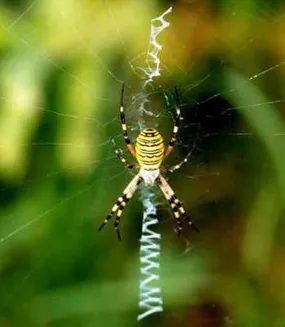
The spider sits frozen at the center of its web. It isn’t sleeping. It is waiting for a tremor.
Think of the web not just as a trap, but as an extended nervous system. The spider monitors the radius threads like a musician listens to a cello string. If an insect crashes into the mesh, the vibration travels along those lines straight to the spider’s legs. It knows exactly where the prey is trapped. It doesn’t need eyes. It needs only tension.
But spiders are smart enough to protect themselves. They often leave the main web to retreat to a separate nest. They don’t abandon their sensory field. They connect that nest to the web with a signal line. This single strand of silk acts like a long-distance telephone line. The spider stays safe in its hiding spot while still feeling every pluck of the web’s radius threads.
This setup raises an obvious question. Why not just sit in the middle all the time?
Because the middle is dangerous.
Spiders have evolved a sophisticated filter. They possess an innate ability to distinguish between the chaotic noise of the environment and the specific frequency of dinner. A falling leaf creates a dull, thudding vibration. A struggling fly creates a sharp, erratic buzz. The spider’s legs are tuned to pick out that specific rhythm.
Even more impressive is their ability to identify threats. Many species can distinguish the characteristic vibrations of dangerous insects, such as wasps, from their preferred prey. A wasp flutters differently. It fights differently. The spider feels the difference. It knows when to strike and when to cut the line and run.
Why This Matters Beyond the Garden
This isn’t just about spiders catching flies. It’s about how biology solves the problem of sensing a wide area without building a massive brain.
The web acts as a low-cost sensor array. It extends the spider’s reach. One tiny creature can monitor hundreds of square feet of space. This efficiency explains why web-spinning spiders are so successful in varied environments. They don’t need to chase. They don’t need to hide constantly. They wait. They listen. They strike.
We often think of webs as passive structures. Static nets of glue and silk. But they are active extensions of the spider’s body. They are sensory organs made of protein.
Consider how much energy a spider saves by not patrolling. It conserves calories. It reduces exposure to predators. It turns the entire garden into an ear.
There are over 48,000 species of spiders. Not all of them spin orbs like this. Some are hunters. Some are ambushers. But for those who build webs, the strategy is clear. Build a sensor. Wait for the signal. And know the difference between a leaf and a wasp before it even lands.
The next time you see a web glistening with dew, don’t just see a messy corner. See a listening device. See a nervous system spread wide and thin across the air. It is waiting for a vibration. It is always listening.
The Circular Economy of Spider Silk
It isn’t just a messy cleanup. It’s strategic resource management.
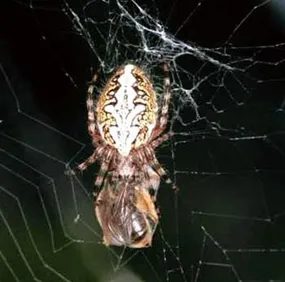
When an orb web gets tattered, tangled, or simply too old to catch anything worth eating, the spider doesn’t toss it aside. Most species will dismantle it entirely. They eat the silk.
Why? Because spider silk is expensive to produce. It takes energy. It takes protein. Recycling the threads allows the spider to reclaim those raw materials for a new web.
There is a catch, though. Spiders often leave the heavy bridge thread behind. This is the main anchor line. Keeping it saves time. It makes rebuilding faster. The spider doesn’t waste effort on the structural base when it can focus on the sticky, trapping coils.
Beyond the Trap
But not every spider relies on a web.
Spinning silk is a specialized tactic. It requires patience. It requires a specific location. It doesn’t work for everyone.
In the next section, we will look at how other spiders hunt without spinning a single thread.