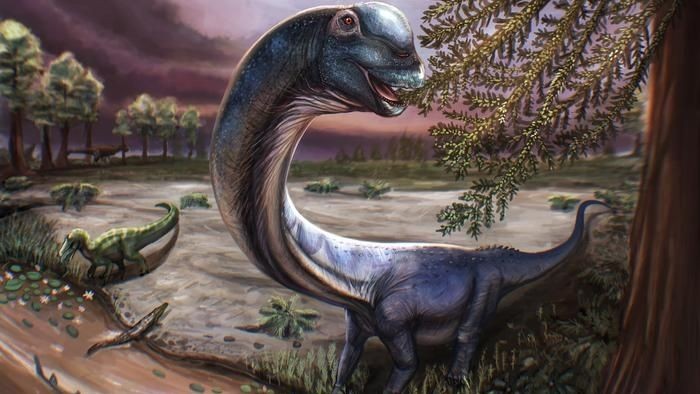
A massive new dinosaur was found in Thailand. They called it the “last titan.” It belongs to the group with the longest necks, and it is the biggest of its kind ever pulled from Southeast Asia soil. The creature roamed when the landscape was dry. Very dry. Semi-arid dust and heat, roughly 120 million years back.
The study dropped in Scientific Reports this Thursday.
Name and Size
The name? Nagatitan chaiyaphumensis. That is a mouthful, but it means something here. Naga refers to those serpentine giants in Asian folklore, tied to water and Buddhism, while Titan borrows from Greek myth. Chaiyaphumensis points to the Chaiyaphum province where the bones lay dormant.
Big? Yes. Huge, even.
Researchers estimate the beast stretched 90 feet, or about 27 meters, head to tail. It tipped the scales at around 30 tons. To put that in perspective, it outweighs the famous Dippy diplodocus by at least 10 extra tonnes.
But let’s get real for a second. In the world of sauropods, Nagatitan isn’t the heavyweight champion. Titans from South America like Patagotitan dwarfed it. This creature was less than half their weight. Still impressive, though. Just not the biggest.
The Find
How did they find it?
A local guy saw the fossils back in 2016. He spotted them on the side of a drying pond, exposed in the Khok Kruat rock formation. A bone bed, scattered and waiting.
The team dug up vertebrae. Pelvic bones. Leg bones. Including a right femur that was broken into pieces but likely stood about 6.5 feet tall when whole. Basically, as tall as a very tall person.
These shapes are distinct. Different from other sauropods already in the books. This puts Nagatitan squarely in the somphospondylan group. A lineage that survived from the late Jurassic right through to the Cretaceous. Found on every continent, except maybe Antarctica for good reason, but that’s a tangent.
The bones tell us exactly who it was and where it stood in the family tree.
End of the Road?
The environment back then wasn’t a jungle. Northeastern Thailand was hot. Semi-arid. The dinosaur used its massive body surface area to radiate heat and stay cool.
It probably walked near river systems. You can picture the scene—N. chaiyaphumensis moving slow and steady, while crocodiles lurked nearby and fish-eating pterosaurs circled above. Life found a way.
But this is likely the finale for big sauropods in this part of the world.
Why? Geology.
These fossils are in the youngest layers in Thailand that actually hold dinosaur remains. After this point in time, the region filled up. Shallow sea coverage. The land changed completely.
“Younger rocks laid down towards the end… are unlikely to contain dinosaur remains,” first author Thitiwoot Setharianakul noted. “So this may be the last… we will find in Southeast Asia.”
We probably won’t find another giant neck swinging around these rocks anytime soon. Or ever. The window closed.