Agricultural and forestry waste sits on a paradox. It is everywhere. Lignin makes up to 35% of that discarded biomass. It is nature’s largest renewable source of aromatic chemicals. These compounds have stable ring structures. They are the building blocks for plastics, fuels, and pharmaceuticals.
But lignin is stubborn. It resists breaking.
Its tangled network of strong carbon-oxygen and carbon-carbon bonds protects plant stems and wood. That rigidity keeps trees standing. It also keeps us from processing lignin efficiently. We need a way to untangle it without destroying it. An international research team has done exactly that.
The Ruthenium Solution
The findings, published in ACS Catalysis, detail a single-atom catalyst. Most catalysts use metal particles. These new materials isolate individual ruthenium atoms within a carbon matrix doped with nitrogen. This isn’t just about using less metal. It’s about maximizing efficiency.
By dispersing ruthenium as single atoms, the team ensures nearly every metal atom participates in the reaction. They also identified the exact molecular mechanism. Knowing the “why” allows for precise design rather than trial-and-error.
How It Works: The Ru-N4 Site
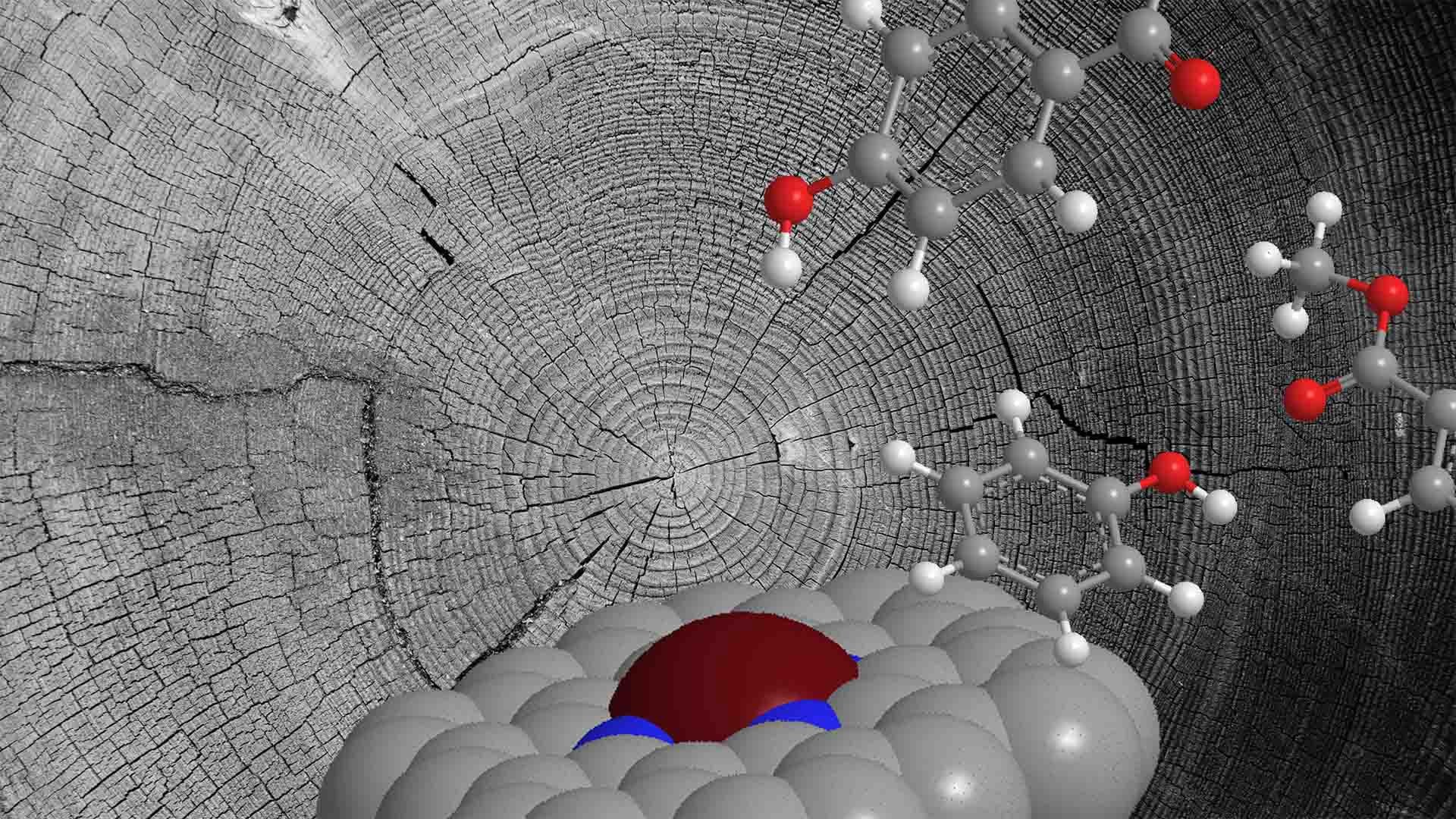
The key lies in a configuration called the Ru–N₄ site. Here, a single ruthenium atom is anchored by four surrounding nitrogen atoms. This arrangement is critical. Ordinary oxygen is too stable to attack lignin bonds. It sits on the sidelines of the chemical reaction.
At the Ru–N₄ sites, the catalyst activates oxygen molecules. It turns passive O₂ into reactive species. These activated oxygen forms then attack lignin. They cut the tough C–O and C–C bonds that hold the polymer together.
The researchers combined lab experiments with computational modeling to map this sequence. They watched the products form and calculated how the atomic bonds shifted in real time. The result is a clear picture of oxidative cleavage. First, oxygen activates. Then, it shreds the lignin into smaller, valuable aromatic molecules.
Turning Waste Into Wealth
The tests didn’t just stop at theory. Under optimized conditions, the catalyst converted model lignin compounds almost entirely. It yielded high amounts of phenol. Phenol is a precursor for many industrial materials.
Crucially, this didn’t require harsh conditions. No extreme heat. No brutal chemical treatments. This mild processing could significantly reduce energy use in future manufacturing.
But model compounds aren’t real life. Actual lignin is messy and complex. To prove the catalyst’s viability, the team tested it on lignin harvested from various real biomass sources. The results were consistent. It successfully converted raw, real-world samples into usable aromatic compounds.
These compounds can replace petroleum-based feedstocks. They can fuel plastics and chemicals production. This supports a shift toward a circular economy. We stop extracting resources and start recovering them.
Designing for the Future
This work offers more than one working recipe. It provides a blueprint. By understanding how the Ru–N4 structure functions, engineers can design better materials for other difficult biomass conversions.
“Understanding exactly how these catalysts work allows us to design better materials for renewable resources,” Dr. Christopher Parlett stated. The shift is clear: treat plant waste not as trash, but as a chemical goldmine. The chemistry exists. The catalysts are ready. The question is now scale.
Reference: “Unveiling the Role of Ru-N4 on Ru-N-C Single-Atom Catalyst in C-O/C-C Bonds’ Oxidative Cleavage in lignin” by Yingxiang Zhao et al., 4 February 2025, ACS Catalysis.