You’re exhausted. The commute is over. All you want is to zone out with your favorite playlist. But the city has other plans. A drill hammers at a nearby construction site. Horns blare. Voices shout over the din. It’s enough to make anyone lose their mind.
Enter noise-cancelling headphones. They promise silence. Or at least, a reasonable facsimile of it. But do they deliver? And more importantly, how do they actually pull off the trick?
Let’s look under the hood.
The Two Types of Noise Isolation
Not all headphone noise reduction is created equal. There is a significant difference between passive noise isolation and active noise cancellation. Confusing the two leads to bad expectations.
Passive isolation works exactly like high-quality earplugs. It is a physical barrier. The earbud or the ear cup sits in your ear canal or over your ear. It blocks sound waves from reaching your eardrum through sheer mass and seal.
This method is simple. It is effective for high-frequency sounds. It works well against bird calls, clattering dishes, or distant chatter. But it has limits. Low-frequency rumbles? They tend to sneak through.
To block those, you need a tight seal. If your headphones are loose, you get leaks. Sound leaks in. The isolation fails. Some people find tight-fitting in-ear monitors uncomfortable. The pressure builds. After an hour, you might get a headache. That is the trade-off for physical blocking.
Active Noise Cancellation Explained
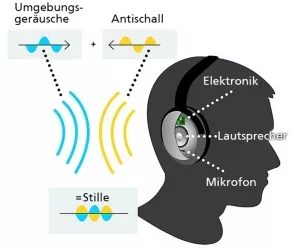
Active noise cancellation, or ANC, is the more sophisticated approach. It does not rely on a seal. It relies on physics. Specifically, on the principle of destructive interference.
Here is the basic mechanism:
- Microphones pick up sound. Small mics on the outside of the ear cup listen to the environment. They detect incoming noise waves.
- The processor analyzes the sound. The headphone’s internal chip studies the waveform. It maps the frequency and amplitude of the unwanted noise.
- Anti-noise is generated. The system creates a new sound wave that is the exact opposite of the noise. This is called the “anti-noise” signal.
- The waves collide. The anti-noise wave meets the incoming noise wave. The peaks of one wave fill the troughs of the other.
The result? Cancellation.
It is like two ocean waves meeting. If one wave is high where the other is low, they cancel each other out. The water becomes flat. In the audio world, flat means silence. Or close to it.
“ANC doesn’t create silence. It removes specific, repetitive low-frequency sounds.”
This process happens in milliseconds. Your brain barely notices the delay. You just hear less of the bus engine or the airplane turbine.
What Does ANC Actually Remove?
ANC is not magic. It is not a universal mute button. It struggles with certain types of sound.
It works best on:
* Engine noise
* Airplane cabin hum
* Air conditioner rumble
* Train track vibrations
These sounds are consistent. They are predictable. The algorithm can track them and generate the counter-wave effectively.
It struggles with:
* Human speech
* Sudden loud noises (like a car backfiring)
* High-pitched sounds (like a dog barking)
Why? Because speech is chaotic. It changes pitch and volume rapidly. The system cannot
It’s no accident that active noise cancelling has become the gold standard for headphones. We aren’t relying on thick foam or heavy plastic to block the world out anymore. Instead, we’re using a surprisingly clever piece of engineering that turns the chaos of the outside world against itself. The technology relies on the principle of anti-noise, generating a sound wave specifically designed to erase the one coming in.
But how do you delete a sound? You can’t just hit “delete” on a frequency.
Inside the earcup sits an external microphone. Its only job is to listen. It picks up the ambient roar of a plane engine, the chatter of a coffee shop, or the hum of an HVAC system. That data is sent instantly to a tiny processor. The electronics don’t just hear the noise; they analyze it. They map out the waveform.
Think of a guitar string. When you pluck the low E string, it vibrates with a specific speed and force. Those physical properties determine what you hear. In acoustics, we call these amplitude (how loud or strong the wave is) and frequency (how fast it vibrates). The microphone captures these exact parameters from the outside world.
Destructive Interference in Action
Once the processor knows the shape of the incoming sound, it creates a mirror image of it. This is the anti-noise. If the incoming sound wave has a peak—a high point of pressure—the anti-noise generates a corresponding valley, a low point of equal magnitude. When these two waves meet, they cancel each other out.
This phenomenon is known as destructive interference. It’s a fundamental physics concept that applies to all waves, not just sound. Imagine throwing two stones into opposite ends of a bathtub. Ripples spread out from each stone. If timed perfectly, the peak of one ripple meets the trough of the other. In the center, the water becomes still. Flat. Silent.
That’s exactly what happens at your eardrum. The noise and the anti-noise collide and neutralize each other before they can stimulate your auditory nerve. The result isn’t just quieter. It’s silence. Or as close to it as physics allows.
Why You Can Still Hear the World Around You
Walking through a dense city with active noise cancellation engaged doesn’t mean you’re walking into a vacuum. It sounds risky, almost reckless, to muffle the sounds of traffic and pedestrians, but the technology isn’t designed to create absolute silence. Even the best noise cancelling headphones on the market let some ambient sound through.
Part of this is physical. No earcup fits perfectly against your head. That tiny gap acts as a leak, letting external noises bypass the dampening material entirely. But there is a second, even more fascinating reason you remain aware of your surroundings: bone conduction.
Your body isn’t just a passive observer. Your skull bones pick up vibrations from loud environmental sounds and transmit them directly to your inner ear. This bypasses the eardrum’s normal function. No amount of electronic wizardry in your headphones can stop vibrations already traveling through your bones.
The Physics of Frequency and Timing
The real limitation of noise cancelling lies in how it handles different types of sound. It is exceptionally good at lower frequencies. That low, constant hum of an airplane engine or the rumble of distant traffic? It gets neutralized with impressive precision.
Here is why. To cancel a sound wave, the headphones must generate an “anti-wave” that is the exact inverse of the noise. This requires the system to listen to the outside world and produce the counter-signal in a fraction of a second. The delay between hearing the noise and creating the anti-noise must be mere milliseconds.
If the system is too slow, the original sound wave has already reached your ear before the cancellation signal even arrives. It’s a race against physics.
This timing issue becomes a major problem with high-pitched sounds. High frequencies vibrate much faster than low ones. They change shape and amplitude rapidly, making them harder to predict and counteract accurately. The technology struggles to keep up with the chaotic, fast-moving waves of a shrieking child or a slamming door.
So, while you might feel isolated from the deep droning of the subway, you will still hear the sharp, sudden noises that demand attention. It’s not a bug. It’s a safety feature built into the limits of acoustic engineering. You are never truly cut off. The world still finds a way in, whether through the cracks in the seal or through the bones of your skull.