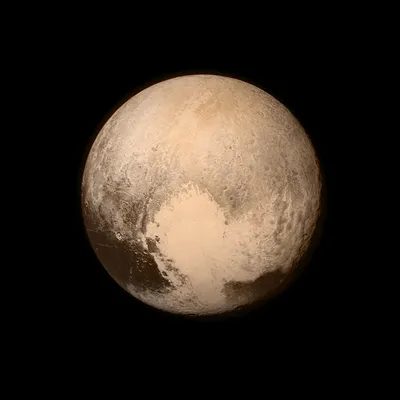
Pluto was once a distant anomaly in our solar system. It has held the ninth planet for decades. Things changed in August 2006. The International Astronomical Union (IAU) has stripped Pluto of its planet status. They reclassified it as a dwarf planet. This decision was not arbitrary. This reflects a growing understanding of what Pluto really is. It is a large resident of the Kuiper belt. This region is a ring of ice and rocky debris left over from the formation of the solar system. It lies outside the orbit of Neptune.
The International Astronomical Union takes a hard line. Planets must cleanse their neighboring planets. Pluto shares an orbit with countless other Kuiper belt objects. That’s why the test fails. This change in classification highlights the difference between dwarf and giant planets. It’s about control. Pluto is important. It is not the king of the kingdom.
Dual system in the dark
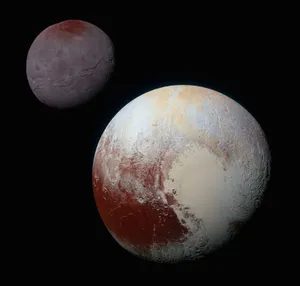
Pluto is invisible to the naked eye. It’s too far. It’s too small. It’s too dark. Its largest satellite, Charon, completely changes this dynamic. Charon is massive relative to Pluto. Because they are so close in size, scientists often consider them to be a double system. Two objects orbit a common center of mass. Pluto’s symbol is ♇. This is a tribute to the Roman god of the underworld. The Greek equivalent is Hades. The name is perfect. It is a cold and dark place.
Light travels very fast. About 300,000 kilometers per second. However, it takes more than five hours for sunlight to reach Pluto. Think of the sun as a very bright star. That’s it from there. The intensity of this light is about 1/1600 of the light received by the Earth. The temperature drops enough that freeze common gases. nitrogen. carbon monoxide. They appear on the surface as solid ice. This is a world where the air is frozen.
New Horizons breaks the silence
Telescopes on Earth have struggled for years. Even the best instruments in orbit provide little detail. The basics are incomprehensible. What is Pluto’s radius? What is its mass? The numbers are vague. For decades, we have learned more about the surface of Mars than about this distant ice ball.
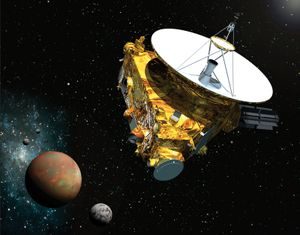
Things changed in July 2015. NASA’s New Horizons spacecraft flew close to Pluto and Charon. This is the first time in history close-up look in history. The mission answered important questions. It mapped the terrain. The complex world of mountains and plains is revealed. Until New Horizons, Pluto was just a fuzzy pixel. Then it became a destination.
The dwarf planet’s strange orbit
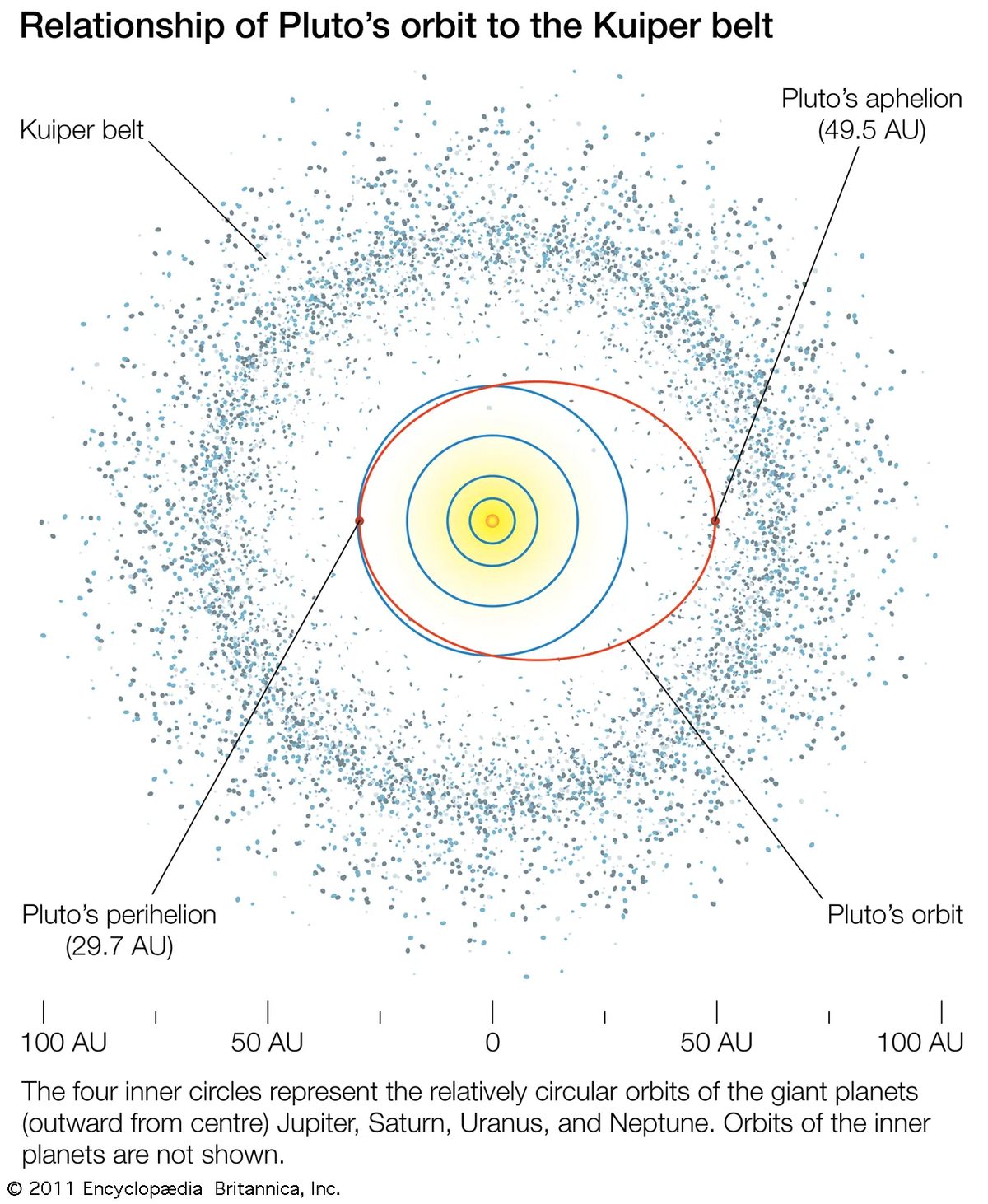
Pluto’s orbit around the sun is chaotic compared to other planets. The average distance is about 5.9 billion kilometers. This is 39.5 astronomical units (AU). 1 Astronomical unit is the distance between the Earth and the Sun. Pluto’s orbit is elongated. Astronomers call this high eccentricity. It is also tilted 17.1 degrees from the plane of the ecliptic. Most planets stay flat. Pluto tilts.
This eccentricity creates strange proximity problems. Pluto’s distance from the Sun varies from 29.7 AU (perihelion) at its closest point to 49.5 AU (aphelion) at its farthest point. Neptune’s orbit is nearly circular, 30.1 AU. Sometime during each revolution, Pluto actually crosses Neptune’s orbit. It is closer to the Sun than Neptune.
Doesn’t this cause a collision? No, gravity prevents chaos here. Pluto and Neptune are in 3:2 resonance. Neptune orbits the Sun three times, while Pluto orbits the Sun twice. This gravitational dance prevents them from getting closer than 17 AU. They passed safely. The last time Pluto reached perihelion was in 1989, and for about 10 years before and after, Pluto was the eighth planet from the Sun.
Sleeping Sideways
Pluto rotates slowly. The rotation period is 6.3873 Earth days. It was that sidereal day. Of the major planets, only Mercury and Venus rotate slowly. However, Pluto’s tilt is extreme. Its axis is inclined 120 degrees from normal to the orbital plane.
This means that Pluto rotates on its side. The North Pole points 30 degrees below the orbital plane. The Earth’s North Pole is tilted upwards by 23.5 degrees. Pluto’s retrograde rotation is even stranger. It rotates in the opposite direction to the Sun and most planets. If you were standing on Pluto, you would see the sun rise in the west. It would set in the east. A day in the underworld is a confusing experience.
Pluto doesn’t fit.
Not in size, not in density, and certainly not in its physical makeup. Compared to the other planets, it is an anomaly. Its radius is less than half that of Mercury. It is only about two-thirds the size of Earth’s moon. Next to the outer solar system’s gas and ice giants Jupiter, Saturn, Uranus and Neptune, it looks like a rock.
But the real clue isn’t just how small it is. It’s what it’s made of.
When you combine its small footprint with its low density and composition, Pluto starts to look less like a dwarf planet and more like a moon. More specifically, it looks like a large icy moon orbiting an outer giant star.
The Case for a Moon Origin
Pluto’s closest twin in the entire solar system is not another planet. It is Neptune’s largest moon, Triton.
The similarities are striking. Their densities are nearly identical. Their compositions suggest that both objects formed from the same primordial material in the cold regions of the early solar system. This suggests a common origin story. They probably did not begin life as planets, but as independent objects trapped in the gravitational net of a larger giant.
If Pluto is basically a runaway moon, why does it orbit the Sun directly? The answer lies in its chaotic history. Triton orbits Neptune in the opposite direction of the planet’s rotation. It is a captured object. Pluto may have suffered a similar fate, or it may be part of a population of Kuiper belt objects scattered by wandering giant planets.
The numbers don’t lie
You can see the disconnect in the data. Pluto is not a rocky world like Mars. It is not a gas giant like Jupiter.
- Average distance from the Sun: 5,910,000,000 km (39.5 AU)
- Radius: 1,185 km (smaller than Earth’s moon)
- Average density: About 2 g/cm3 (indicating a mix of rock and ice)
- Rotation period: 6.3873 Earth days (retrograde)
- Average surface temperature: 40 K (-387 °F / -233 °C)
That low density is the smoking gun. A purely rocky body would be much denser. Pluto is a mix. It holds enough ice to give it buoyancy and enough rock to make it solid.
A Tilted Existence
Pluto’s orbit is also strange. It is not in the plane of the ecliptic like the eight major planets.
- Eccentricity: 0.251 (highly elliptical)
- Inclination: 17.1° relative to the ecliptic
Although its orbit crosses that of Neptune, the two planets never collided due to orbital resonance. But the tilt is more telling. Pluto’s equator is inclined 120° to its orbit. It rolls on its side as it travels around the Sun. This extreme tilt causes the seasons to last for decades and exposes the different poles to the sun over hundreds of Earth years.
The Faint Breath of Air
for

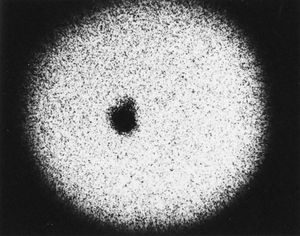
Scientists had an inkling of Pluto’s atmosphere long before they could prove it. The discovery of methane ice on Pluto’s surface in the 1970s led scientists to early confidence that the dwarf planet was more than just dead rock. This shows that the body is able to hold on to something unstable. But proving that atmosphere existed the existence of this atmosphere? That had to wait. Direct observation was only possible in the following decade.
This breakthrough happened in 1988. Neither the telescope’s lenses nor the new sensors did the heavy lifting. This is geometry. Pluto passing directly in front of a distant star is a phenomenon known as an occultation. Observers on Earth observed the glow of the star. It didn’t go away quickly. Instead, the light gradually dimmed and finally disappeared behind the silhouette. The slow fade was the smoking gun. It demonstrated the presence of a thin, greatly distended atmosphere that filters the star’s light.
The physics here are brutal. Pluto’s atmosphere must consist of vapor in equilibrium with ice, making this system extremely fragile. Small changes in temperature shift the air around. This can cause large fluctuations in gas levels. The atmosphere is basically a phase change engine. Solid ice turns into gas. The gas settles back and turns into ice. It’s a toggle switch, not a dial.
The dwarf planet was several years near Pluto’s perihelion in 1989, and was slightly less cold than average. This small change is important. More frozen gas evaporated. The atmosphere expanded and reached its thickest state. This makes this particular period a good time to explore the body. If you want to see Pluto’s air, you have to catch it while Pluto is trying to hold its breath.
Fast forward to the year 2000. Astronomers estimated the surface pressure to vary from a few microbars to tens of microbars. For comparison: 1 microbar corresponds to one-millionth of the Earth’s sea level pressure. By Earth standards, that’s a vacuum. A whisper of air.
But then Pluto was much closer to the Sun. Aphelion, where the dwarf planet is furthest away and receives the least amount of sunlight, is cold. The gas freezes and returns to the surface. Far away in the Kuiper Belt, Pluto’s atmosphere may not be detectable at all. It collapses. It disappears into the ice.
The atmosphere isn’t a permanent feature. This is the seasonal pulse. A tide. Breathe as the sun approaches. Hold your breath when the sun recedes. We only see it when Pluto has the courage to let go.
What is there where there is nothing?
Pluto breathes mainly nitrogen. We know this from Earth-based observations of starlight shining behind a dwarf planet during occultations. But New Horizons did more than check the basics. Let’s dig deeper. The detectors detected methane and carbon monoxide in the mixture. Hydrogen cyanide showed up too. It’s a small amount, but it means a lot. Nitrogen is not unique to Pluto. The earth breathes it. Saturn’s largest moon Titan, Saturn’s biggest moon, is wrapped in it. Neptune’s moon Triton has it too. in the outer solar system, a cold, nitrogen-rich world seems to be the norm.
However, the numbers tell a different story about vulnerability. The surface pressure is only 10 microbars. thin. Paper-thin. The spacecraft was also labeled with acetylene, ethylene, and ethane. New compounds. New chemical reactions take place in the dark.
Temperature near the ground? 45 Kelvin. That’s minus 228 degrees Celsius. or minus 379 degrees Fahrenheit. It’s so cold that most things freeze. Yet the atmosphere doesn’t collapse. It stretches.
A sky that refuses to end
The fog layer is visible at an altitude of 200 kilometers. 120 miles of airborne particles. But what’s really surprising is how far the atmosphere goes. It stretches upward for 1,800 kilometers. 1,100 miles above the ground. Although the world is so small, it is huge.
Why won’t this go away? The upper atmosphere is still quite cold. Cold nitrogen molecules move slowly. They don’t have the speed to escape Pluto’s weak gravity. So the air stays put. It hangs there, extended and thin, defying expectations of what one should expect from a small, cold body.
Surface and interior
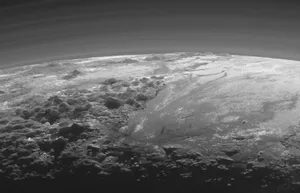
New Horizons is lucky. Or maybe you’re unlucky, depending on how you look at the odds. When the spacecraft passed Pluto, it only saw one hemisphere. There’s only one thing. This face is complex enough to rewrite everything we thought we knew about dwarf planets.
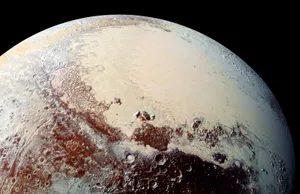
Tombaugh Regio leads this view. The white heart-shaped plateau is so striking that it has become the most iconic image of the mission. But look closely at the western lobe of the heart. Sputnik Planitia. A pool of soft nitrogen ice.
Zero impact craters.
This absence is not an empty space. This is proof. Craters are scars left by cosmic collisions lasting billions of years. Their smoothness meant that something had wiped them off recently. Geological activity. Pluto is not a dead rock. It lives in its own icy way.
This pristine pool is surrounded by rugged terrain. The mountains rose from the ground and looked jagged and alien. It is not made of rock like the mountains of Earth. They are water ice. Hard, ancient water ice floats in an ocean of softer nitrogen ice. This is a geological contradiction that makes perfect sense in the frozen vacuum of the Kuiper Belt.
Then dark spots appear.
Look north. The higher the latitude, the darker the color. Plains of Shadow. But the real contrast is in the West. Cthulhu Regio. Originally called “the whale” because of its shape, it is now named after H.P. Lovecraft’s Cosmic Horror. This is the darkest region of Pluto. It is a patchwork of flatlands, steep slopes, mountains and craters.
Why is it so dark? Organic compounds. Tholins. When simple hydrocarbons are exposed to sunlight or radiation, complex molecules are formed. They colored the ice. They give the area a deep reddish-brown hue.
It’s not just a matter of color. It’s all about reflection. Albedo. Pluto has an average albedo of 0.72. Reflects 55% of the light. Compare this to the Moon’s of 0.1. For Triton it is 0.8. Pluto is bright.
However, this average hides the truth. The range is very wide. Cthulhu Region’s reflectivity is only 0.1-0.2. absorbs most of the light. Tombaugh Regio? Reflects 0.8 to 1.0. It’s almost a mirror.
This is more than just a pretty photo. This is a time record. Activities. Chemicals. We looked at the one side. The other side remains a mystery, hidden in the dark, waiting for a mission that will never come. Or maybe just knowing what we saw is enough.
What is frozen in Pluto?
The story of Pluto’s surface begins with a chaotic first sight. In 1976, astronomers made the first crude infrared spectroscopic measurements. Although the data are inconclusive, they point to the undeniable fact that there is solid methane on the surface. This is not a guess. It was a detection.
Fast forward to the early 1990s. Ground-based instruments have been improved to the point that they cancel out atmospheric noise. The picture becomes clearer. The observers found more than just methane. They spotted water ice. They found carbon monoxide. Next is the nitrogen molecule.
Detecting nitrogen is a nightmare. Its spectral properties are weak in nature. It hides in plain sight and refuses to shout its presence. But the data eventually revealed a signal. Nitrogen is not just a trace element. It is the main substance that covers the surface.
Methane does not float alone. It exists in two different forms. Sometimes pure methane ice is formed. It can also be frozen as a solution in nitrogen ice. It’s a mixture. A frozen blend. The surface is a complex tapestry of these volatile ices, mostly nitrogen but methane in color.
Although the spectral signature of nitrogen is inherently very weak, it is now clear that this species must be the main surface component.
This combination is important. Nitrogen ice is dominant because it is the most abundant volatile substance on a dwarf planet. The methane mixes to form a frozen “solution”. Water ice gets trapped at greater depths where it may be too cold to move. Carbon monoxide coexists with nitrogen, but in small amounts.
A 1976 study opened the door. The 1990s instruments walked through it. The reality is colder and more complex than early models suggested. The surface changes. Over time, the ice sublimates and re-precipitates. But the core structure remains, and nitrogen ice mixed with methane blankets the rest of the world.

Look at the numbers. Pluto sits at 1.85 grams per cubic centimeter. Charon is a light 1.7. This gap is important. This is more than just a statistic. It tells you what’s in these dead worlds.
Both objects are filled with a substance that is denser than water ice. Ice floats. Rocks and organic compounds sink. Pluto’s high density suggests that the interior of the planet is a huge rock. Charon is similar, but slightly lighter. Maybe it’s more porous. Maybe there are fewer stones. I’m not sure. Mathematically, however, a common history is demonstrated.
Think Jupiter’s icy moons. Of Saturn. Pluto is just right. A rocky core at the heart. It is surrounded by a thick layer of frozen water. This is the standard model for small objects in the solar system. But Pluto has a neat trick up its sleeve.
The mystery of the dark side
Surface observation revealed frozen nitrogen. carbon monoxide. methane. These are volatile substances. They sublimate. If you don’t keep it cool, it will disappear into thin air. Here they form a thin skin. It is just like the oceans on earth. thin. floating. heavy.
Next is Sputnik Planitia.
It’s a giant basin. A crater. It was formed in a collision billions of years ago. Or so the surface says. But location is a problem. This is not random. It is located on the tidal axis. The exact opposite of Charon.
Why is this important?
If the shock basin is on the other side of a tidally locked object, it shouldn’t stay there. Tidal forces would realign the planet. Heavier sinks. The lighter it is, the more it floats. Unless something already exists. Things are heavy.
Sputnik Planitia’s location requires additional mass beneath it.
The basin is a hole. It should be light. But it is anchored. On the other side is the moon. This implies a subsurface ocean. There is liquid water above the core of the rock. Below the ice shell.
The liquid layer acts as ballast. It shifts the center of mass. It pulls the basin into alignment. The sea is more than just a geological feature. It is a stabilizer.
Which moons have subsurface oceans?
We know Europa has it. The same goes for Enceladus. Ganymede? perhaps. But what about Pluto? It’s already so far away. dark. cold. There the sun is just a bright star. How do you keep it hot enough to keep the liquid inside?
Radioactive decay. The core of the rock contains radioactive isotopes. They decay. They release heat. over time. slowly. Enough to keep the rock-ice interface warm. Just enough to melt the ice crust on the bottom.
Charon may not have that luxury. Lower density means fewer stones. There will be less radioactive material. Less heat. There is no sea. Just frozen rocks and ice.
Why does Pluto have an ocean?
Shock heating? Early accretion heat? Or is the radioactive energy released gradually?
The presence of the sea changed everything. This means that Pluto is more than just a chunk of ice and dirt. It is very active. Differentiation. Layered. The stone sank. Ice floats. Water becomes liquid.
This is not just about Pluto. About the Kuiper Belt. How many of these dwarf planets have hidden oceans? How many
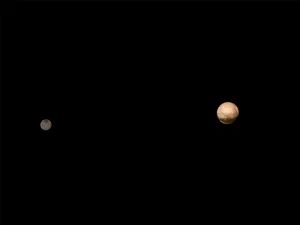
Charon is more than just a satellite. Half the size of its parents, it is a giant companion that rules the system. Most of the satellites in the solar system are just accessories. Charon is a partner.
The two objects orbit a common center of mass about 12,200 miles (19,640 km) apart in the open space between them. About 8 diameters from Pluto. Think about scale.
Compare it to the Earth and the Moon. Our moon is a little more than a quarter the size of Earth. Its diameter from Earth is about 30. Pluto and Charon are closely aligned. They are trapped in the embrace of gravity that defines their entire existence.
This proximity creates a strangely silent sky. Charon’s orbital period is exactly the same as Pluto’s orbital period. They are tidally locked. The result is a heavenly handshake that never changes.
If you stood on Pluto’s hemisphere facing Charon, you would never see it rise or set. It floats in the same place in the sky day and night. It is a fixed point in the dark, just like a geostationary satellite on Earth.
Charon is completely invisible from the opposite side of Pluto. It is permanently hidden by the curvature of the planet.
A Face Locked in Time
It’s not just about the location. Charon also spins in rhythm. It still shows the same face to Pluto.
This is a double lock. The faces of both bodies are facing each other. Their rotations and rotation are completely and seamlessly synchronized.
Why is this important? It determines the thermal and geological history of both worlds. The side of Charon facing Pluto always experiences a different solar wind and radiation pattern than the other side. It shaped the composition of the Charon’s surface for billions of years.
Charon can’t just be thought of as a passive rock. It is an active participant in a complex and locked system. The lack of rotation relative to Pluto means a stable temperature gradient. A stable slope means stable geological processes.
We are still learning what these processes are. New Horizons gave us a snapshot. However, the long-term effects of this binary lock are a mystery that is only beginning to be unraveled.
Does the never moves moon in the sky feel like a companion or a prisoner? The answer depends on whether you want to escape or stay.
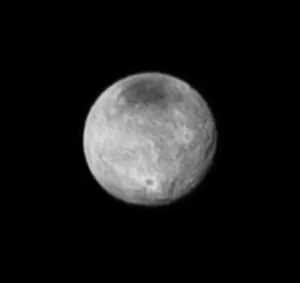
Charon does not have the showy personality of Pluto. It was dark. Its albedo hovers around 0.25, making it less reflective than the dwarf planet itself. The color is neutral. It’s almost monotonous. But let’s take a closer look at the spectrum.
Water ice covers the surface. This is the most important ingredient. There is no solid methane here. Is Pluto’s neighbor covered in bright red? Completely gone. Instead, traces of ammonia are found deep inside some impact craters.
Density tells a deeper story. Charon is dense enough to contain silicates and organic compounds. Something heavier than water ice. Something that sank to the core long ago. It means an interior like no other. The moon has layers.
The other side of the big moon
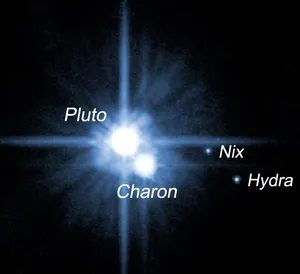
Charon is not alone. But this is the boss. The other four moons, Styx, Nix, Kerberos and Hydra, seem small in comparison. They are elongated. Lumpy. Irregular.
Their orbit is far from Charon’s orbit. The distance is amazing.
Hydra is approximately 64,721 kilometers away.
Kerberos is approaching 57,750 kilometers.
Nix orbits is 48,690 kilometers.
Styx is the innermost of the small ones at a distance of 42,413 km.
Their orbits are roughly circular. Charon too. They share the same orbital plane. This is a flat system. Ordered.
Reflection and rotation
How bright are these little stones? Styx, Nix, and Kerberos reflect light in the same way as Charon. Hydra is brighter. More reflective.
Charon locks into synchronous rotation. Its rotation coincides with its orbit. One side always faces Pluto. The small moons? Their cycle time is a mystery. In fact, it’s confusing.
Styx and Kerberos fall. Their radial dimensions vary greatly. Styx ranges is 10-25 kilometers. Kerberos is 13-34 kilometers long. Nix and Hydra are even larger, with radii of about 44 km and 36 km, respectively.
| Name | Average distance (km) | Orbital period (days) | Inclination (degrees) | Eccentricity | Orbital period (days) | Radius (km) | Mass ($10^{20}$kg) | Density (g/cm3) |
|---|---|---|---|---|---|---|---|---|
| Charon | 17,536 | 6.387 | 0 | 0.0022 | 0.0022 | Sync. | 604 | 15 |
| Styx | 42,000 | 20.2 | 20.2 | 10-25 | 10-25 | |||
| Nix | 48,708 | 24.86 | 0.195 | 0.003 | 0.003 | 44 | 0.0058 | 0.0058 |
| Kerberos | 59,000 | 32.1 | 32.1 | 13–34 | ||||
| Hydra |
Chaotic dance of Pluto’s moons
Orbital mechanics around Pluto are tricky. Charon rules the dance floor. For every orbit that Charon completed, Hydra completed only about one-sixth of its orbit. Kerberos does about a fifth of the work. Nix takes for about a quarter of the total. Styx clocks in at one-third.
This is not random. The ratio of the orbits of Hydra, Kerberos, Nix and Styx is exactly 6:5:4:3. These relationships based on small integers indicate the existence of stable dynamic resonances. Five bodies pass by regularly. Gravity pulls and pushes to maintain the regularity of encounters. It’s a delicate balance.
However, the field is constantly changing. Pluto and Charon orbit each other, creating an ever-changing gravitational landscape. The result? Chaos. Nyx and Hydra rotate chaotically. Their poles flip. It is not a steady spin.
Unlike most moons in the Solar System, Pluto’s four small moons do not rotate in sync. Their rotation period is not fixed according to their orbital period. Hydra spins fast and completing a rotation in just 0.4295 days. Kerberos is slow and taking 5.31 days to turn once.
Discovery of a planet by accident
When Pluto was discovered, it was known as the ninth planet. Along with Uranus and Neptune, it is the third discovered planet after the ancient naked-eye world. The logic seems reasonable. Astronomers have hypothesized the existence of a ninth object since the late 19th century.
They saw Uranus. Significant disturbances are observed in its orbital motion. The math suggests that more distant objects cause gravitational disturbances. The search continues.
These confusions turned out to be false. Pluto’s mass is too small. Its gravity is not strong enough to cause suspected disturbances in Uranus’ orbit. This discovery was an amazing coincidence. This is not an exact prediction of a hypothetical planet, but rather a careful observation.
The hunt is led by the Lowell Observatory in Flagstaff, Arizona. Founder Percival Lowell drives this movement. He gained notoriety for his public claims that Mars had canals. Until his death in 1916, the search continued despite two failed attempts to find the planet.
In 1929, an astronomical camera built especially for this purpose was introduced. It collects light from the vast sky. Clyde Tombaugh, a young amateur astronomer, was hired to study the sky.
On February 18, 1930, he discovered Pluto. Less than a year had passed since the start of the work. He found it in Gemini.
The object appears as a faint “star” of magnitude 15. It is moving slowly over a solid background of stars. It takes 248 years to go around the sun.
Lowell and his colleagues predicted larger and brighter objects. What Tombaugh found was small. However, Pluto was soon identified as the expected ninth planet. The symbol ♇ designed for this purpose represents the first two letters of Pluto and the initials of Percival Lowell.
Charon’s story didn’t begin with a telescope or a flyby of the planet. It started with a blurry photo taken at the US Naval Observatory in Flagstaff. Location is important. The observatory is less than 6 kilometers from where Pluto was discovered decades ago, a short distance with great historical weight.
James W. Christy and Robert S. Harrington are the men behind the camera. Their goals were mundane but important. Better information about Pluto’s orbit was needed. They want precision. They look for small changes and tiny wobbles that can reveal gravitational anomalies or measurement errors in existing models.
Instead, they found a ghost.
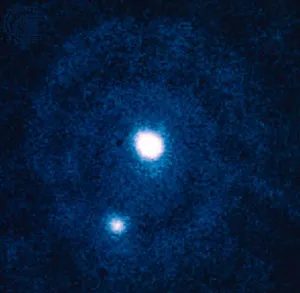
In 1978, Christie noticed a strange phenomenon while reviewing photographic plates. One image shows a faint bulge on Pluto’s edge. In the second picture, there was a lump on one side. This is not the film’s fault. These are not cosmic rays. It was a companion.
This new celestial body, the Moon, was hidden in plain sight. It’s small. It was dark. But it’s there.
Why the Mythology Matters Less Than the Mechanics
We know the moon as Charon, named after the ferryman who carried souls to the underworld. This myth is well suited to a dark and distant world. However, this myth does not explain the physics.
This discovery made astronomers reconsider Pluto. Before Charon, Pluto was seen as a lonely dwarf planet, a lonely dot in the Kuiper Belt. After Charon, it has become part of the system.
Think what difference this makes.
Once we know the moon exists, we can measure the mass of the system. Density can be calculated. understand the dynamics. Without Charon, Pluto’s mass would be just a guess. With Charon, it became a calculation.
Its influence also extends outside.
- Pluto’s mass has decreased significantly.
- The density suggests that most of Pluto is ice and not rock.
- The orbital period of the pair revealed a tidal lock.
The Tidal Lock: A Dance, Not a Orbit
Here’s the weird part. Charon doesn’t just orbit Pluto. Pluto just doesn’t spin. Locked.
They are tidally locked to each other. This means that Charon will stay in the same place in Pluto’s sky. Pluto remains in the same position in Charon’s sky. This is a binary relationship in its true sense. Rotating both objects relative to the other does not change their faces.
If you stood on the surface of Pluto facing Charon, the moon would be fixed in the sky. It never comes up. It would never set. It would just hang there, a constant presence.
This lock happens due to gravity. In the past, tidal forces slowed Pluto’s rotation until it matched Charon’s orbital period. This is a common fate for moons in our solar system, but seeing it at the edge of the known world felt different. This makes the external system feel more intimate. More connected.
Why is this important now?
You might be wondering why a satellite discovered in 1978 is important today.
This is important because Charon is the key to Pluto.
Without Charon, we might think of Pluto as a failed planet, a cosmic mistake. we may have overlooked
Before we learned about Charon, Pluto was a mystery shrouded in a fog of speculation. More massive too. However, these two numbers cannot be measured directly. You can’t just weigh a rock floating 3.7 billion miles away. You have to guess it. And your guess was wrong.
Even in the first image showing Charon, it is not an obvious ball. It was a bump. There is a small bulge on one side of Pluto. This shows two things. These objects are very close to each other and very far from Earth. Then there was the atmosphere. Earth’s atmosphere obscured everything. Distorts light. Softens sharp edges.
This problem was solved only in the late 1990s.
The Hubble Space Telescope has arrived. Ground instruments are equipped with adaptive optics. These systems compensate for atmospheric turbulence in real time. Suddenly the blur died there. Pluto and Charon became separate bodies. Not two bumps. Two worlds.
Finding the Rest of the Squad
Charon is not the only satellite. But finding the others requires a different kind of patience.
In 2005, a team of nine astronomers studied the dark. They use Hubble images. They are looking for objects as small as 25 kilometers in diameter. They found Hydra and Nix. small. Tiny. Hard to catch.
But they didn’t stop at new pictures. They dig deep into archival data. In particular, the 2002 Hubble image was used to map the surface. There were two more objects, dim but clearly visible. they move. These correspond to the orbital paths calculated from the 2005 data. Confirmation.
This pattern was repeated.
In 2011, six astronomers discovered Kerberos in Hubble images. They checked again. The marks are visible in the pictures from 2006 and 2010. It’s just a small stain. But they are there.
Next is Styx was next. It was also discovered by Hubble in 2012.
We currently know that Pluto has five moons. Charon. Hydra. Nix. Kerberos. Styx. You have to sift through the noise to find every signal.
Where do they come from?
The prevailing theory before Charon was wild.
Pluto is a satellite of Neptune. That’s how people think. It had escaped. How? An intimate encounter. gravitational shove that pushed Pluto out of the Neptune system. It provides Triton’s retrograde orbit.
The logic seems reasonable. Pluto and Triton are about the same size. Pluto rotates once every 6.4 days. Triton takes 5.9 days to complete one orbit. This number is too close to ignore.
However, the math does not work.
Pluto’s revised mass is only half that of Triton. half. It is not heavy enough to reverse Triton’s orbit. Not strong enough. The escape theory has died there.
Then there’s Charon’s size. Pluto has a moon that is proportionally huge. If Pluto fled Neptune, why did it take such a large companion with it? This makes an escape scenario implausible.
The current model is cleaner. Violent, but cleaner.
Pluto and Charon formed independently in the solar nebula. A gaseous cloud that condensed into our solar system. they collided. The Proto-Charon collided with Pluto. The collision created a debris ring. That ring accreted. Gravity attracts dust. Charon was formed.
It’s the same story with Earth’s moon. An object the size of Mars crashed into the earth. The fragments formed a ring. The Moon coalesced.
Look at the chemistry. The moon has a high-temperature origin, so it lacks volatile elements. There is no methane on Charon. Pluto and Charon are relatively dense. This collision explains both. Heat drove off volatile substances. The density remains the same.
Origin of small satellites
What about Hydra, Nyx, Kerberos and Styx?
Some astronomers believe they were born independently. They were later captured. The origins are different. different types of trucks.
But orbital mechanics says otherwise.
The four small satellites have circular coplanar orbits. They dance on the same plane. They have a common dynamic resonance. This is not a random capture. This is family.
Charon’s impact released enough debris to form the rest. Material from its ring accresed on all three moons. Probably more. It just hasn’t been found yet.
This suggests something from the early solar system.
About 4.6 billion years ago, the outer nebula was crowded. There are a lot of icy bodies It is the same size as Pluto and Charon. They weren’t unique. They are built from smaller entities. Today we call these the nuclei of comets.
Triton is probably one of those giant icy planetesimals. Captured by Neptune in early history. Chiron, orbiting between Saturn and Uranus is another example. The nucleus of a giant comet. It is a smaller version of Saturn’s moon Phoebe.
We are looking for survivors. piece. Remnants of the Age of Chaotic Formation. Pluto’s system is not an anomaly. This is a snapshot of the structure of the outer solar system.
We are still learning to read. The dim traces of old Hubble data remind us that the universe hides details until we’re ready to see them. Or until you build the right tools.
The Kuiper belt and the Oort cloud
Most icy planetesimals are swallowed up by giant planets as they form. But that’s not all.
Many objects stayed. They become loose pieces of the Kuiper belt. This is the thick, flat disc behind Neptune. It follows the plane of the solar system. Specifically, it includes the outer part of Pluto’s orbit.
Billions of other objects are scattered outside. This happened during the formation of Uranus and Neptune. They probably form the Oort cloud. A huge spherical shell. It is located at a distance of about 50,000 astronomical units.
In the early 1990s, astronomers discovered more than 1,000 Kuiper Belt Objects (KBOs). The conclusion is clear. Pluto and Charon are just large members of this belt. Objects such as Chiron and Neptune’s moon Triton may have originated from objects in the Kuiper belt. The same is true for many other icy moons.
Consider the orbits. Some Kuiper belt objects have highly eccentric paths. They are inclined to the solar system’s plane. They have common features with Pluto. Stable 3:2 orbital resonance with Neptune. Astronomers called them Plutinos. Little Plutos
Why did Pluto’s planet status change
Before Pluto lost its planet title, there was no strict definition. Astronomers have not yet agreed on a minimum mass. or radius. or mechanism of origin.
The old separation was instinctive. The large celestial bodies are the planets. Smaller are asteroids and comets. The moon is different. This approach works if the differences seem significant. This works when small objects are hardly understood as building blocks for others.
This is an early and fragmented view. Think of the blind men and the elephant. Each touches different parts. Everyone recognizes different objects.
We later realized that the original grouping failed. The components of the solar system must be reclassified. Requires complex and interrelated definitions.
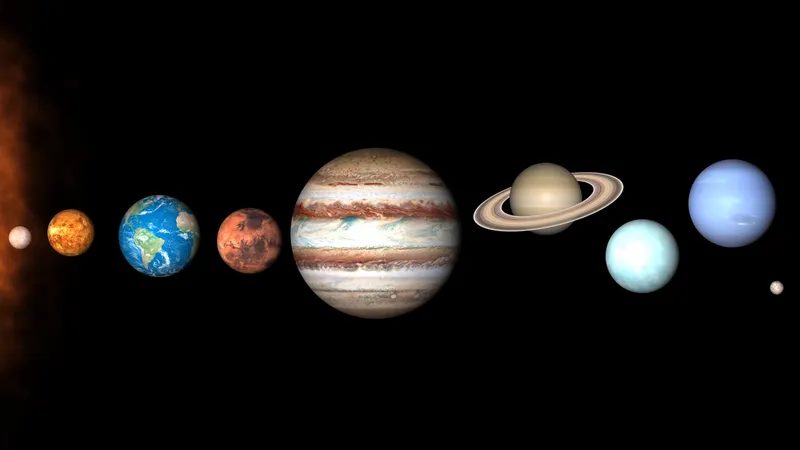
When Pluto was first discovered, astronomers thought it was a lonely wanderer. This sense of isolation justified its spot in the Inner Solar System Club. If it was discovered later and surrounded by objects in the Kuiper belt, no one would call it a planet.
For decades, size didn’t matter. The ice composition didn’t help. The weird orbit didn’t help. Some experts kept questioning its status. Then came the beginning of the 21st century.
Eris changes the math
Astronomers began to discover other Kuiper belt objects. Charon-sized objects become common. Eris came there.
Eris is slightly larger than Pluto.
Suddenly, Pluto wasn’t special anymore. It was just one of many. Astronomers faced a choice. Add planets to the list or remove Pluto. The International Astronomical Union chose the latter path in 2006. They also created a new category: dwarf planets.
This category includes large objects with similar origins and orbits. Pluto, Eris and Ceres got the label. Ceres is located in the asteroid belt. It is about 940 kilometers wide.
Defining plutoids
Another update was made in June 2008. The International Astronomical Union classifies dwarf planets into several subcategories. They added “plutoids”.
Pluto is a dwarf planet that is farther from the Sun than Neptune. It is basically a large Kuiper belt object.
Pluto is a plutoid. Eris is a plutoid. Ceres is different. It lives in the asteroid belt too close to the sun.
Since then, the list has grown longer and longer. Makemake and Haumea joined the club. Both are dwarf planets. Both are plutoids.