It looks like spilled treasure.
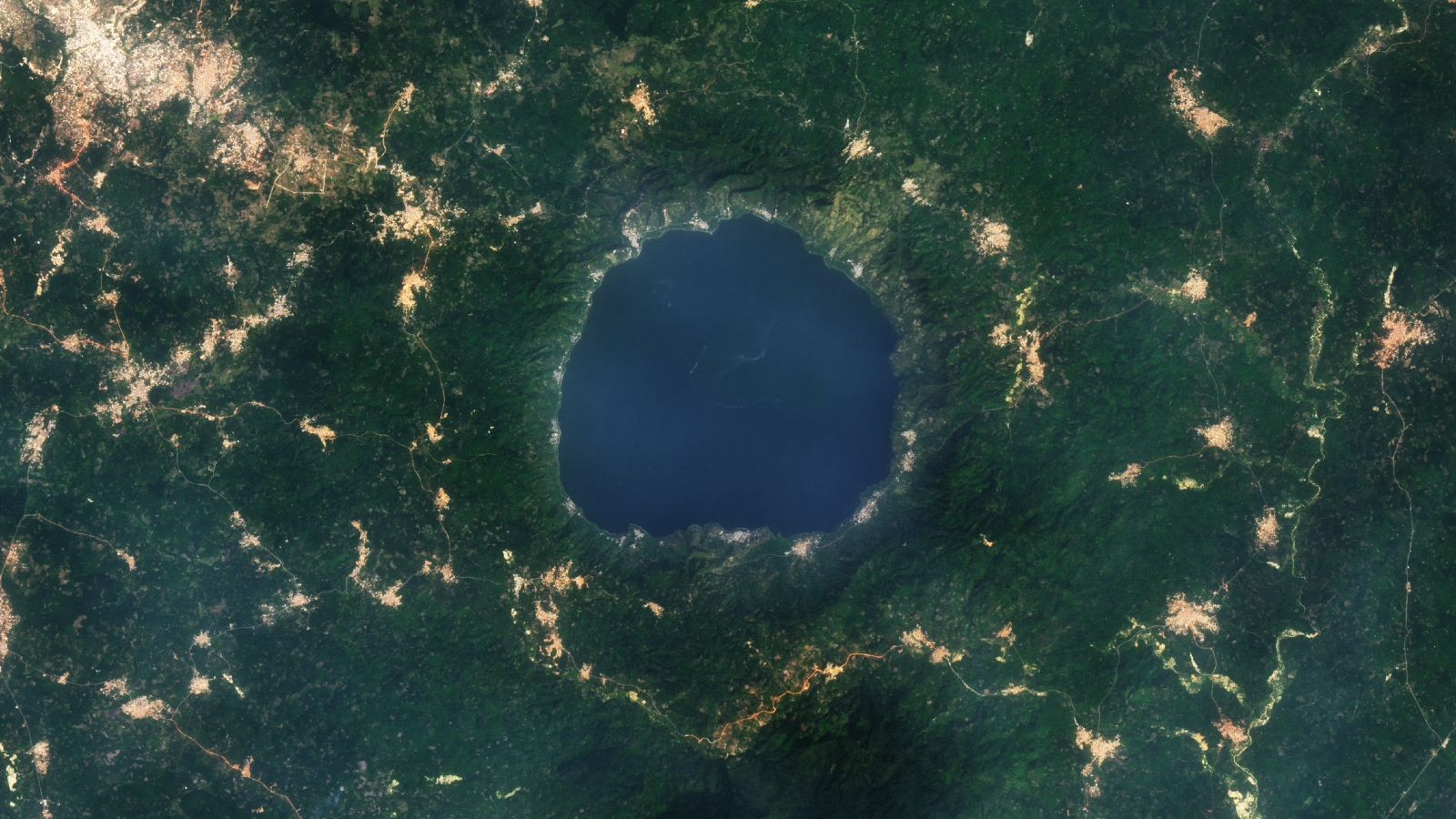
Or maybe just erosion wearing away the crust. In these satellite shots, tendrils of yellow streak radiate out from Ghana’s Lake Bosumtwi. They catch the light. They shimmer. To the casual observer, it looks like a map drawn in liquid gold.
But this isn’t a panning party.
The lake itself is an oddity. It is roughly circular. Up to 70 meters deep. Nineteen square kilometers. About the size of Manhattan. It sits just southeast of Kumasi, Ghana’s second-largest city. If you squint at the top left of the image, you can see the sprawl of the city edge creeping toward the water.
Bosumtwi is the only natural lake in the country.
Why it matters
For the Asante people, this water is not just hydrology. It is holy ground. Their myth tells of a hunter, Akora Bompe. He chased a wounded antelope. The animal stumbled into a tiny magical pond. Suddenly, the pond expanded. Instantly, violently, it became the lake we know today.
It is considered the “lake of souls.” A place where spirits leave the Earth before moving on to the afterlife.
Myth is nice. Geology is brutal.
The truth is less about hunters and more about physics.
Around 1 million years ago, a meteor slammed into this spot. It was about 3.3 kilometers wide. The impact was catastrophic.
A blinding flash
Marian Selorm Sapah from the University of Ghana paints the picture. She tells the Earth Observatory that the strike would have created an immense fireball. A blinding light. It would have incinerated everything within dozens of kilometers.
Think about that for a second.
If the same rock hit the same target today, Kumasi wouldn’t just be damaged. It would be gone. Obliterated.
What’s left is “arguably the best-preserved young complex impact structure” on the planet, says the International Commission on Geoheritages. It is a fossil of destruction.
Rare patterns
Here is the twist. The crater has lobes on the rim. Bumps on the edge. This is called a rampart crater.
It rarely happens here on Earth.
But look at Mars. Look at Ganymede, or Dione, or even Charon, Pluto’s moon. They have these patterns. They are common across the solar system. Studying Bosumtwi isn’t just about local history. It might be a Rosetta stone for how craters form elsewhere in space.
Why does this Earth crater look like a Martian one?
Sapah has a theory. When the meteor hit, the area was soaked in groundwater. The liquid turned to steam or mud, creating those distinctive lobed ejecta patterns as the earth was thrown upward and outward.
Veins of wealth
Then there is the gold.
The impact cracked the Earth’s crust. It broke the seal. Mineral-rich magma rose to the surface. It formed shallow veins. These veins contain gold and other elements. People have been digging them up for generations.
That’s why the satellite sees gold. Those shimmering lines in the image? That’s exposed rock.
Mining technology has improved. The digging has sped up.
Take a look at a newer satellite photo from 2024.
The gold exposure is worse. Much worse. The yellow patches have expanded aggressively. The lake itself looks greener, choked with phytoplankton.
The stark visual evidence of anthropogenic change juxtaposed with a million-year-ago geological landmark is striking.
That was Sapah again.
She didn’t have to spell it out. You can see the tension in the pixels. A million years of stability against modern human hunger. The hunter’s antelope is gone. The souls are still leaving, presumably. But the land is changing. Fast.
We are rewriting the crater.