Our Galaxy’s disk looks stable. Pancake-shaped. It spins. Fast. Over 220 km/s. The Sun and billions of stars live here, drifting in a coherent rotation.
Astronomers spent decades trying to find when this structure began.
Dr. Matthew Orkney (University of Barcelona) and Dr. Chervin Laponte (CNRS) argue that the timing of that “spin-up” is the key. They think stars moved in unison at a specific early point.
The Milky Way never formed in a vacuum.
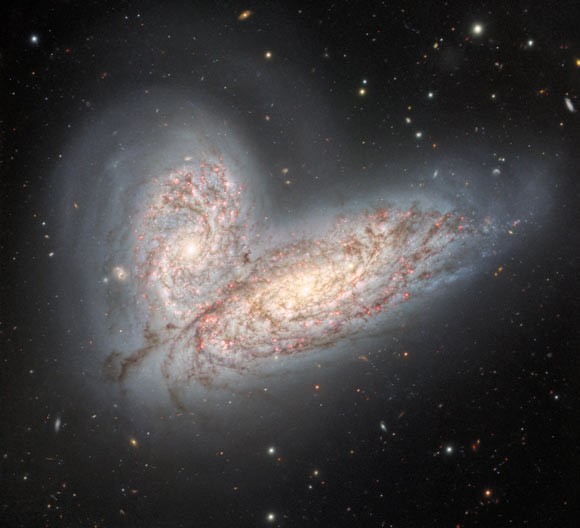
We’ve long suspected a smaller galaxy ran us over. A violent merger. In 2018 the ESA Gaia mission found evidence. Stars were moving oddly. Too weird to be normal. This proved a massive merger happened about 10 billion years ago. It’s called the Gaia-Sausage-Encelidus (GSE).
To see how disks actually form Orkney and Laponte ran simulations. They built fake galaxies that looked like ours and smashed them.
What came out surprised everyone.
Stellar disks might form much earlier than anyone thought. But major collisions destroy them. They get ripped apart. Shattered.
This means the rotation we see now? It might not be the original birth of the disk.
It might be the reconstruction.
The timeline matters. The simulations point to an 11 billion year old impact. Earlier than most estimates. Why does it matter?
Because it lines up perfectly with a starburst.
Gas clouds compressed during the crash. Ignited. Globular clusters formed. A galactic firework show. Dr. Laporte called it a predicted aftermath of impact. “This is the first time this link is made.”
Is the galaxy we know just the scar tissue?
Structure and collisions are tied together. You cannot understand one without the other. – Dr. Orkney
Published in Monthly Notices of the Royal Astronomical society the study suggests our disk didn’t survive. It was rebuilt.
Matthew D.A. Orkley & Chervin F.P Laporte 2026 Build-up and survival of the disc: from numerical models of galaxy formation To The Milky Way. MNRAS.