518 million years.
That’s how long ago a tiny sea creature named Urokodia aequalis was prowling the Cambrian ocean floor in China. And guess what it had?
Precursor fangs.
Specifically chelicerae. The pincer-like tools that eventually evolved into spider venom injectors and scorpion claws. This isn’t some late-game addition to the spider family tree. It’s ancient history. Written in rock.
The Chengjiang Discovery
You probably know spiders, ticks, and scorpions as land-dwelling bugs. Wrong.
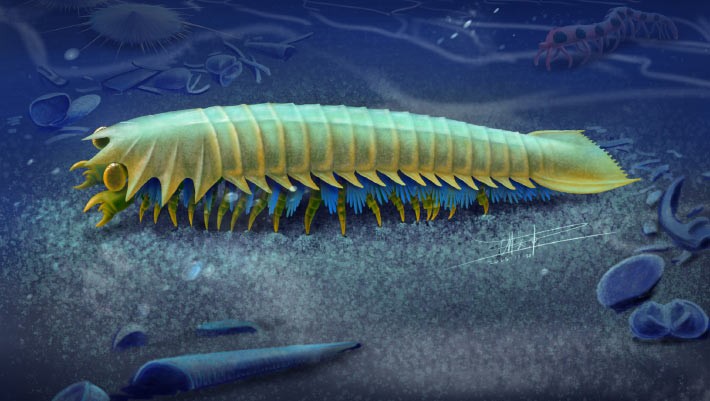
Their ancestors started in the sea. The early fossil record is murky for sure but the Chengjiang biota in Yunnan province keeps showing us surprising things. Here paleontologists dug up Urokodia aequalis. A small guy. Only 2-3 cm long. With huge stalked eyes bulging out front and a segmented body trailing jointed limbs underneath.
“Urokodia aequalis was part an ancient ecosystem over 500 mya,” noted Prof. Mark Williams.
Professor Williams and team at Leicester didn’t just look at the hard shell though. They used X-ray tomography to peek inside the stone itself.
Most soft tissue rots away. This one survived.
Hidden behind those protruding eyes were two small pincer limbs. An early version of the cheliceral apparatus. The moment researchers spotted them via scan it clicked. This creature links directly back to modern chelicerates. Distant relative yes. But related nonetheless.
More Than Just Teeth
Wait. There’s more.
Look at the legs. Really look at them. They have features that mirror book gills — those layered breathing structures found on horseshoe crabs right now. Horseshoe crabs are living fossils in their own right. So seeing their respiratory machinery in a 500-million-year-old ancestor is … wild.
“Its trunk appendages support a megacheiran origin of book gills,” the scientists explain.
Basically the appendages bridge the gap. Between messy multi-segmented limbs of the deep past and the specialized chelicerae of today. A morphological transition captured perfectly in slate and lime.
Why It Matters
Why does a worm-sized ancient predator matter today?
Because it breaks our timeline. We thought chelicerae appeared later. The evidence suggests they were already tweaking the design in the Cambrian seas. Pushing back the origin point helps us map out the evolutionary tree without all those annoying blank spots.
How much longer until we find a prehistoric tarantula? 🕷️
The full breakdown dropped in Nature. Read it if you like rocks and dead things. Most people won’t.
That’s okay. Let them sleep. You now know spiders have been packing heat for half a billion years.
Ref: Y. Liu et al., Urokodia sheds light origin of chelicera book gills Chelicerata Nature online Jul 2026.