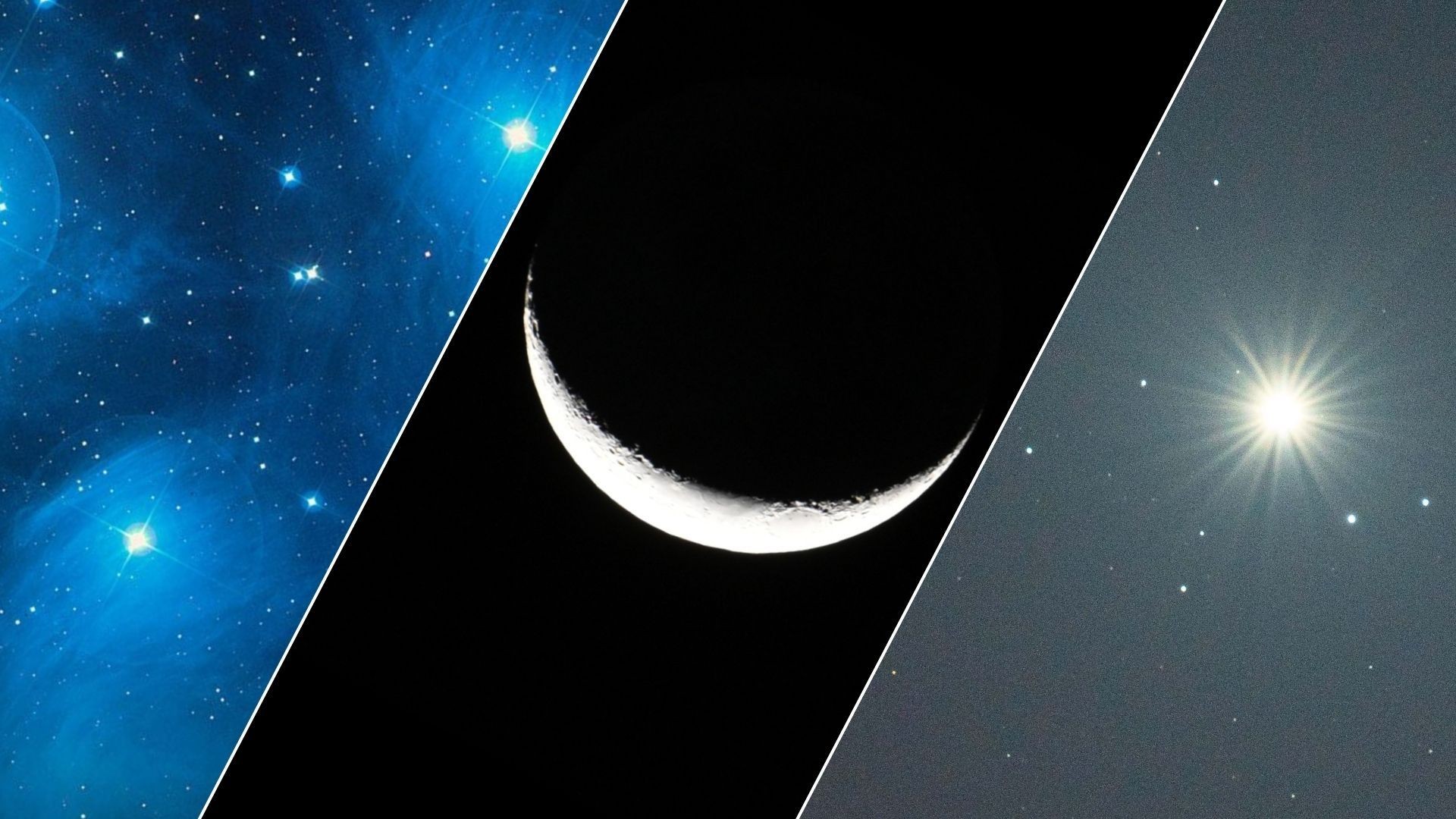
On the evening of April 19, stargazers will have a unique opportunity to witness a rare celestial gathering in the western sky. Shortly after sunset, a thin crescent moon, the brilliant planet Venus, and the ancient Pleiades star cluster will align in a visually stunning display.
The Main Event: Moon, Venus, and the Pleiades
To catch this alignment, observers should look toward the western horizon approximately 30 to 90 minutes after sunset. The sky will feature three primary focal points:
- The Waxing Crescent Moon: Only 11% illuminated, this razor-thin crescent will sit about 20 degrees above the horizon (roughly the width of two clenched fists held at arm’s length).
- The Pleiades (The Seven Sisters): Located just to the lower right of the moon, this open star cluster appears as a cluster of blue-white stars enveloped in a soft, diffuse glow. While it contains over 1,000 stars, its most famous members are the seven brightest: Asterope, Alcyone, Celaeno, Electra, Maia, Taygete, and Merope.
- Venus: Acting as the “Evening Star,” Venus will shine brightly below the moon. Because it sets only about two hours after the sun, a clear view of the western horizon is essential to see all three objects in proximity.
Hidden Details for Advanced Observers
For those equipped with extra tools, there are two additional phenomena to look for:
1. The “Da Vinci Glow” (Earthshine)
During this phase, you may notice a faint, ghostly light illuminating the dark portion of the moon. This is known as earthshine. It occurs when sunlight reflects off Earth’s clouds and hits the moon, acting like a mirror. This effect is most prominent around the new moon phase when the lunar crescent is at its thinnest.
2. The Hunt for Uranus
The ice giant Uranus will also be positioned near Venus, roughly 5 degrees to the upper right. However, with a magnitude of +5.8, it is far too dim to be seen with the naked eye. To spot the tiny, greenish disk of Uranus, observers will need binoculars or a telescope, and even then, the low position of the planet near the horizon may present a challenge.
Viewing Tips
To maximize your experience, ensure you are in an area with minimal light pollution and an unobstructed view of the western horizon. While the moon and Venus are easily visible to the naked eye, the Pleiades and Uranus are best enjoyed with magnification.
Summary: The alignment on April 19 offers a perfect “entry point” for amateur astronomers, combining bright, easily identifiable objects like Venus and the Moon with more subtle wonders like the Pleiades and earthshine.