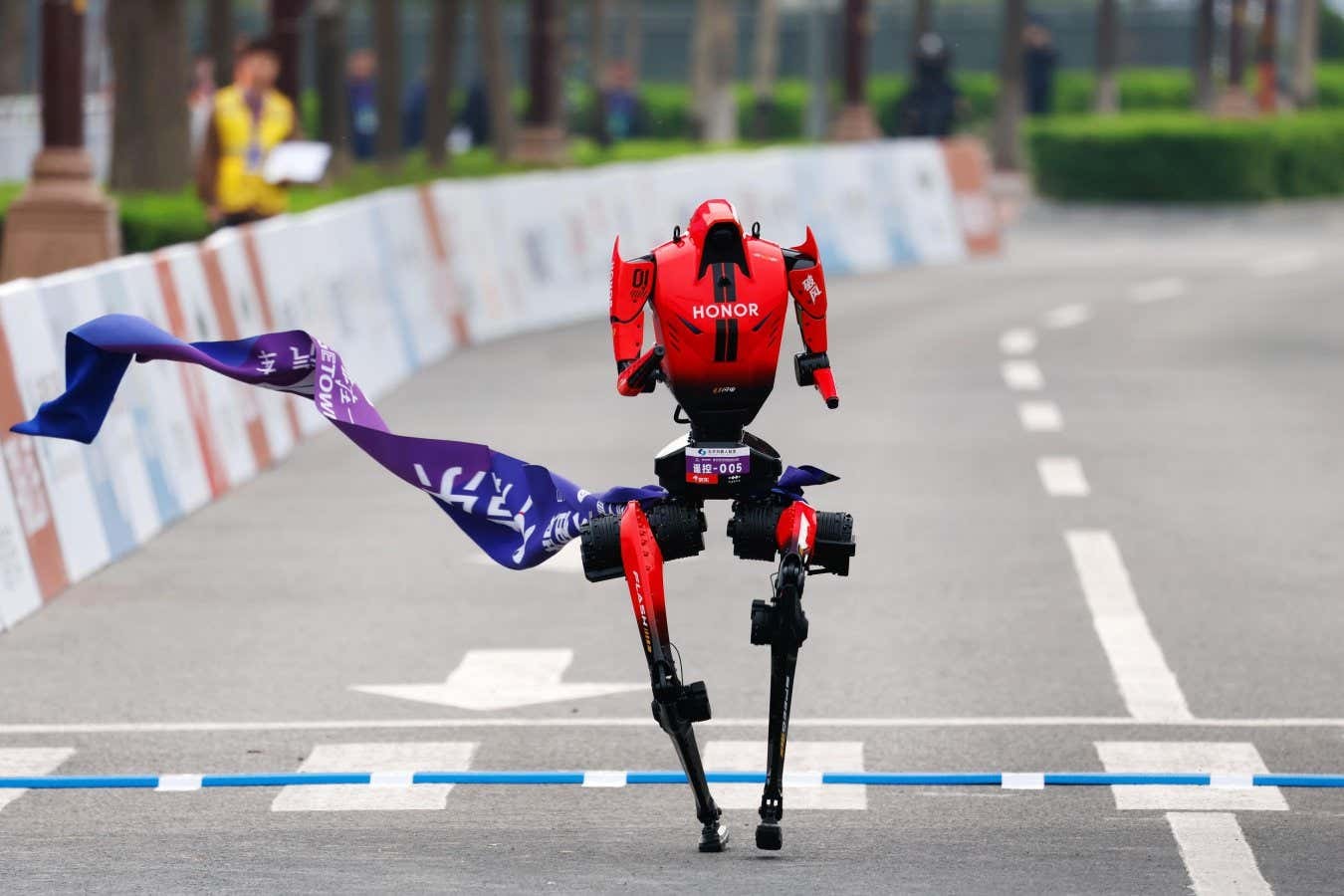
The boundary between human athletic achievement and machine capability is blurring. While human runners continue to push the limits of endurance, a new class of competitors is emerging on the track: humanoid robots. Recent breakthroughs suggest that machines are no longer just mimicking human movement—they are rapidly approaching human speed.
The Rapid Acceleration of Robotic Performance
Recent milestones indicate a steep upward trajectory in robotic mobility. In the Beijing E-Town Half-Marathon, the evolution of robotic performance was strikingly evident:
– In 2025: The fastest autonomous robot completed the 21.1-kilometer course in 2 hours and 40 minutes.
– This year: The record plummeted to just over 50 minutes.
Even more provocative is the progress in short-distance sprinting. Unitree’s H1 bipedal model recently clocked a speed of 10.1 meters per second. To put that into perspective, Usain Bolt’s world-record 100-meter sprint requires an average speed of 10.44 meters per second. The gap between the fastest human and the latest technology is now a matter of mere fractions.
Why is this happening now?
The sudden leap in capability isn’t the result of a single invention, but rather a “perfect storm” of technological convergence. According to Petar Kormushev of Imperial College London, several factors are driving this acceleration:
* Hardware Efficiency: The emergence of stronger, more responsive, and more efficient motors.
* Computing Power: Faster, more energy-efficient chips that can process complex control algorithms in real-time.
* Sensor Precision: Smaller, more accurate sensors that allow for better environmental awareness.
* Cost Reduction: A dramatic drop in the price of high-quality components, making rapid prototyping and testing more accessible.
The “Humanoid” Paradox: Form vs. Function
While the headline is about “humanoid” robots, experts suggest that mimicking the human body might actually be a technical disadvantage.
Biologically, humans are not optimized for pure running efficiency; our evolution was driven by diverse survival needs, not just sprinting. Research suggests that robots designed with emu-like locomotion can be up to 300% more efficient than those designed with human-like legs.
Furthermore, there is a tension between the design of a “racing robot” and a “service robot”:
1. Specialization vs. Versatility: Racing robots are often highly specialized, lacking hands, faces, or the ability to move sideways. Their mass and power are optimized solely for forward momentum.
2. The Utility Question: If the goal is pure speed, wheels remain a more efficient solution than legs.
Why race if it isn’t practical?
If racing robots doesn’t lead directly to better vacuum cleaners or factory assistants, why invest in the technology? The answer lies in stress testing.
Much like rally car racing serves as a proving ground for consumer vehicles, high-speed robotic competitions act as a rigorous test for hardware. Running at high speeds subjects actuators to extreme torque and overheating, while the impact of each stride tests the durability of gearboxes. A robot that can survive a sprint can be trusted to handle the rigors of daily life.
Ultimately, the value of the humanoid form is not speed, but compatibility. A robot that looks and moves like a human is uniquely equipped to navigate a world built for humans—mastering door handles, stairs, and tools that were never designed for wheels or avian limbs.
While humanoid robots may soon surpass human records in speed, their true value lies not in outrunning us, but in our ability to integrate them into a human-centric world.
Conclusion
Humanoid robots are rapidly approaching the limits of human athletic performance, driven by breakthroughs in motors and computing. However, the true goal of this technology is likely not to win races, but to use high-intensity competition to develop resilient machines capable of navigating our human-designed environments.