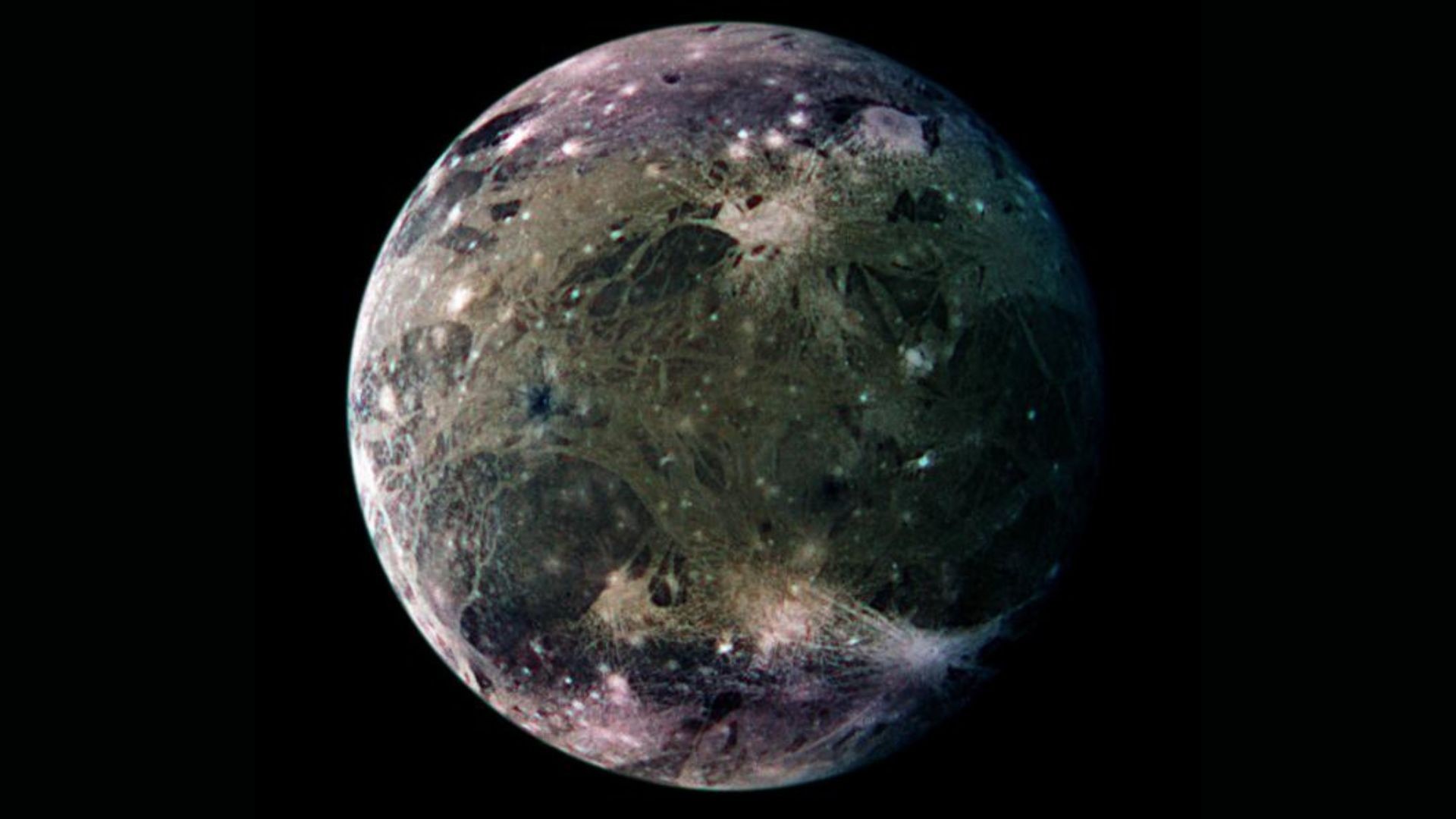
Jupiter’s biggest moon is heating up. It shouldn’t be.
Ganymede is an outlier in every sense. At nearly 3300 miles wide, it dwarfs our own Moon. It’s bigger than Mercury, that tiny planetary afterthought we keep. It is the solar system’s largest moon.
There’s another distinction, one that separates it from every other satellite out there. It has its own magnetic field. Discovered by the Galileo probe in 1996. Powered by a churning core of liquid iron.
Here’s the rub. Nobody can quite agree on how that iron got there in the first place.
“Many formation studies suggest that Ganymedeformed too cold to start with a metal-core, Meanwhile, many modeling studies… assume that Ganymede formed its… core… when the moon itself… Both… cannot be… simultaneously true.”
— Kevin Trinh (Caltech planetary scientist)
It’s a paradox. The standard view says big rocks like Earth heat up, melt their insides, and settle into a core-mantle-crust structure quickly. Early. Like, within the first 200 million years of solar system history.
But moons are small. They cool off. They’re supposed to be dead rocks. So how did Ganymede get so hot inside that it started whipping up a dynamo effect?
A new paper, out May 6 in Science Advances, suggests the moon didn’t start hot. It started cold.
The Late Bloomer
Think of it like dough. Cold. Stiff.
Instead of a fiery beginning, Ganymede formed quietly. Frozen. Dark. Then, over billions of years, something shifted.
The new model proposes a “warming-driven dynamo.” It flips the script on planetary science textbooks. Usually, we think bodies heat up and then cool down. Ganymede might have spent eons getting warmer.
Two engines are running this process right now.
- Radioactive decay. Heavy isotopes in the moon’s body break down. They turn into lighter elements. Heat is a byproduct of the collapse.
- Tidal heating. Jupiter is massive. It exerts a gravitational grip that doesn’t just pull; it squeezes. As Ganymede orbits, Jupiter stretches it. Kneads it. Like a giant, icy baguette being pulled apart and shoved back together. Friction. Heat.
This internal friction melts iron sulfide blobs. The metal is denser than the surrounding rock, so it sinks. Down to the center. Pooling. Accumulating.
These blobs feed the core. The core churns. The churn creates the magnetic field.
It’s messy. It’s late to the party. But it works.
Why Does This Matter?
Look at the stars. There are exoplanets everywhere. Rocky ones. Earth-like ones. We hunt for life there because life needs protection from radiation. A magnetic field is basically a force field. Without it, the surface gets fried by cosmic rays and stellar wind.
Earth has one. It’s weak. Weaker than your fridge magnet, honestly. But it saves us.
If Ganymede’s theory holds water — if “cold start” cores are a real thing in the cosmos — we might be looking at a new way planets get shields. Not just for giants. For the young. For the quiet. For worlds that started frozen and slowly woke up.
Kevin Trinh put it to Live Science:
“There could be young rocky exoplanets… that would be favorable for a recent, warming-driven dynamo… The challenge is that no one… detected… a… dynamo… yet.”
We haven’t found any yet.
But we’re looking at the wrong kind of heat. Maybe we shouldn’t expect every habitable world to be born in fire. Some might just be turning up the thermostat, one orbit at a time.