


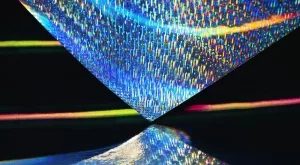
Objects can vanish. Light can freeze. Radiation can be twisted into submission.
This isn’t sci-fi. It’s metamaterials.
These aren’t natural substances. You won’t find them in a periodic table. They are engineered structures, designed at a microscopic level to interact with waves in ways nature never intended. From cloaking devices to super-lenses, the boom in research and technology surrounding these materials is driven by one question: how do they defy standard physics?
The Secret Lies in Structure, Not Chemistry
Most materials get their properties from their chemical composition. Gold is gold because of its atoms. Wood is wood because of its cellulose structure.
Metamaterials work differently. Their magic comes from their geometry.
Scientists build tiny, repeating patterns—often smaller than the wavelength of the light or radiation they interact with. Think of it like weaving a fabric so fine that it traps air, or arranging tiles so perfectly that they reflect sound rather than absorb it. The “stuff” might be plastic or metal, but the arrangement dictates how energy moves through it.
“Metamaterials don’t just react to waves; they command them.”
This structural manipulation allows for properties that do not exist in nature. Negative refractive index. Reverse Doppler effect. Invisibility.
Bending Light and Stopping Time
The most famous application is invisibility. But “invisibility” is a simplification.
A traditional mirror reflects light. A window lets it pass. A metamaterial cloak guides light around an object and lets it continue on its original path. To an observer, the light never “saw” the object. The object is effectively erased from the visual field.
But it goes deeper.
Researchers have demonstrated the ability to slow light down. In extreme cases, they have stopped it completely, storing the information within the material’s structure. Imagine capturing a beam of light and releasing it seconds later. The implications for data storage and quantum computing are staggering.
Real-World Applications: Beyond the Lab
Why does this matter? It’s not just about cool tricks for movies.
1. Medical Imaging
Traditional optics have a resolution limit. You can’t see details smaller than half the wavelength of the light used. Metamaterials can bypass this “diffraction limit.” Super-lenses could allow doctors to see viruses in real-time without electron microscopes, transforming early disease detection.
2. Radiation Shielding
Satellites and nuclear facilities need protection from harmful radiation. Metamaterials can be tuned to absorb or redirect specific frequencies, offering lighter, more efficient shielding than heavy lead or concrete.
3. Stealth Technology
Military applications are obvious. If you can control radar waves, you can make aircraft invisible to detection systems. This isn’t just about looking good; it’s about survival.
4. Energy Efficiency
Thermal metamaterials can redirect heat. Imagine buildings that reflect solar radiation in summer and trap it in winter, or electronic devices that channel heat away from sensitive components automatically.
The Limits of Magic
It’s not a perfect system.
Current metamaterials are often bulky, expensive to manufacture, and work only within specific frequency ranges. A cloak that works for visible light might fail completely for radio waves. Making them scalable
Most metamaterials look boring. To the naked eye, they are just ordinary crystals or smooth surfaces. They might be made of metal, silicon, or plastic. No exotic ingredients required. Yet they force light and electromagnetic radiation to behave in ways that defy standard physics.
Negative Refraction Explained
Some of these materials push light into reverse. They alter direction, phase, and polarization so drastically that the beam acts like it’s in backward gear. A normal concave lens focuses light. A metamaterial concave lens scatters it. Conversely, a standard diverging lens would actually focus the beam.
This paradox exists because of a negative refractive index. When radiation enters the material, it doesn’t bend toward the normal line. It bends backward. Viktor Veselago predicted this in 1968. He knew negative refractive indices were theoretically possible. Nature rarely shows them, so scientists dismissed the idea for decades. Now, researchers have built countless variants.
Applications in Optics and Imaging
The ability to manipulate radiation unlocks new tech. Optics relies on these materials for novel lenses, camera displays, microscopes, and 3D projections. US scientists recently created a camera lens made of metamaterial. It is only half a millimeter wide. Yet it matches the resolution and light strength of a traditional lens 500,000 times larger.
Some meta-lenses act as light transformers. They convert low-energy, long-wavelength radiation into short-wavelength energy. This should be impossible without external energy input. Resonance effects cause frequency doubling to achieve this. Specialized metamaterials also generate holograms and holographic videos.
The Structural Secret
The magic lies in structure. These materials feature tiny, repeating units. Like normal crystals, these units influence light transmission. But their small size and unique shape force unusual manipulation.
Size matters relative to wavelength. Exotic refraction occurs only when repeating units are smaller than one-quarter of the incoming wave’s length. For long-wavelength radar or radio waves, cells can be several centimeters wide. For visible light, they shrink to the nanometer scale.
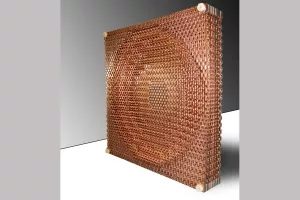

You wouldn’t look at a pile of copper hooks and see a lens. It looks more like something left behind after a hardware store explosion. But at the MIT Media Lab, that chaotic jumble of tiny, S-shaped metal pieces is a masterpiece of engineering. Researchers there built a flat, concave lens out of more than 4,000 of these copper links. Each hook is just a few millimeters wide. They interlock like a chainmail shirt. The result is a slab four centimeters thick and twenty-five centimeters wide that manipulates radio waves.
How does it work? The secret lies in the structure. Metamaterials are not defined by what they are made of, but by how they are arranged. Some use microscopic channels or pillars embedded in silicon chips. Others rely on regular arrays of slits or holes. Think of it as stacking tiny logs in a precise pattern. The geometry and spacing of these elements create exotic refraction effects that natural materials simply cannot achieve.
This specific MIT design has a negative refractive index. That sounds technical, but the real-world implication is massive. It bends and focuses radiation with a power usually reserved for meter-long optical paths. You get that same focusing power in a device you can hold in your hand. It makes micro-waves and radio waves pass through while controlling their trajectory. This isn’t just a curiosity. It changes how we might build antennas, sensors, and imaging devices in the near future.
The Reality of Cloaking Devices
The ultimate dream of metamaterial research is the invisibility cloak. We’ve all seen the movies. The science is catching up, but it is nowhere near Hollywood levels of perfection. Scientists have developed cloaking devices for microwaves and infrared light. Some even work on single bands of visible light. They exist. They are real.
But there is a catch. These devices are bulky and impractical. They are also limited in scale. You can only hide objects that are significantly smaller than the cloak itself. If you try to wrap a car in one, it won’t work.
John Pendry from Imperial College London offers a blunt assessment of the current state of the art. He compares these early cloaks not to Harry Potter’s magical invisibility garment. He compares them to the scales on the dragon in Harry Potter and the Philosopher’s Stone. It’s a fitting analogy. You can hide parts of yourself. You can’t disappear completely. The material disrupts the light or waves around the object, but the effect is localized and often awkward to wear.
Why Structure Matters More Than Substance
The shift from traditional materials to metamaterials represents a fundamental change in how we approach physics. In the past, if you wanted to bend light, you bought glass or crystal. You relied on the chemical properties of silicon or copper. Now, you build the material. You design the unit cell—the repeating pattern—and that pattern dictates the behavior.
This allows for properties that don’t exist in nature. Negative refraction is the most famous example. It allows for super-lenses that can see beyond the diffraction limit. It enables beam steering without moving parts. It creates flat optics that replace bulky curved glass.
The MIT lens demonstrates this potential. By arranging thousands of simple copper hooks in a specific way, they created a device that acts

The Real World Cloak: Berkeley’s Ultra-Thin Metamaterial
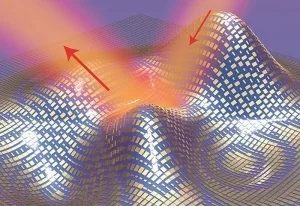
We are getting closer to the fantasy. Not quite the floating, flowing cloak from Hogwarts, but something grounded in hard physics. Researchers at the University of California, Berkeley, made waves in 2015 by introducing a metamaterial that could hide irregularly shaped, relatively large objects. It wasn’t a spell. It was engineering.
The material is startlingly thin. Just 80 nanometers thick. Think of it as a microscopic skin. It doesn’t wrap around things with tension or weight. Instead, it conforms to whatever lies beneath it. This flexibility is key. Rigid camouflage fails when objects have bumps or curves. This “tarn cloth” (as some called it) adapts.
The magic happens on the surface. Tiny gold blocks form a nanostructure there. When light hits them, something specific occurs. The blocks manipulate the incoming waves. They bend the light around the object’s imperfections. To an observer, the uneven surface disappears. The object blends into the background. It’s optical illusion via physics.
But there is a catch. A big one.
Right now, this technology works for only one color. Specifically, red light at 730 nanometers. That’s a narrow slice of the visible spectrum. If you shine green or blue light on it, the cloak fails. The object becomes visible again. The manipulation of light is precise but limited to that specific wavelength.
This limitation explains why we don’t have invisibility cloaks in our closets yet. Creating a material that hides an object across the entire visible spectrum—red, green, blue, and everything in between—is immensely difficult. Light behaves differently at different frequencies. A single nanostructure designed for red might scatter green light chaotically.
So, how long until we see a true Harry Potter-style cloak? Probably longer than you think. The Berkeley discovery proved the concept works for irregular shapes. That’s a huge leap from hiding flat, simple lines. But bridging the gap from monochromatic red to full-color invisibility requires solving complex physics problems we haven’t fully cracked.
The dream of total invisibility remains on the horizon. We have the skin. We have the gold. We have the theory. We just need the material to handle every color of light at once. Until then, the cloak stays in the lab.


