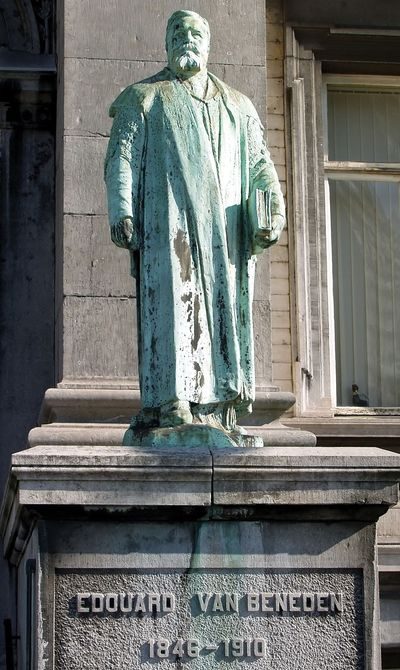
Edouard van Beneden didn’t just study life. He counted it.
Born in Leuven, Belgium, in 1846, he lived through a century of biological upheaval. When he died in Liège in 1910, he left behind a legacy that redefined how we understand reproduction. He wasn’t just an embryologist. He was a cytologist who saw something others missed: the rigid arithmetic of the cell nucleus.
His early education came at the kitchen table, essentially. His father, P.J. van Beneden, was a professor of zoology at the Catholic University in Leuven. The elder van Beneden spent his days staring into microscopes, cataloging protozoans and nematodes. The younger Edouard took that microscope and pointed it at dicyemids. These wormlike organisms were strange. They produced two distinct types of embryos. Edouard tracked their development, laying groundwork that would eventually lead him away from simple taxonomy and toward the mechanics of inheritance.
By 1870, he had secured a faculty position at the University of Liège. His focus shifted to comparative morphology. He wasn’t just drawing shapes. He was testing theories. Specifically, he was looking at tunicates, marine creatures that look like unassuming sacs but are actually chordates. The Russian zoologist Aleksandr O. Kovalevsky had proposed this controversial link. Van Beneden proved it. He did so by dissecting the segmentation of the embryo, showing that tunicates shared a phylogenetic lineage with other animals in a way that was undeniable.
But the real revolution happened later.
In 1883, Van Beneden turned his attention to Ascaris megalocephala. It’s an intestinal worm found in horses. Common enough. Boring to most. To Van Beneden, it was a key.
He published a series of papers that would become foundational texts for anyone studying fertilization and chromosome numbers. His findings were simple, yet they shattered the prevailing confusion about how life begins.
He observed that fertilization isn’t a blending of fluids. It’s a union of nuclei. Two half-nuclei. One male, delivered by the sperm. One female, sitting in the egg. Each carries only half the chromosome count found in the body cells of that species. When they join, you get a cell with the full number. A diploid state restored.
This wasn’t abstract theory. He proved it with a specific subspecies of the horse worm: Ascaris megalocephala univalens.
This subspecies has only two chromosomes in its body cells. Two.
Watching these two distinct entities behave during cell division allowed Van Beneden to see them as individuals. They weren’t just blobs of genetic material. They were discrete units. He demonstrated that the chromosome number is constant for every single body cell of a species. It doesn’t fluctuate. It doesn’t drift. It stays fixed.
This constancy was the missing piece.
Before Van Beneden, the mechanism of heredity was a black box. People knew traits passed down. They didn’t know how. His work on the horse worm provided the concrete details. It showed that the “half” contributed by