


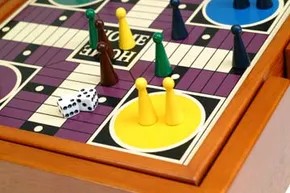
Parcheesi is a race game with a simple objective: get all four of your pawns from your starting home circle to the center of the board before anyone else does. But getting there isn’t just about rolling dice and hoping for the best. There is a rhythm to the movement, specific rules for entering the board, and a handful of quirks that can turn a lead into a loss in seconds.
Here is how the board actually works when it is your turn.
Starting the Game and Entering the Board
The game begins with everyone rolling the dice. The highest roller takes the first turn, and play moves to the left.
When it is your turn, you roll the pair of dice. Your options depend entirely on what you see.
If you roll a five—either on a single die or as the total sum of both dice—you can move a pawn out of your home circle. Pawns enter the game on the safe space directly to the left of your home circle. If you roll double fives, you can move two pawns out to occupy that same safe spot. This is often a strategic move, as it sets up pawns for future movement.
If you do not roll a five and all four of your pawns are still in your home circle, your turn ends immediately. The dice go to the player on your left.
Moving Pawns Around the Track
Once a pawn is on the main track, it moves counterclockwise. You have two choices for how to distribute the movement:
- Move one pawn the total number of spaces shown on both dice combined.
- Move one pawn the number shown on one die and a different pawn the number shown on the other die.
For example, if you roll a three and a four, you can move one pawn seven spaces. Or, you can move one pawn three spaces and another pawn four spaces. If you used a five on one die to bring a pawn onto the board, you can still use the number on the other die to move that same new pawn further along the track.
The Double Doubles Rule
Rolling doubles changes the flow of the game. If you roll doubles, you get to roll again immediately. This can lead to rapid progress across the board.
If you roll doubles when all four of your pawns are already on the board, you get a special bonus. You can use the numbers on the top of the dice and the numbers on the bottom (opposite side). Since opposite sides of a standard die always add up to seven, the two dice provide a total of 14 movement points. You can spread these 14 points across up to all four of your pawns.
There is a catch. If you roll doubles three times in a row, it is bad news. Your turn ends, and one of your pawns is sent back to its home circle. Three in a row isn’t a charm here—it is a penalty.
The Exact Roll to Enter the Home Space
Once a pawn has circled the board, it enters the home row—the center row to the left of the player’s home circle. From there, it must reach the central home space to be fully safe.
This final stretch requires precision. You cannot move into the center space unless you roll the exact number of spaces remaining. If a pawn is four spaces away from the finish and you roll a six, you cannot move it. You must wait for a roll that matches the remaining distance. This rule forces players to plan their earlier moves carefully, as overshooting the finish line leaves them stuck until luck aligns.
Luck or Strategy?
Parcheesi feels like a game of pure chance. The dice determine everything, right? Not entirely. There are mathematical principles at play. Understanding probabilities can help you make better decisions about when to move which pawn, when to risk a double roll, and how to position your pawns to block opponents. It is less about hoping for luck and more about managing the odds.


