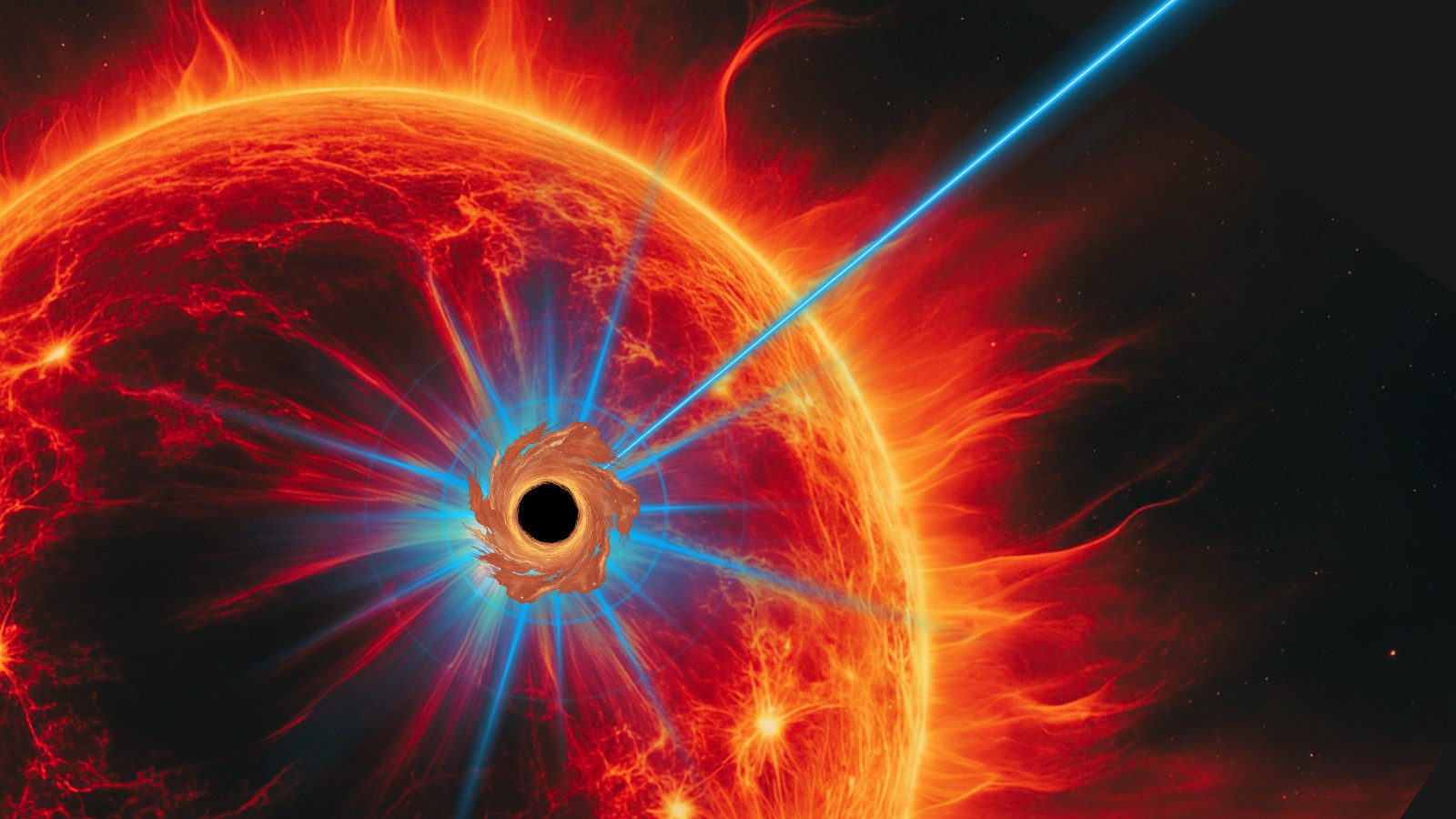
Luminous Fast Blue Optical Transients (LFBOTs) are among the most enigmatic phenomena in modern astronomy. These intense, blue-colored explosions appear suddenly, peak in brightness within days, and fade just as quickly. Since the first detection in 2018, only 14 such events have been recorded, leaving their origins shrouded in mystery.
New research led by Anya Nugent of Harvard University’s Center for Astrophysics (CfA) proposes a definitive answer: LFBOTs are likely caused by the collision between a compact stellar remnant—such as a black hole or neutron star—and a Wolf-Rayet star, one of the hottest and most massive classes of stars in the universe.
Why LFBOTs Defy Standard Models
Astronomers have long struggled to classify LFBOTs because they do not fit neatly into existing categories of cosmic explosions. Two primary theories previously dominated the field:
- Core-Collapse Supernovas: The death of massive stars, which typically occur in dense, massive galaxies.
- Tidal Disruption Events (TDEs): Occurrences where supermassive black holes rip apart passing stars, usually found in galactic centers.
However, observational data contradicts both models. LFBOTs emerge from environments that are neither the dense stellar nurseries typical of supernovas nor the central regions associated with TDEs. Furthermore, their light curves—how their brightness changes over time—are distinctively rapid and consistently blue, indicating extreme temperatures that persist throughout the event.
“Because LFBOTs are so rare and their light-curve properties are so different than many other transients, it is hard to pin down what their progenitors are,” said Nugent. “They obviously represent some unique astrophysical phenomena, but what that could be has remained an open question.”
The Wolf-Rayet Merger Hypothesis
The new model suggests a specific binary star evolution pathway that explains both the nature of the explosion and its location. The process unfolds in several critical stages:
- Binary Formation: It begins with two massive stars in a close orbit.
- Mass Transfer: One star (the “cannibal”) strips away the outer hydrogen envelope of its companion (the “donor”). This leaves the donor as a Wolf-Rayet star —a hot, helium-rich core.
- Supernova and Kick: The cannibal star eventually collapses into a supernova, forming a black hole or neutron star. This violent collapse often imparts a “kick” velocity, pushing the entire binary system away from the dense star-forming region where it was born.
- The Collision: Over hundreds to thousands of years, the compact object spirals inward and merges with the Wolf-Rayet star’s core. This merger releases a massive burst of energy, creating the luminous blue flash observed as an LFBOT.
This model elegantly resolves several observational puzzles. It explains why LFBOTs are found in less massive, star-forming galaxies rather than dense galactic cores. It also accounts for the dense circumstellar material surrounding these events—debris ejected during the earlier mass-stripping phase of the binary system’s life.
Solving the Environmental Paradox
A key advantage of this merger model is its ability to explain the spatial distribution of LFBOTs. Unlike core-collapse supernovas, which are tightly clustered in star-forming regions, LFBOTs are often found offset from their host galaxies’ centers.
Nugent explains that the “kick” received during the initial supernova event propels the binary system into sparser regions of the galaxy. By the time the final merger occurs, the system is isolated, far from its birthplace. This movement distinguishes LFBOTs from TDEs, which are anchored to galactic centers, and standard supernovas, which remain near their stellar nurseries.
Future Discoveries with the Rubin Observatory
While the Wolf-Rayet merger model fits current data well, the sample size of known LFBOTs remains too small for statistical certainty. The next breakthrough is expected from the Vera C. Rubin Observatory, which has begun its decade-long Legacy Survey of Space and Time (LSST).
The Rubin Observatory’s wide-field cameras will detect fainter LFBOTs at greater cosmological distances. This influx of data will allow astronomers to:
* Build a larger population sample for robust statistical analysis.
* Track how the frequency and nature of LFBOTs have evolved over cosmic history.
* Confirm whether the binary merger model holds true across different epochs of the universe.
Conclusion
The hypothesis that LFBOTs result from black holes or neutron stars colliding with Wolf-Rayet stars offers a compelling explanation for their unique speed, color, and location. As next-generation observatories like Rubin come online, these rare cosmic collisions may finally move from mystery to mainstream understanding, revealing new insights into the violent endgames of massive binary star systems.