For decades, neuroscientists debated a fundamental question: Does the human brain begin life as a tabula rasa —a blank slate waiting to be written upon by experience? Or is it pre-wired with inherent structures? A new study published in Nature Communications suggests the answer is neither entirely one nor the other. Instead, the brain’s memory center appears to start as a “full slate” (tabula plena ), densely packed with connections that are later pruned away to create precision.
This finding challenges the traditional view of memory formation and offers a compelling biological explanation for childhood amnesia —the phenomenon where most adults struggle to recall events from their earliest years.
From Chaos to Clarity: The Pruning Process
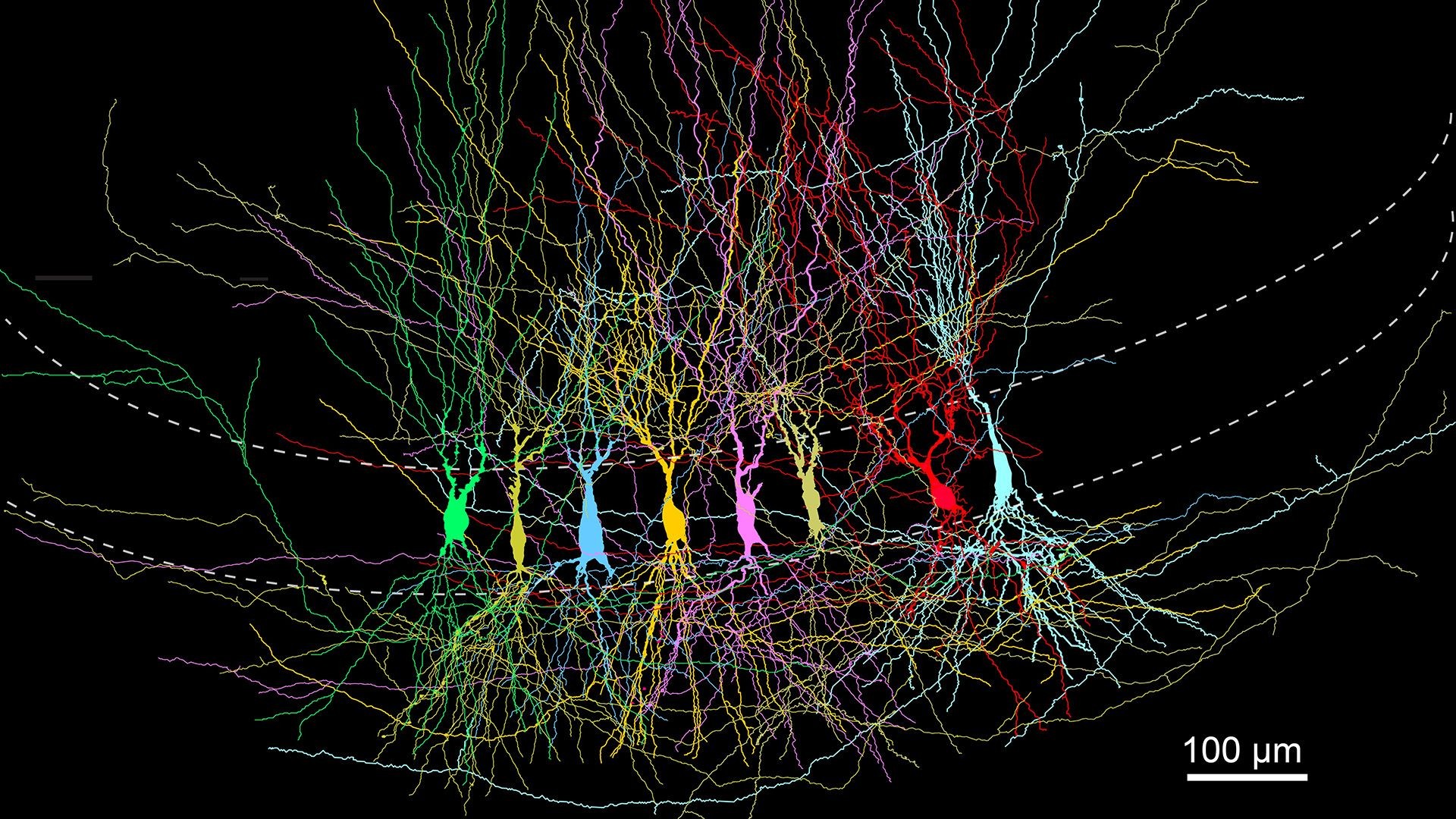
The research, conducted by scientists at the Institute of Science and Technology Austria (IST Austria), focused on the hippocampus, a seahorse-shaped region deep within the brain essential for forming and retrieving memories. Specifically, they examined the CA3 region of the hippocampus, which plays a central role in storing and recalling information.
By analyzing mouse brain tissue at different life stages—shortly after birth, during adolescence, and in adulthood—the team observed a dramatic shift in neural architecture:
- Early Life (The “Full Slate”): Shortly after birth, hippocampal networks are densely wired. Neurons are hyperconnected in what appears to be a random, haphazard pattern.
- Maturation (The Pruning): As the brain develops, these connections are aggressively pruned. By adolescence, the network becomes sparser but significantly more structured.
“We find, in a nutshell, that the system is not a tabula rasa… Rather, it starts out as a tabula plena [full slate] and then becomes more sparser and specifically connected,” explained study co-author Peter Jonas.
Why We Can’t Remember Our Infancy
This structural evolution explains why infant memories are so elusive. The study reveals that the neural mechanisms for storing memories change drastically as the brain matures.
In the young brain, synapses (the connections between neurons) are highly excitable. A single input can cause a neuron to fire. While this sounds efficient, it creates a problem: lack of precision. Because neurons fire too easily, different experiences trigger overlapping patterns of activity. The result is a “noisy” system where distinct memories blur together into broad, indistinct impressions.
In contrast, the mature brain requires multiple inputs to fire a neuron. This selectivity allows for the creation of distinct, separate neural networks. Each memory is stored in a specific, stable pattern, making it easier to retrieve later without confusion.
This biological shift mirrors behavioral observations. Rodent studies show that young animals may learn to fear a location where they received a mild shock, but their fear response is imprecise—they freeze in similar environments, not just the exact spot. Adults, however, freeze only at the precise location. Early memories are not absent; they are too poorly defined to be retained in the long term.
The Evolutionary Advantage of Overconnectivity
If the brain starts with such a chaotic, overconnected network, what is the evolutionary benefit? The researchers suggest that this “full slate” provides a crucial head start for neural communication.
If the brain began as a true blank slate with sparse connections, neurons might struggle to “find” each other to establish initial communication. By starting with an abundance of connections, the brain ensures that the necessary wiring is already in place to link different types of sensory information—sights, sounds, and smells. Experience then acts as a sculptor, refining these rough drafts into precise memories.
A New Understanding of Prenatal Influence
The study also sheds light on the debate regarding prenatal learning. While the findings do not rule out the possibility that experiences before birth leave lasting traces, they suggest these traces may not resemble the detailed, episodic memories we form later in life.
Hauður Freyja Ólafsdóttir, an assistant professor at Radboud University in the Netherlands, noted that these early forms of learning likely rely on different neural systems than mature hippocampal circuits. “They leave a trace, let’s say, in our brain and probably in our psychology even,” she said, but emphasized that these are not the same as the specific memories encoded by the pruned hippocampus.
Conclusion
The brain does not start empty; it starts overconnected. This initial density allows for rapid, albeit imprecise, information processing in infancy. As we age, the brain undergoes a critical pruning process that sacrifices quantity for quality, transforming chaotic noise into the precise, distinct memories that define our adult consciousness. This biological transition explains why our earliest days remain shrouded in mystery—not because we failed to record them, but because the recording medium was not yet refined enough to hold them clearly.