Wood is not just a material. It is a biological engine.
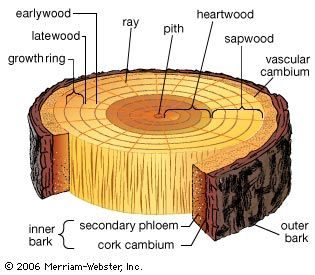
More precisely, it is the hardened remnant of secondary xylem. This tissue accumulates as the vascular cambium pushes outward. It forms a structural backbone for the trunks and roots of trees and shrubs. Think of it as a skeleton that holds the tree up against gravity and wind.
How growth rings make history
Wood accumulates in layers. It surrounds a central core known as the pith. These concentric layers are called growth rings. Each ring represents a year of life.
If you cut through the trunk of a tree, you can see a clear pattern. The center is made of heartwood. It’s darker. The cells here are dead. They no longer transport fluids and no longer support the tree’s metabolism. They are now structural fillers.
This dark core is surrounded by sapwood. The color is lighter. These cells are alive. They actively transfer water and nutrients from the roots to the leaves. This difference between heartwood and sapwood is crucial to understanding the physical properties of wood.
Softwood vs. Hardwood: A Misleading Name
We divide commercial wood into two broad categories.
Coniferous trees produce coniferous wood. This group includes pine, spruce and fir.
deciduous trees produce hardwoods. Typical examples are oak, walnut and maple.
Here’s the catch. “Hardwood” does not mean that the wood is physically hard. It refers to the leaf structure of the tree, not its density. Balsa is a hardwood. It is one of the softest materials you will ever handle. Pine is a softwood. It can be surprisingly dense.
Why Density and Moisture Matter
Not all wood is the same. The strength of a piece of wood depends on two main factors.
- Density
- Moisture content
Higher density usually means higher load capacity. But engineers also test for elasticity. How far can it bend before it breaks? What about toughness? Impact resistance is just as important as static weight.
Wood is also an insulator. It resists heat and electricity. Its internal structure gives it the desired acoustic properties. That is why concert halls are often equipped with wooden panels.
Identifying Characteristics
You can identify wood by several physical characteristics.
– Color
– Odor
– Texture
– Grain direction
The grain is the direction of the wood fibers. It determines how the wood is split, nailed or sanded. It also determines the appearance of the finished product.
Versatile resource
There are about 10,000 different wood products on the market. We use it to make lumber and plywood. We turn it into paper. We use it to make fine furniture. We even make toothpicks.
Chemical processing opens up even more possibilities. From these remains we get:
– Cellophane
– Charcoal
– Dyes
– Explosives
– Lacquers
– Turpentine
And in many parts of the world it is still the main source of fuel.
Unlike coal, ores or oil, wood is renewable.
But that sustainability requires proper care.
If we consume it faster than it grows, the resource collapses. With management, it persists.
Why do we still rely on a