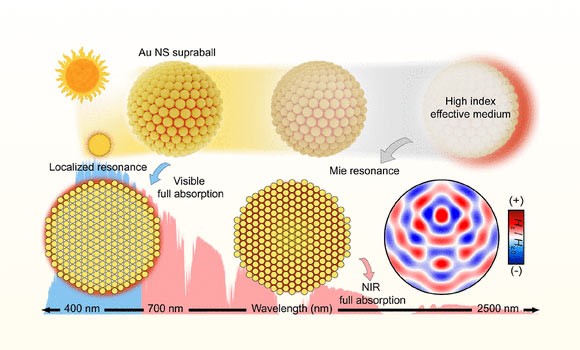
Researchers at Korea University have developed a new nanomaterial design using self-assembling gold nanospheres that significantly improves solar energy absorption. This breakthrough addresses a key challenge in renewable energy: capturing the full spectrum of sunlight, including wavelengths beyond visible light.
The Challenge of Solar Spectrum Absorption
Current solar technologies struggle to efficiently absorb the entire range of solar radiation. While materials like gold and silver nanoparticles show promise, their absorption is typically limited to visible wavelengths. Capturing near-infrared light, which makes up a substantial portion of sunlight, has remained difficult. This is critical because a broader absorption spectrum directly translates to higher energy conversion efficiency.
The Solution: Self-Assembling Gold Supraballs
The Korea University team, led by Seungwoo Lee, tackled this challenge by engineering “supraballs” – clusters of gold nanoparticles that spontaneously assemble into tiny spheres. By carefully adjusting the diameter of these supraballs, they maximized absorption across a wider range of wavelengths.
Simulation and Fabrication
The researchers first used computer simulations to optimize the supraball design, predicting over 90% absorption efficiency. Next, they created a film of these supraballs by drying a liquid solution onto a thermoelectric generator, a device that converts light directly into electricity. Notably, the process doesn’t require specialized cleanroom conditions or extreme temperatures, making it highly scalable.
Performance Results
Testing with an LED solar simulator showed the supraball-coated generator absorbed approximately 89% of sunlight – nearly double the absorption rate (45%) of a similar device using conventional gold nanoparticles.
“Our plasmonic supraballs offer a simple route to harvesting the full solar spectrum,” Dr. Lee explains.
Implications for Renewable Energy
This technology could drastically lower the cost and improve the efficiency of solar-thermal and photothermal systems. The simplicity of fabrication makes it potentially viable for large-scale deployment. The key advantage is that this approach could make high-efficiency solar energy more accessible, accelerating the transition to renewable sources.
The research was published in ACS Applied Materials & Interfaces.
https://doi.org/10.1021/acsami.5c23149
This development represents a significant step toward more effective and affordable solar energy harvesting, potentially unlocking a new generation of renewable technologies.