A new study reveals that shifts in the Gulf Stream—specifically a sudden northward drift—could serve as a critical early warning sign for the potential collapse of major Atlantic Ocean currents, including the Atlantic Meridional Overturning Circulation (AMOC). The AMOC is a vast system responsible for distributing heat across the Northern Hemisphere, and its weakening poses significant climate risks.
The Gulf Stream as a Bellwether
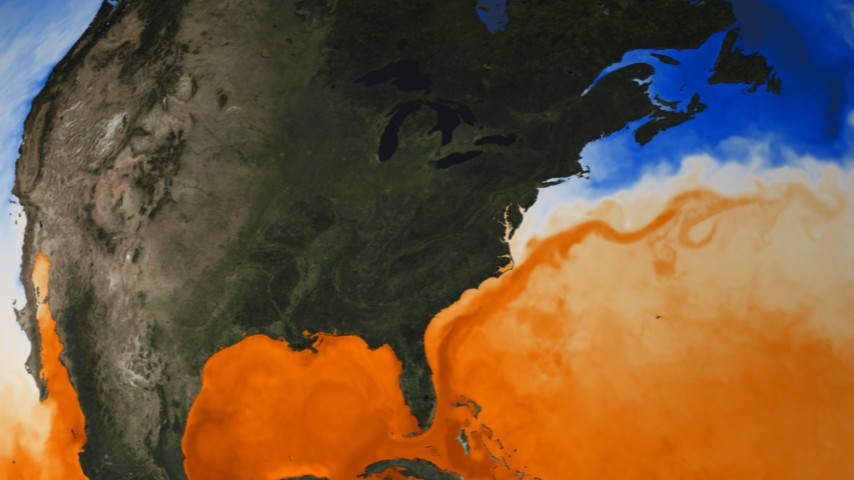
The Gulf Stream, originating in the Gulf of Mexico and flowing along the U.S. East Coast, is uniquely positioned to indicate AMOC instability. Unlike other currents within the AMOC, it is primarily wind-driven. This allows for a clearer signal when the deeper, AMOC-controlled vortices loosen and the Gulf Stream begins to drift northward—a change that precedes a full AMOC collapse by decades.
Researchers simulated an AMOC collapse using high-resolution ocean models, observing an abrupt, 136-mile northward shift in the Gulf Stream just 25 years before the modeled collapse. This suggests the current could act as a natural alarm system, giving scientists advance notice of a potential climate tipping point.
Two-Stage Shift Already Underway
The Gulf Stream’s response unfolds in two stages. First, a gradual northward creep occurs as the AMOC weakens over centuries. Second, a sudden and dramatic jump happens as the AMOC approaches instability. Satellite data confirms that this slow drift is already underway, indicating the AMOC is actively weakening.
While the simulated 25-year lag might be conservative due to real-world accelerating factors like Arctic ice melt and global warming, the discovery still provides a valuable, quantifiable signal. The research highlights that the current shift is not merely coincidental; it is directly linked to the broader AMOC dynamics.
Broader Implications
A northward shift in the Gulf Stream has far-reaching consequences:
– Ocean Ecosystems: Marine life accustomed to colder waters will face rapid warming, potentially disrupting entire food chains.
– Sea Level Rise: The altered current could exacerbate rising sea levels along the U.S. East Coast.
– Climate Disruption: A full AMOC collapse could cause extreme weather shifts in Europe and tropical monsoon regions.
Further research is needed to refine the timing of this warning signal and account for the accelerated pace of climate change. However, the Gulf Stream’s behavior provides a concrete, observable indicator of a system under stress.
The study underscores that the weakening of the AMOC is not a distant threat but an ongoing process, and the Gulf Stream’s drift could be one of the first clear signs that a climate tipping point is approaching.