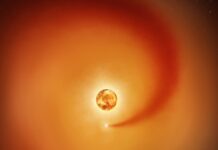
Astronomers using the Hubble Space Telescope have observed an unprecedented cosmic event: a massive young star blasting a jet of hot gas across interstellar space at 2.2 million miles per hour (3.5 million kilometers per hour). This outflow, the fastest ever recorded, extends an astonishing 32 light-years – roughly 8 to 10 times the diameter of our solar system.
The Protostar and Its Outflow
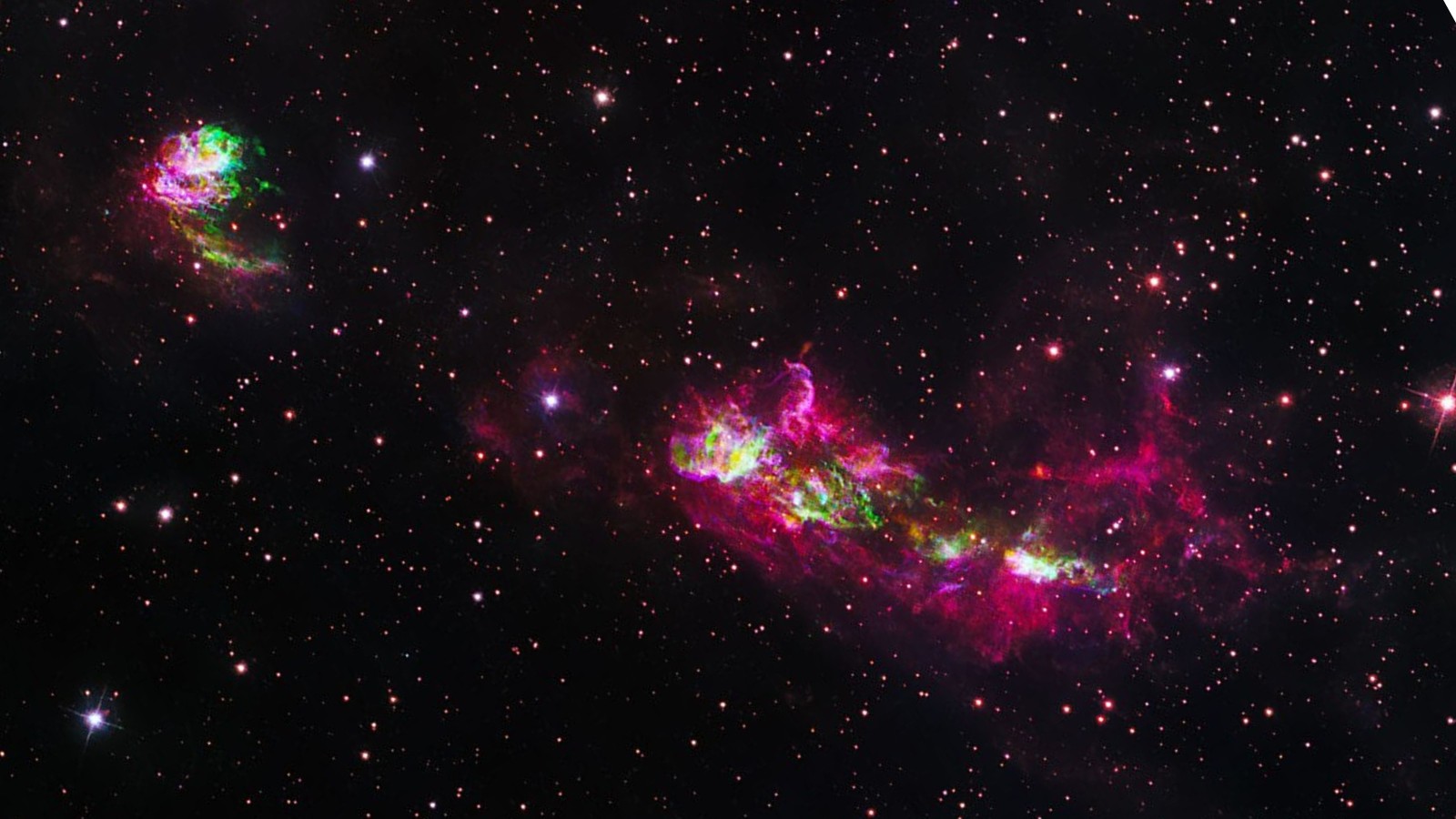
The source of this spectacular eruption is a protostar known as IRAS 18162-2048, residing approximately 5,500 light-years away within the L291 molecular cloud. This protostar is already 20 times more massive than our Sun, making it one of the most energetic stellar nurseries observed to date. The event is visualized through two glowing formations, HH 80 and HH 81, which appear in striking neon green and pink hues in the Hubble image.
How Stellar Jets Form
Protostars don’t consume gas directly; instead, they feed from a swirling disk of material called an accretion disk. As gas and dust spiral inward, powerful magnetic fields channel plasma from this disk to the star’s poles, launching it into space as high-speed jets. This process is messy, much like a human infant feeding, but crucial for stellar development.
Herbig-Haro Objects Explained
The glowing regions, HH 80 and HH 81, are known as Herbig-Haro (HH) objects. They form when these jets collide with previously ejected gas, creating shockwaves that heat the surrounding material to extreme temperatures, resulting in their characteristic bright glow. These objects are not uncommon, but this is the first time one has been observed driven by a massive young star. Previously, such jets were only confirmed from smaller, less energetic protostars.
Hubble’s Role in Discovery
Hubble’s Wide Field Camera 3 was essential in capturing this event. The telescope’s sensitivity and resolution allow astronomers to study even the most minute changes within these cosmic structures. The images of HH 80 and HH 81 have been available since 1995, but the latest data shows why Hubble remains a critical tool for astronomical research, even after three decades of operation.
This observation highlights the dynamic processes in star formation and underscores how much we still have to learn about the early lives of massive stars.
The discovery provides a rare glimpse into the violent yet crucial stages of stellar development, offering insight into how massive stars shape their environments and the wider galaxy.