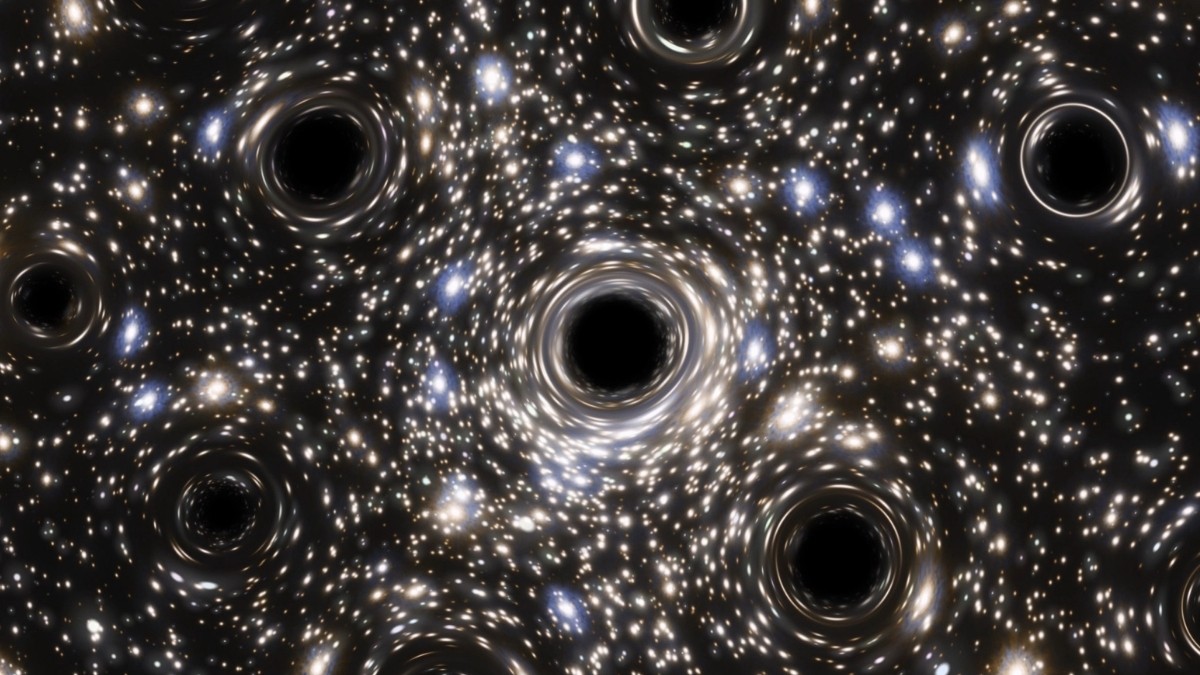
Astronomers have detected a surprisingly dense concentration of black holes—over 100 stellar-mass black holes—traveling within the remnants of an ancient star cluster called Palomar 5. This discovery offers a rare glimpse into the chaotic dynamics of stellar populations and provides evidence that such clusters may ultimately dissolve into streams of black holes orbiting the Milky Way.
The Fossil of a Star Cluster
Palomar 5, a globular cluster located roughly 80,000 light-years from Earth, stretches across 30,000 light-years of space as a tidal stream. Globular clusters like Palomar 5 are among the oldest structures in the galaxy, formed from the same primordial gas clouds as the earliest stars. These dense collections, typically containing hundreds of thousands to millions of stars, act as time capsules of the early universe, providing insights into galactic history and dark matter distribution.
Tracking Stellar Streams with Gaia
For years, identifying the formation of tidal streams—long, trailing rivers of stars—was difficult. However, the European Space Agency’s Gaia observatory has mapped the Milky Way with unprecedented precision, bringing more of these structures to light. Palomar 5 is unique because it is both a wide, loose star distribution and a long tidal stream spanning over 20 degrees of the sky. This makes it a crucial case study for understanding how star streams form.
The Role of Black Holes in Cluster Disruption
Using detailed computer simulations, researchers found that the observed configuration of Palomar 5 could only be explained by the presence of a disproportionately high number of black holes. The gravitational interactions between stars and black holes would have ejected stars into the tidal stream, but only with an abundance of black holes far exceeding previous estimates.
The simulations suggest that over 20% of Palomar 5’s total mass is composed of black holes, each roughly 20 times the mass of our Sun. This higher-than-expected concentration implies that the cluster will dissolve completely within a billion years, leaving behind only a swarm of black holes orbiting the galactic center.
Implications for Black Hole Mergers
This discovery has significant implications for understanding binary black hole mergers, which are believed to occur frequently in star clusters. The method used to estimate the number of black holes in Palomar 5—by tracking the stars they eject—provides a new way to constrain black hole populations in other clusters.
“A big unknown in this scenario is how many black holes there are in clusters… Our method gives us a way to learn how many black holes there are in a star cluster by looking at the stars they eject.” – Fabio Antonini, Cardiff University
The findings also suggest that other globular clusters will likely follow a similar fate, eventually dissolving into streams of black holes. This reinforces the idea that such clusters are excellent places to search for both black hole collisions and intermediate-mass black holes, bridging the gap between stellar-mass and supermassive black holes.
The research, published in Nature Astronomy, confirms that the universe is full of surprises, even within the remnants of ancient star clusters.