For the first time in history, researchers have successfully measured the pressure exerted by a single particle. This breakthrough, achieved by a team at Yale University, utilizes a microscopic silica sphere suspended by a laser beam to detect individual atomic collisions. The implications are profound: this ultra-sensitive technology could redefine how we understand extreme vacuums, probe the empty spaces between stars, and potentially hunt for elusive dark matter particles.
The Mechanics of Microscopic Pressure
Traditionally, pressure is understood as a macroscopic phenomenon—an average force resulting from billions of particles striking a surface simultaneously. In everyday conditions, tracking individual particles is unnecessary; the collective “average” is sufficient. However, in environments with extremely low pressure, such as high-grade vacuums, the statistical average breaks down. To understand the physics in these regimes, scientists must account for every single collision.
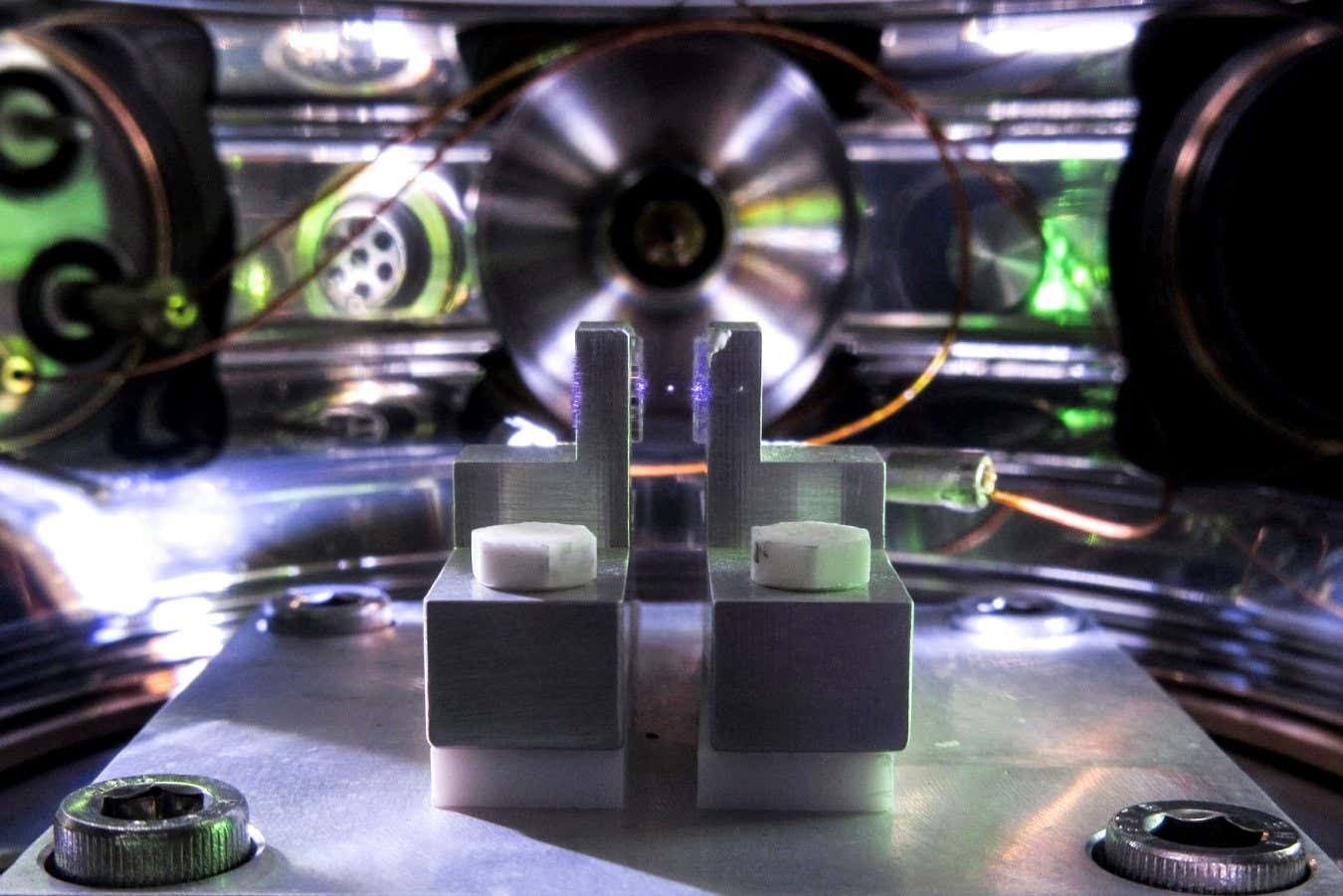
Yu-Han Tseng and his colleagues at Yale engineered a device capable of this granular observation. The core of their instrument is a silica sphere, roughly half the size of a typical virus. This sphere is held in place by a laser beam, a technique known as optical trapping, which uses electromagnetic interactions to suspend the particle in mid-air.
When a gas particle strikes the sphere, it causes a minute displacement. This movement alters the way light reflects off the sphere, a change the researchers can detect with high precision. By analyzing these optical shifts, the team can calculate the force of individual impacts.
Validating the Instrument
To prove the device’s accuracy, the team conducted rigorous tests in an ultra-high vacuum chamber. They systematically introduced particles from three different gases and monitored the sphere’s motion upon impact.
The results were striking. The pressure calculated from individual particle collisions matched mathematical predictions with remarkable agreement. As Tseng noted, the success relied on meticulous calibration: “You need to get everything right to get this measurement working… When we did everything carefully enough, the measurement turned out to be beautiful.”
This validation confirms that the device is not just sensitive, but accurate, capturing real-time data that was previously invisible to standard sensors.
Why This Matters: Beyond the Lab
The ability to count individual collisions opens several new avenues for scientific inquiry:
- Redefining Vacuum Standards: Current pressure sensors often read zero in extreme vacuums, lacking the sensitivity to detect residual particles. Clarke Hardy of Yale suggests this device could establish a new definition for high vacuum by simply counting collisions, providing a precise estimate of pressure where traditional tools fail.
- Astronomical Insights: Animesh Datta from the University of Warwick points out that similar technologies could help astronomers map the low-pressure regions between stars. By detecting sparse gas particles that evade other sensors, scientists could gain a better understanding of the interstellar medium.
- The Hunt for Dark Matter: Perhaps the most ambitious application is in particle physics. The team aims to use this detector to search for sterile neutrinos —hypothetical particles that do not interact via the weak nuclear force. These particles are prime candidates for explaining dark matter and resolving long-standing anomalies in particle physics experiments.
A New Window into Reality
“Individual molecular collisions are rarely observed in real time. Traditionally, their effects are only seen on average, like how a fast-moving object appears blurred in a long-exposure photograph,” explains Joseph Kelly of King’s College London.
This new technology effectively stops the blur, allowing scientists to see the individual “frames” of molecular motion. By shifting from average measurements to single-particle detection, researchers have moved from observing the crowd to identifying the individual.
In summary, this breakthrough transforms our ability to measure the physical world at its most fundamental level. By capturing the impact of single particles, scientists have not only refined vacuum technology but also equipped themselves with a powerful new tool to explore the mysteries of dark matter and the cosmos.