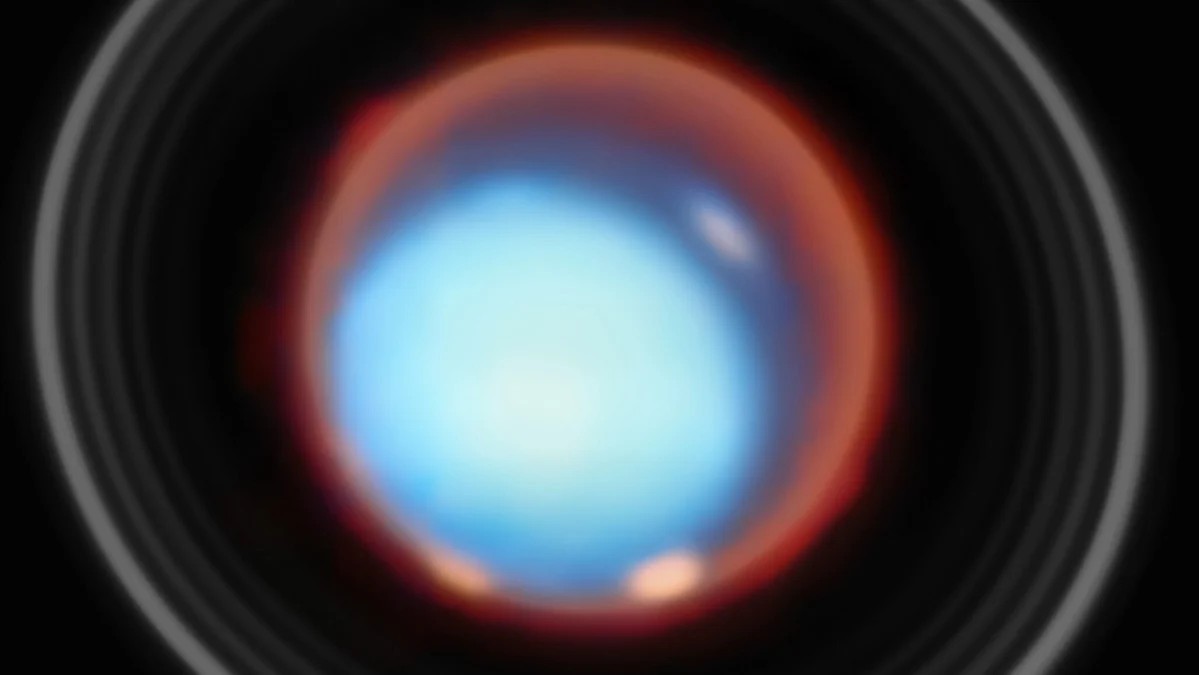
New observations from the James Webb Space Telescope (JWST) have provided the most detailed mapping yet of Uranus’ upper atmosphere, revealing a surprisingly uneven and cooler ionosphere than previously understood. This breakthrough, published in Geophysical Research Letters, offers unprecedented insight into the ice giant’s bizarre auroral formations and the influence of its highly tilted magnetic field.
Mapping Uranus’ Invisible Layer
For decades, scientists have relied on indirect measurements to estimate conditions in Uranus’ upper atmosphere. The JWST’s infrared observations have now enabled a three-dimensional scan of the planet’s ionosphere, tracking the faint glow of trihydrogen cations – charged molecules formed by sunlight and cosmic particles interacting with the atmosphere. This glow varies with temperature and density, acting as a natural tracer for atmospheric structure.
Unexpected Findings
The data reveals that Uranus’ upper atmosphere is weaker than earlier models predicted. Furthermore, the temperature is unexpectedly low, and appears to be continuing to decline—a trend observed over the past three decades. This cooling effect is significant because atmospheric temperatures influence how energy flows through the planet.
The Role of Uranus’ Unique Magnetic Field
Uranus spins on its side, creating extreme seasonal shifts where each pole faces the sun for 21-year periods. This odd rotation also results in a lopsided magnetic field, unlike any other in our solar system. The JWST observations detected bright auroral bands near the poles, similar to those seen on Jupiter, but also revealed patches of varying charged activity due to the planet’s complex magnetic geometry.
“Uranus’ magnetosphere is one of the strangest in the Solar System… It’s tilted and offset from the planet’s rotation axis, which means its auroras sweep across the surface in complex ways.”
– Paola Tiranti, Northumbria University
Implications for Exoplanet Research
Understanding Uranus’ atmosphere isn’t just about this distant world; it offers a vital benchmark for studying exoplanets. With thousands of gas giants discovered around other stars, knowing how energy, temperature, and charged particles behave in a similar planetary environment will improve our ability to interpret observations of these distant worlds. The JWST’s new data provides a real-world template for understanding the atmospheric dynamics of ice giants elsewhere in the galaxy.
These observations mark a shift in our understanding of Uranus, moving it from a featureless blue sphere to a dynamic planet with complex atmospheric processes. The ongoing data analysis will continue to refine our understanding of this unique world and its place in the broader context of planetary science.