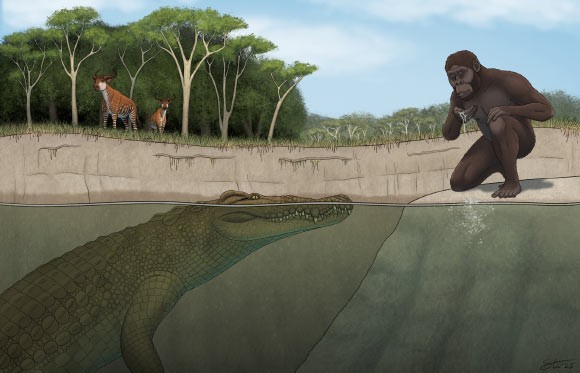
A newly identified fossil crocodile species, Crocodylus lucivenator, once patrolled the same Ethiopian wetlands as the famous hominid Australopithecus afarensis – the species best known from the “Lucy” fossil. This massive predator, which lived between 3.4 and 3 million years ago, weighed up to 1,300 pounds and stretched 15 feet long. It was the apex predator of its time, and likely posed a direct threat to early human ancestors.
A Formidable Predator
Crocodylus lucivenator was an ambush hunter, lying in wait beneath the water to strike at unsuspecting prey coming to drink. Professor Christopher Brochu of the University of Iowa stated bluntly: “It was the largest predator in that ecosystem… and the biggest threat to our ancestors who lived there.” The fossil record confirms that this crocodile would have hunted Australopithecus afarensis, including the individuals represented by the “Lucy” remains.
The species is identified from an extensive collection of 121 fossils – skulls, teeth, and jaw fragments – discovered in Ethiopia’s Hadar Formation. One lower jaw shows healed injuries, likely from a violent clash with another crocodile. Paleontologist Dr. Stephanie Drumheller notes that such face-biting behavior is common throughout the crocodile family tree, suggesting this ancient species was aggressive even toward its own kind.
A Unique Evolutionary Mix
Crocodylus lucivenator combines traits from several extinct East African crocodiles, including some features seen in more recent species. Notably, it possessed a distinctive raised ridge along its snout, also found in modern Neotropical crocodiles and species from Libya and Kenya. Researchers believe this ancient crocodile lineage was unique to East Africa, forming a distinct branch on the evolutionary tree.
Interestingly, while the Hadar Formation appears to have hosted only Crocodylus lucivenator during the Pliocene, nearby sites in the Turkana Basin contained up to four crocodile species at the same time. The reason for this difference in biodiversity remains unclear, though variations in habitat may play a role. The Hadar environment consisted of woodlands, grasslands, and shrublands alongside its lakes and rivers.
Why This Matters
The discovery of Crocodylus lucivenator provides a more complete picture of the prehistoric environment in which early hominids evolved. It highlights the dangers early humans faced – not just from other mammals, but from massive reptiles actively hunting them. Understanding these pressures helps us reconstruct the selective forces that shaped our ancestors. The fossil record demonstrates that survival in the Pliocene was brutal, and even Australopithecus afarensis was vulnerable to predation.
The research, published in the Journal of Systematic Palaeontology, confirms that Crocodylus lucivenator was one of the few species capable of thriving in this dynamic environment. Its survival through changing habitats underscores its adaptability and dominance in the ancient African landscape.