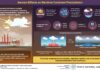
NASA’s Parker Solar Probe has provided unprecedented visual evidence of the sun’s ability to recycle its own material – specifically, solar wind that erupts outward, then falls back in. This isn’t just a curious phenomenon; it’s a fundamental part of how the sun regulates its energy and how space weather unfolds.
How the Sun’s Recycling Works
The probe captured footage during its closest approach to the sun on Christmas Eve 2024, just 3.8 million miles from the surface. The video shows a coronal mass ejection (CME) – a burst of superheated plasma – expanding away from the star. Crucially, some of this material doesn’t simply dissipate. Instead, it curves back toward the sun, pulled by powerful magnetic field lines.
The effect is similar to snapping an overstretched rubber band; the magnetic lines break and then reconnect, forming loops that either continue into space or retract, dragging solar material with them. This process of “inflows” has been theorized, but this is the clearest direct observation yet.
Why This Matters: Space Weather Prediction
The sun’s recycling process isn’t just interesting; it’s vital for understanding and potentially predicting space weather. CMEs, when directed at Earth, can disrupt power grids, communications, and satellite navigation. The way material falls back into the sun reshapes its magnetic fields, influencing the trajectory of future eruptions.
According to Angelos Vourlidas, project scientist for the WISPR instrument on Parker:
“That’s enough to be the difference between a CME crashing into Mars versus sweeping by the planet with no or little effects.”
Closer Look, Better Data
Previous missions (like SOHO) have observed inflows from a distance. However, Parker’s close proximity allowed scientists to measure the speed and size of the returning material with unprecedented accuracy. This data is now being used to refine existing models of the sun’s magnetic environment.
The ultimate goal is to improve long-term space weather forecasting. By understanding how the sun recycles its energy, scientists hope to better anticipate the impact of solar events across the solar system.
In conclusion: Parker Solar Probe’s observations confirm that the sun isn’t just an energy producer – it’s a closed-loop system. This recycling process is essential for understanding space weather, and the new data brings us closer to predicting solar storms with greater precision.