In his youth, Albert Einstein famously imagined chasing a beam of light—a thought experiment that eventually birthed the theory of special relativity. In her new book, Radio Universe: How to explore space without leaving Earth , physicist Emma Chapman pursues a different kind of light. Rather than trying to outrun it, she uses radio waves as a guide, a messenger, and a lens to peer into the deepest reaches of the cosmos.
The Power of the Invisible Spectrum
To understand the significance of Chapman’s work, one must understand the nature of light. While we perceive a narrow band of “visible light,” the electromagnetic spectrum is vast. Radio waves sit at the opposite extreme from ultraviolet light; their wavelengths are massive, sometimes stretching several meters between peaks.
This physical characteristic gives radio astronomy a unique advantage:
– Unmatched Range: Because radio waves are so long, they can travel much greater distances than visible light, allowing us to probe the early universe.
– All-Weather Observation: Unlike optical telescopes, which are limited by darkness and weather, radio telescopes can operate day or night.
– Piercing the Veil: Radio waves can penetrate environments that are opaque to visible light, such as the thick, inhospitable clouds of Venus.
Chapman structures her exploration through a cosmic journey, moving from Our Solar System to Our Galaxy, and finally to Our Universe. She highlights how radio waves were our first “touch” of the moon and how they remain our best tool for detecting black holes, gravitational waves, and the elusive presence of dark matter.
A Cosmic Conversation
One of the book’s most compelling themes is the idea that the universe is far from silent. Chapman posits that if we ever encounter extraterrestrial intelligence, it will likely be through radio signals rather than physical visitation.
“Whether that planet has a yellow-green sky, whether it has five moons, or its people five legs, radio waves will be the form of light that will be used for long-distance communication.”
This perspective transforms the vacuum of space from a void into a bustling medium of information. By “listening” to the radiation from interstellar hydrogen or the echoes of ancient stars, astronomers can map the invisible scaffolding of the universe.
Critical Perspectives: Space Ethics and Representation
While Chapman’s writing is praised for being accessible and joyous—reading more like a conversation with a brilliant friend than a dry lecture—the book is not without its omissions.
The reviewer notes two significant areas where the narrative falls short:
1. The Ethics of Space Colonization: Chapman discusses the “second space age” driven by tech billionaires but offers little critique of the commercialization of the moon and Mars. The book leaves unexamined whether scientific exploration can coexist with the profit-driven motives of private entities.
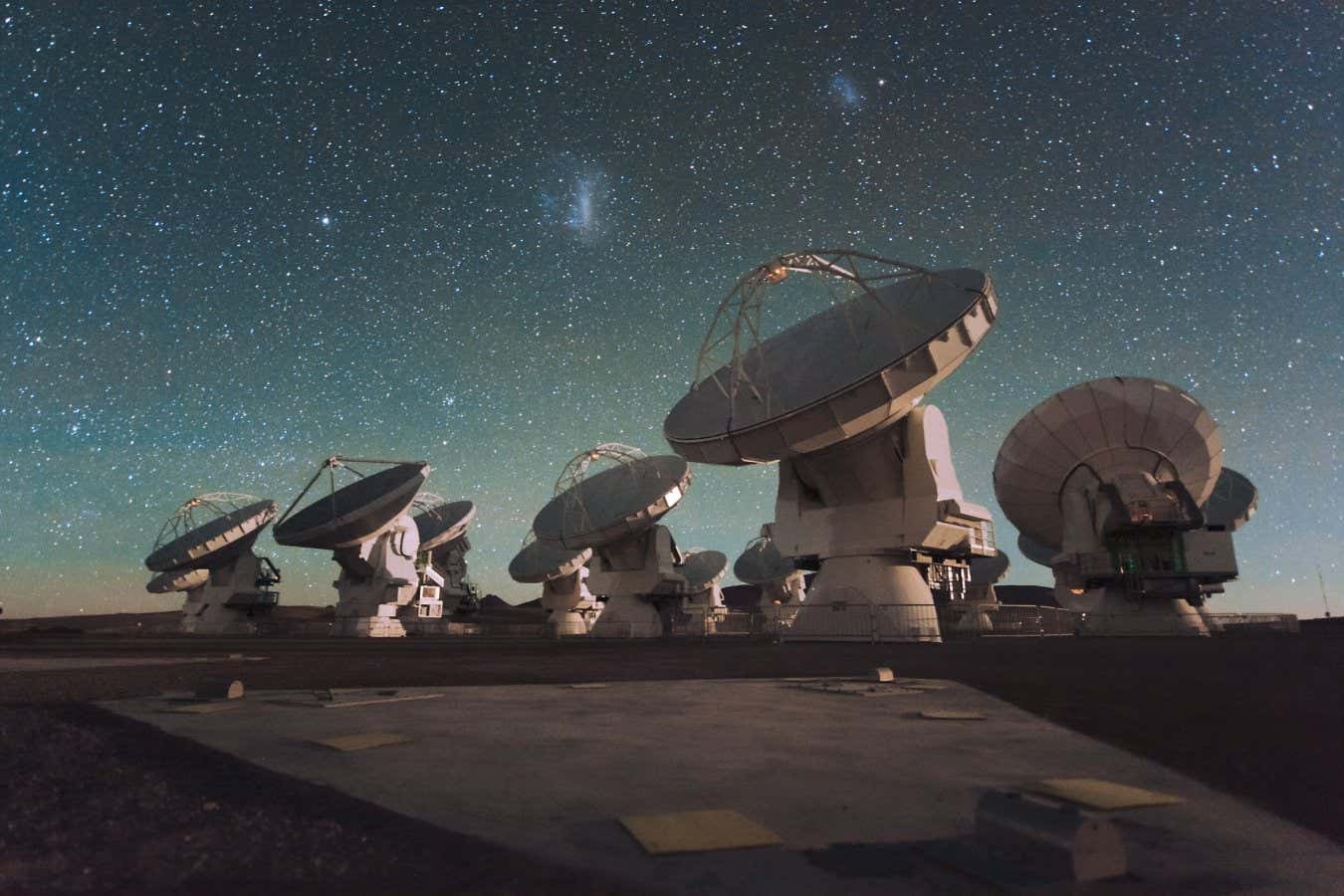
2. Geopolitical Representation: While the book highlights many Western astronomers, it provides less depth regarding the vital contributions of researchers in the Global South, specifically noting the importance of observatories in places like Chile and Puerto Rico.
Beyond the Radio: Further Reading
For those looking to deepen their understanding of physics through different lenses, two other recent releases offer vital context:
- “Fear of a Black Universe” by Stephon Alexander: A unique blend of cosmology and personal narrative, where mathematical theory intersects with the lived experience of a Black man and the inspiration of jazz and Zen Buddhism.
- “The Disordered Cosmos” by Chanda Prescod-Weinstein: A rigorous look at dark matter that explicitly connects scientific discovery to the sociopolitical structures—such as land rights and consent—that dictate where and how we build our telescopes.
Conclusion
Emma Chapman’s Radio Universe serves as a brilliant, inviting gateway into the world of radio astronomy, reminding us that the universe is constantly speaking; we simply need to learn how to listen.