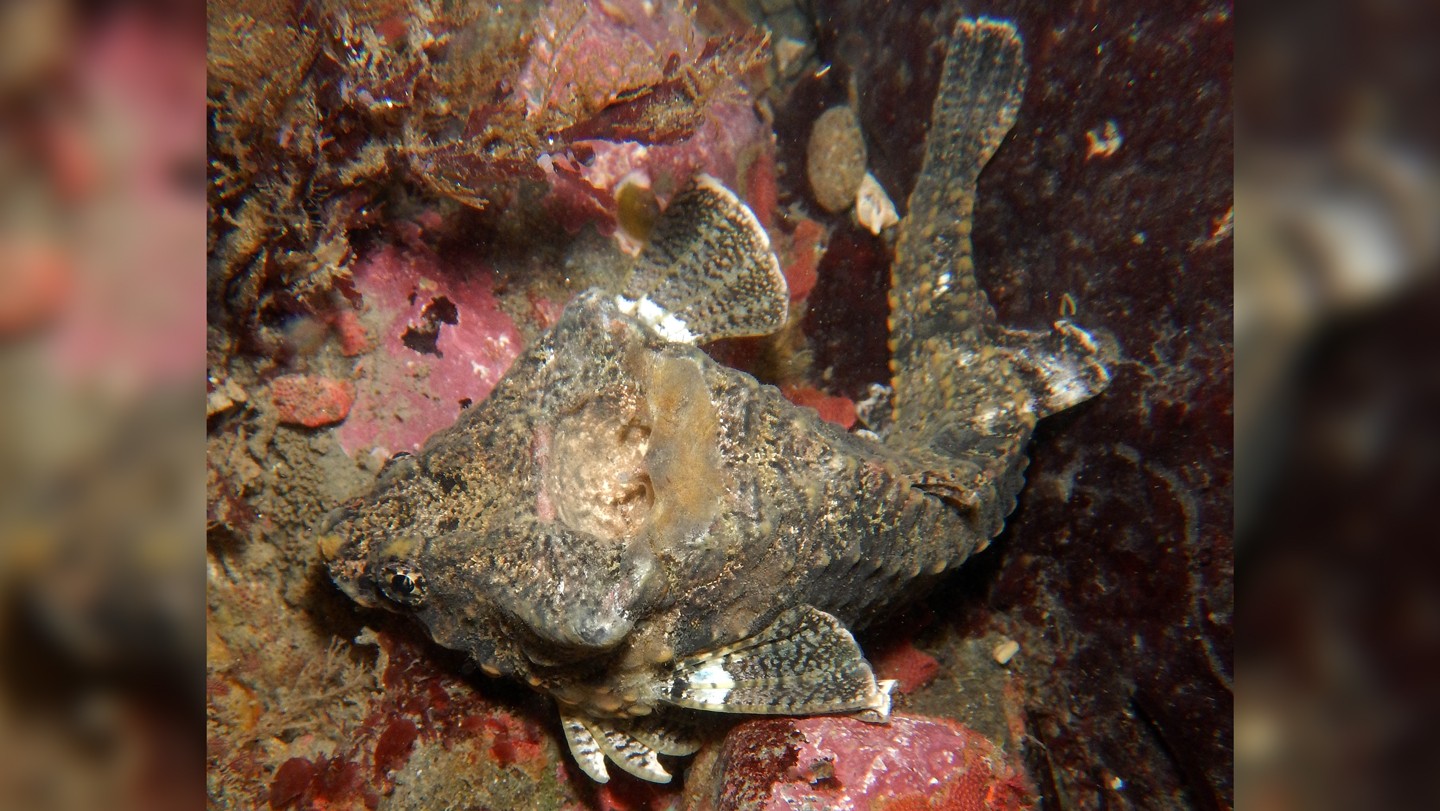
The rockhead poacher, a small but peculiar fish found along the Pacific coast from Alaska to California, possesses a unique anatomical feature: a deep pit in its head that functions like a natural drum. Recent research reveals this isn’t just a random cavity; specialized ribs inside are adapted to strike the underside, producing vibrations possibly used for communication in noisy environments.
A Mysterious Skull Feature Finally Explained
For years, scientists puzzled over the large, brain-sized pit atop the rockhead poacher’s head. Was it for sensing prey, amplifying sound, or something else entirely? Functional morphologist Daniel Geldof and his team at Louisiana State University used X-ray scans to solve the mystery. The scans revealed that flattened, mobile ribs connected to powerful muscles are positioned to strike the pit’s underside, creating vibrations.
“This fish basically has a tiny drum kit or maraca in its head,” Geldof explains. “You can feel them vocalizing; it feels like holding a vibrating cell phone.”
Why a Drum in the Head?
The rockhead poacher lives in turbulent, shallow waters where sound travels poorly. The fish likely evolved this stridulation mechanism – striking body parts together to create noise – to overcome the acoustic challenges of its environment. This drumming could be used for calling mates, warning rivals, or startling predators. While other fish stridulate, the rockhead poacher takes this to an extreme, seemingly specializing in surface-borne vibrations.
Skepticism and Further Research
Not everyone agrees on the exact mechanism. Ecomorphologist Eric Parmentier suggests the pit may amplify existing sounds rather than actively generating them. The predicted frequency of the vibrations is also debated.
Currently, no underwater recordings confirm how the fish actually uses this drumming mechanism. Future experiments and observations are needed to verify how this strange quirk evolved and exactly how the poacher communicates in the noisy shallows it calls home.
This discovery adds to growing evidence that fish may rely heavily on vibrations transmitted through surfaces. Just as scientists study bird songs, understanding fish communication requires investigating their unique sound-producing methods, even those as bizarre as a built-in drum kit.