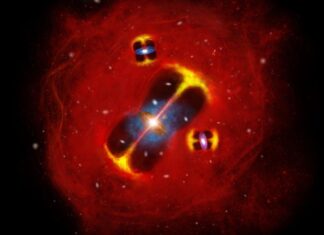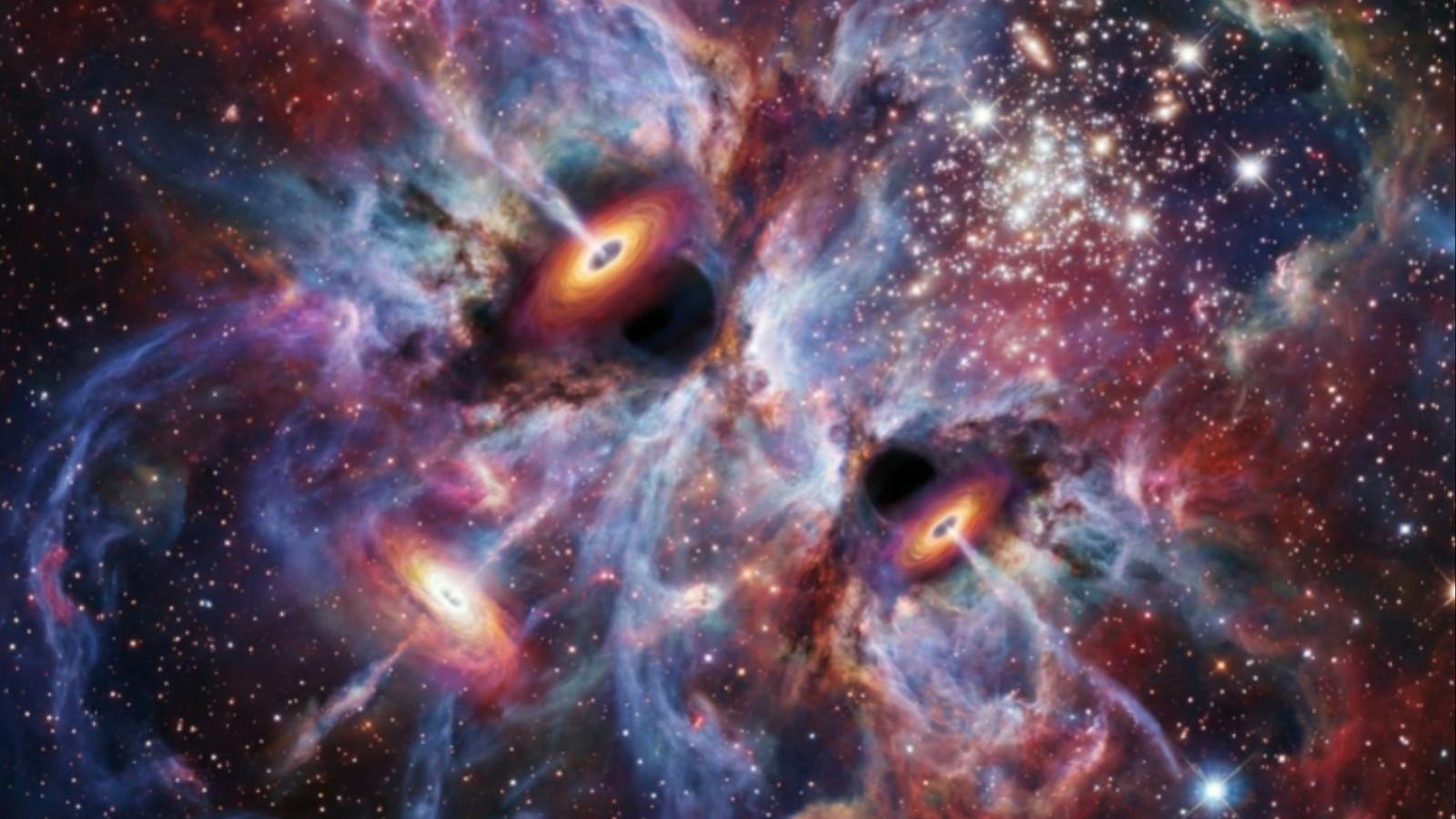
Recent research suggests a solution to a long-standing cosmic mystery: the unexpectedly rapid formation of supermassive black holes in the early universe. Data from the James Webb Space Telescope (JWST) revealed these behemoths existing as early as 500 million years after the Big Bang—far sooner than current cosmological models predict. A new study proposes that these black holes grew explosively through periods of “super-Eddington accretion,” essentially a cosmic feeding frenzy.
The Problem with Early Black Holes
The standard model of black hole formation suggests they grow over billions of years through mergers and gradual accretion of matter. However, JWST observations showed supermassive black holes existing when the universe was only a fraction of its current age, making their development time frame impossible under conventional theory. This discrepancy—the existence of massive black holes too early in cosmic history—demanded a new explanation.
The Solution: Super-Eddington Accretion
Researchers at Maynooth University used advanced computer simulations to demonstrate how early black holes could bypass the usual growth limits. The early universe was characterized by chaotic, dense gas clouds. Under these conditions, smaller black holes could briefly exceed the “Eddington limit”—the maximum rate at which a black hole can consume matter without radiation pressure halting the inflow.
“We revealed, using state-of-the-art computer simulations, that the first generation of black holes… grew incredibly fast, into tens of thousands of times the size of our sun.” – Daxal Mehta, Maynooth University.
This rapid growth, termed “super-Eddington accretion,” allowed early black holes to quickly accumulate mass, reaching sizes of tens of thousands of solar masses. While not yet supermassive, this provides a crucial head start for later mergers that would ultimately form the galactic-center giants we observe today.
Implications for Black Hole Seed Models
Previously, the prevailing hypothesis suggested that only “heavy seeds”—black holes born with already-significant mass—could grow fast enough to explain the JWST data. This new research suggests that even standard stellar-mass black holes, given the right conditions, can grow rapidly enough to jumpstart the supermassive black hole formation process.
The Future of Research
Verifying this theory will require new observational tools. Gravitational wave detectors, such as the upcoming Laser Interferometer Space Antenna (LISA), may be able to detect the mergers of these rapidly growing early black holes, providing direct evidence of the proposed feeding frenzy.
In conclusion, the discovery that early black holes could grow at extreme rates in the chaotic conditions of the young universe offers a compelling explanation for their unexpected presence. This research not only sheds light on the formation of supermassive black holes but also highlights the importance of high-resolution simulations in unraveling the mysteries of the early cosmos.