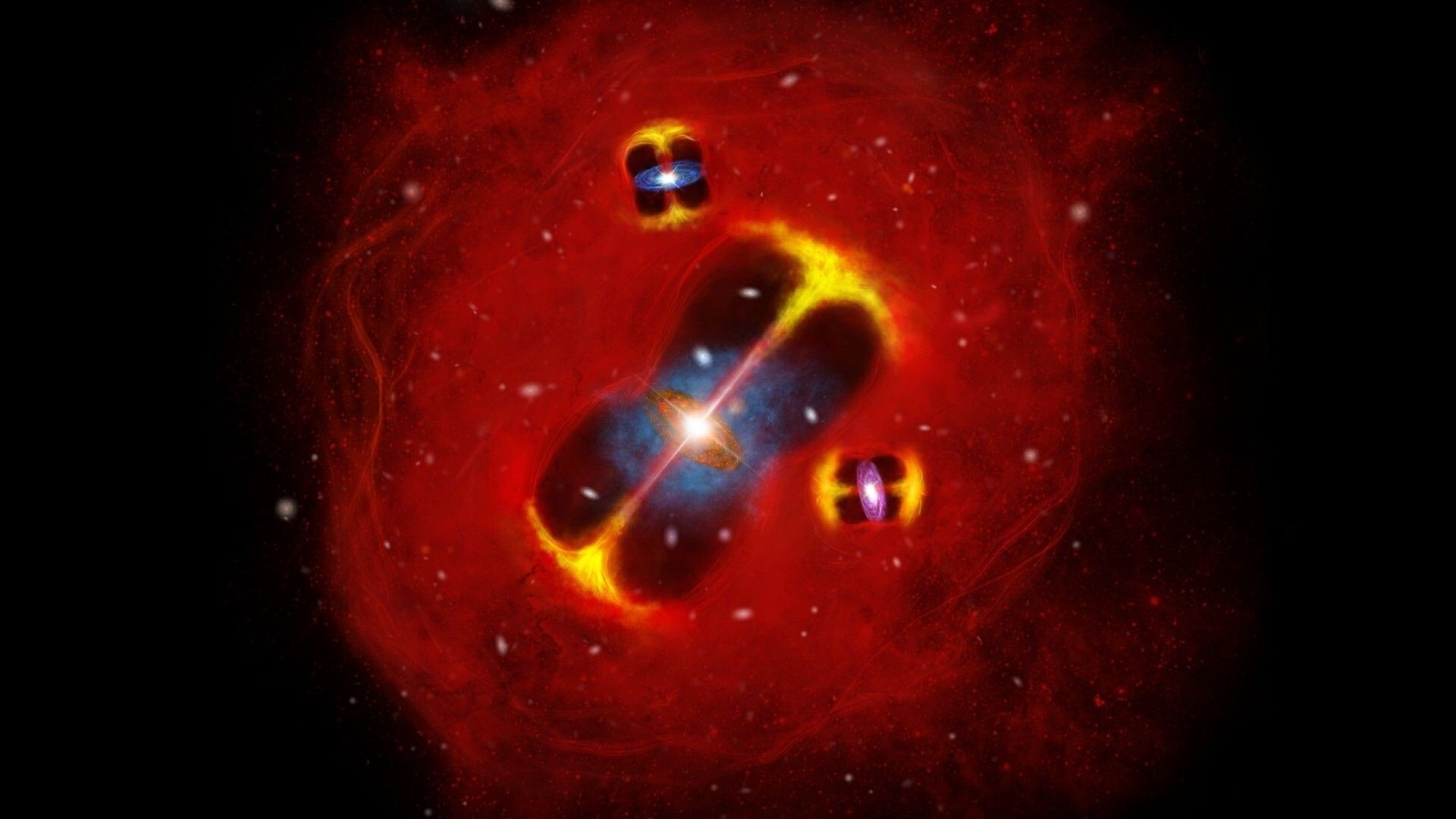
Astronomers have discovered an exceptionally hot and dense galaxy cluster, SPT2349-56, that formed just 1.4 billion years after the Big Bang. This finding challenges current models of galaxy cluster evolution, suggesting that these structures can develop far more rapidly than previously thought. The cluster contains over 30 galaxies packed into a relatively small space – about 500,000 light-years across – and boasts an unusually high temperature for its age.
Unexpectedly Rapid Heating
The key anomaly lies in the extreme heat of the intracluster medium – the hot gas filling the space between galaxies within the cluster. Scientists expected this gas to take billions of years to reach temperatures observed in mature clusters, often tens or hundreds of millions of degrees Celsius. However, SPT2349-56’s intracluster medium is at least five times hotter than predicted, indicating that the heating process occurred far faster than expected.
This heating is likely driven by supermassive black holes residing within the cluster’s galaxies, which pump energy into their surroundings. The discovery implies that these black holes were already highly active and influential in shaping the cluster’s evolution much earlier in cosmic history. The cluster’s temperature was measured using the Sunyaev–Zeldovich effect, which detects the energy boost given to leftover heat from the Big Bang (CMB radiation) when it interacts with the hot gas.
A Shift in Understanding Cluster Formation
Other early galaxy clusters have been found, such as z660D (discovered in 2019) and A2744z7p9OD (identified by JWST in 2023), but these were classified as protoclusters. Protoclusters are not yet fully gravitationally bound, meaning they haven’t settled into a stable state. Current models predict that it takes billions of years for protoclusters to collapse and heat up their intracluster medium to the temperatures seen in mature clusters. SPT2349-56 defies this expectation, suggesting that our understanding of cluster formation is incomplete.
Hyperactive Star Formation Fuels Growth
The cluster’s galaxies are forming stars at an astonishing rate – five thousand times faster than the Milky Way. This intense star formation, coupled with the active black holes and overheated atmosphere, creates a unique environment that challenges existing theories. The compact size of SPT2349-56 (roughly the same size as the Milky Way’s dark matter halo) suggests that the galaxies within it will continue to grow rapidly.
“We want to figure out how the intense star formation, the active black holes and this overheated atmosphere interact, and what it tells us about how present galaxy clusters were built,” stated Zhou.
The discovery raises critical questions about the interplay between star formation, black hole activity, and the rapid heating of the intracluster medium in the early universe. Further research into SPT2349-56 and similar systems could rewrite our understanding of how galaxy clusters form and evolve.