


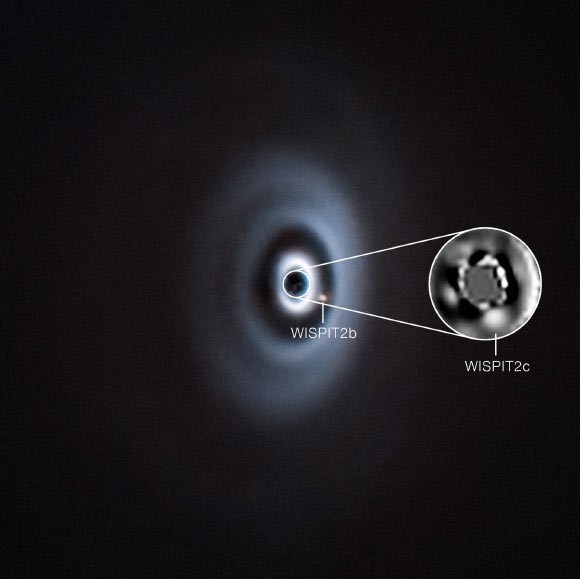
Astronomers have directly observed two gas giants taking shape within the dusty disk surrounding the young star WISPIT 2, providing an unprecedented look at planetary system formation. The discovery, made using the European Southern Observatory’s Very Large Telescope (VLT) and its Interferometer (VLTI) in Chile, offers critical insight into how planets arise from swirling clouds of gas and dust.
A Developing Planetary System
The WISPIT 2 system exhibits clear gaps and ring-like structures in its surrounding disk, strong evidence that multiple planets are actively assembling there. These features aren’t just visual curiosities; they reveal the very process of planet formation. Gas and dust coalesce under gravity, gradually accreting material until a protoplanet emerges, leaving behind distinctive gaps and rings in the disk.
The first protoplanet, WISPIT 2b, was identified last year. It’s a behemoth, roughly five times the mass of Jupiter, orbiting the star at a distance of 60 times the Earth-Sun gap. The newly confirmed planet, WISPIT 2c, is even closer – four times nearer to the star – and twice as massive as its sibling. Both are gas giants, similar in composition to Jupiter and Saturn in our own Solar System.
Unprecedented Observational Capabilities
The ability to directly observe these forming planets is a breakthrough in astronomy. The recent upgrade to the GRAVITY+ instrument on the VLTI was crucial for detecting WISPIT 2c so close to its star. The SPHERE instrument on the VLT also played a key role in confirming the planet’s existence.
“WISPIT 2 is the best look into our own past that we have to date,” stated Chloe Lawlor, a Ph.D. student at the University of Galway, highlighting the system’s importance as a natural laboratory for understanding how planetary systems evolve.
Potential for More Worlds
Beyond the two confirmed planets, astronomers suspect a third world may be carving out a smaller gap farther out in the disk. This potential planet could be around Saturn’s mass, based on the gap’s characteristics.
This discovery reinforces the idea that planet formation is a messy, dynamic process. The gaps and rings observed around WISPIT 2 aren’t just byproducts; they’re evidence of ongoing gravitational interactions and material accretion. By studying these systems, astronomers hope to unravel the mysteries of how planetary systems like our own came to be.
The research appears in the Astrophysical Journal Letters.
Conclusion: The direct observation of protoplanets forming around WISPIT 2 marks a significant step forward in understanding planet formation. The system provides a unique opportunity to study the early stages of planetary development, offering a glimpse into our own Solar System’s past and potentially revealing the prevalence of similar systems throughout the galaxy.


