



Scientists have achieved a significant advancement in manipulating extremely short bursts of light, known as attosecond pulses. Researchers from the Max Born Institute (MBI) and DESY have demonstrated a plasma lens capable of focusing these pulses, a breakthrough that promises to greatly enhance the power available for studying the incredibly fast movements of electrons. The findings, published in Nature Photonics, open exciting new avenues for understanding and controlling electron behavior in atoms, molecules, and solid materials.
Understanding Attosecond Pulses and the Focusing Challenge
Attosecond pulses—lasting just a billionth of a billionth of a second—are vital tools for observing and manipulating the movements of electrons. However, focusing these pulses, which reside in the extreme-ultraviolet (XUV) and X-ray regions of the electromagnetic spectrum, has historically been a major hurdle. Current conventional methods fall short.
- Mirrors: While commonly used, they suffer from low reflectivity and degrade quickly.
- Traditional Lenses: These are effective for visible light, but are unsuitable for attosecond pulses because they absorb XUV light and broaden the pulse duration.
The Innovative Plasma Lens Solution
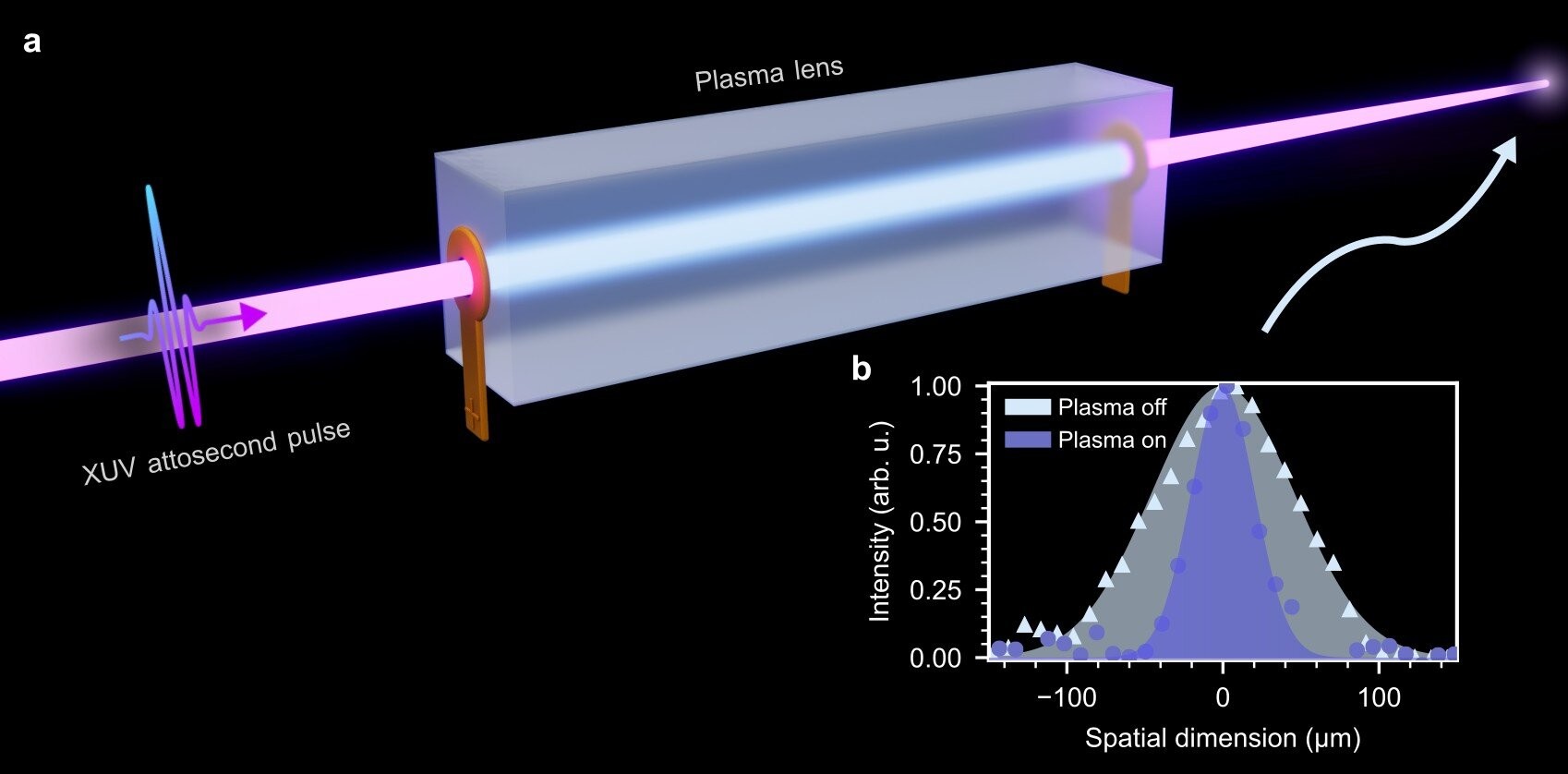
The research team overcame this challenge by developing a novel plasma lens. The process involves firing powerful electrical pulses through hydrogen gas confined within a tiny tube. This rapidly strips the hydrogen atoms of their electrons, creating a plasma —a state of matter where electrons are separated from the atoms. The electrons naturally spread outward, forming a plasma structure resembling a concave lens.
Importantly, unlike ordinary materials, plasma bends light in a way that allows it to focus, rather than spread, the attosecond pulses.
Key Advantages and Findings
The new plasma lens offers several key advantages:
- Broad Spectrum Focusing: The lens can effectively focus attosecond pulses across a range of XUV wavelengths.
- Tunable Focal Length: The focal length of the lens can be adjusted by controlling the plasma density.
- High Transmission Rate: The researchers achieved a transmission rate exceeding 80%, meaning a significant portion of the attosecond pulses passes through the lens.
- Infrared Filter Replacement: The plasma lens effectively filters out the infrared driving pulses that typically require separate metal filters. Removing the need for these filters leads to a stronger, more intense attosecond light source.
Preserving Ultrafast Pulse Duration
To fully characterize the performance of the plasma lens, the researchers conducted detailed computer simulations. These simulations revealed that the attosecond pulses only experienced a slight increase in duration—from 90 to 96 attoseconds—after being focused. Moreover, under realistic conditions where the pulse components travel at slightly different times, the plasma lens actually compressed the pulses, reducing the duration from 189 to 165 attoseconds.
This breakthrough significantly expands the possibilities for attosecond experiments, which are often limited by the available light intensity.
The development of this plasma lens represents a substantial step forward in ultrafast optics, offering scientists a powerful new tool to probe the fundamental dynamics of electrons and paving the way for innovative applications in fields like materials science and quantum technology