


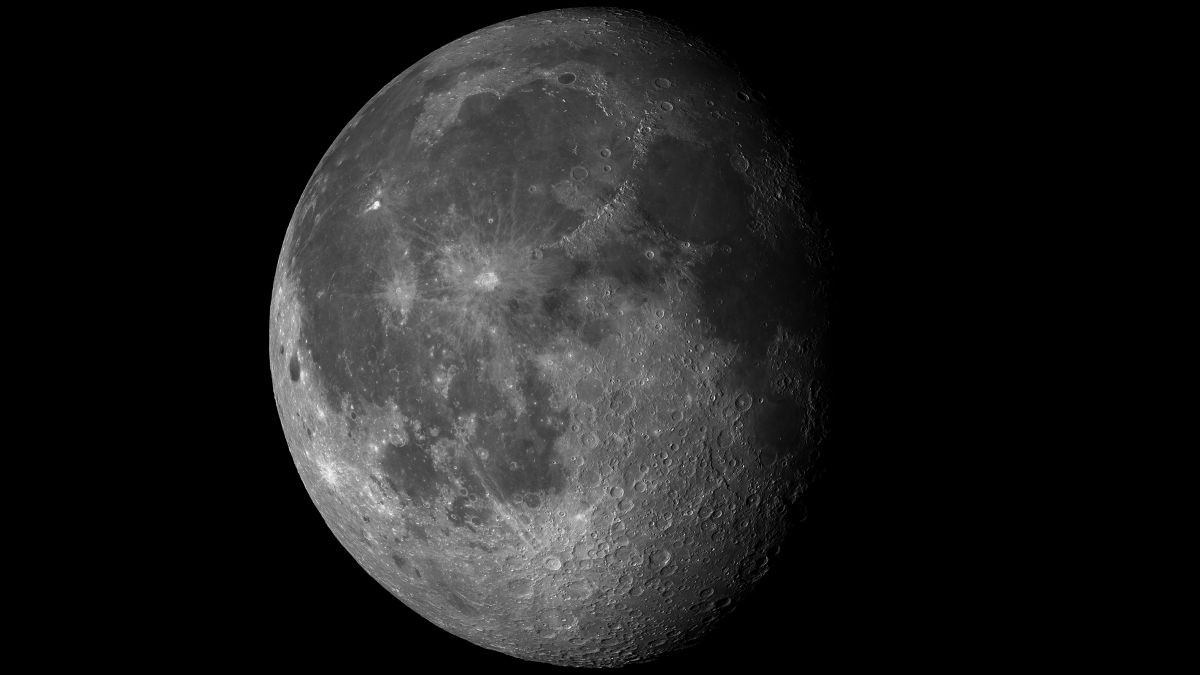
New analysis of lunar samples retrieved by China’s Chang’e-6 mission provides compelling evidence that the Moon’s strikingly different hemispheres are a result of a massive, ancient impact. For decades, scientists have observed the puzzling asymmetry between the near and far sides of Earth’s natural satellite: the near side, facing Earth, is dominated by dark basalt plains, while the far side is lighter and heavily cratered. Now, isotopic analysis of lunar dust collected from the South Pole-Aitken Basin suggests a catastrophic collision reshaped the Moon’s interior.
The Lunar Puzzle: Why Two Sides?
The discrepancy between the two sides has been known since 1959, when Soviet probes first imaged the far side. The key difference isn’t just surface features; it’s in the underlying composition. The far side’s mantle seems to contain a higher proportion of heavier isotopes of iron and potassium, while the near side exhibits lighter isotopes. This isn’t something volcanism alone can explain.
The leading hypothesis has always centered around the South Pole-Aitken Basin—one of the largest known impact craters in the solar system, covering nearly a quarter of the lunar surface. But without physical samples from the far side, confirming this connection remained impossible.
Chang’e-6 Mission: A Breakthrough
The Chang’e-6 mission changed that. For the first time, scientists now have actual lunar dust from the far side. Analyzing this material, researchers led by planetary scientist Heng-Ci Tian have found a clear isotopic difference between far side and near side samples (collected during the Apollo missions and China’s Chang’e-5 mission).
The far side’s samples show higher levels of heavier isotopes. The team concludes that the South Pole-Aitken impactor vaporized material from the Moon’s mantle, preferentially releasing lighter isotopes into space. This would have left behind a concentration of heavier isotopes at depth.
Implications for Lunar Evolution
This isn’t just about one big crater. The findings suggest that large impacts can fundamentally reshape planetary interiors, altering chemical compositions in ways that persist for billions of years. The heat generated by the impact likely drove deep mantle convection, further mixing and distributing these isotopic differences.
“This finding also implies that large-scale impacts are key drivers in shaping mantle and crustal compositions.”
Further sampling from other regions of the far side will be needed to confirm the full extent of these changes. However, the new evidence strongly suggests that the Moon’s lasting scars run far deeper than surface features, permanently altering its chemistry. The Moon’s asymmetry is not just a quirk of geology, but a direct result of cosmic violence.


