A remarkable collection of fossils discovered in a flooded cave in Central Texas is rewriting the known history of the region’s Ice Age wildlife. The findings suggest that roughly 100,000 years ago, during a warm interglacial period, the Edwards Plateau supported a diverse ecosystem unlike anything previously documented in the area.
The discovery challenges long-held assumptions about the region’s paleontology, offering a rare glimpse into a “lost world” that existed before the last major ice age.
A Treasure Trove in Bender’s Cave
The fossils were uncovered in Bender’s Cave, located on private property in Comal County, Texas. Unlike typical dry caves, this site is a water-filled conduit for underground streams. For decades, cavers had anecdotally noted the presence of bones, but systematic scientific investigation had never occurred.
University of Texas at Austin paleontologist John Moretti and local caver John Young led the expedition. The collection process was physically demanding, requiring the team to crawl through streambeds with goggles and snorkels. However, the retrieval was surprisingly straightforward: the fossils were not embedded in rock but lay scattered across the cave floor, easily plucked from the sediment.
“There were fossils everywhere, just everywhere, in a way that I haven’t seen in any other cave. It was just bones all over the floor,” Moretti said.
The team collected specimens from 21 different zones within the cave. The sheer volume and variety of the remains indicate that these animals died in the surrounding area and were washed into the cave through sinkholes during erosion and flooding events thousands of years ago.
An Unusual Animal Community
The fossil assemblage includes several species that are rare or previously unknown for this specific time period in Central Texas. Key discoveries include:
- Giant Tortoise (Hesperotestudo sp.)
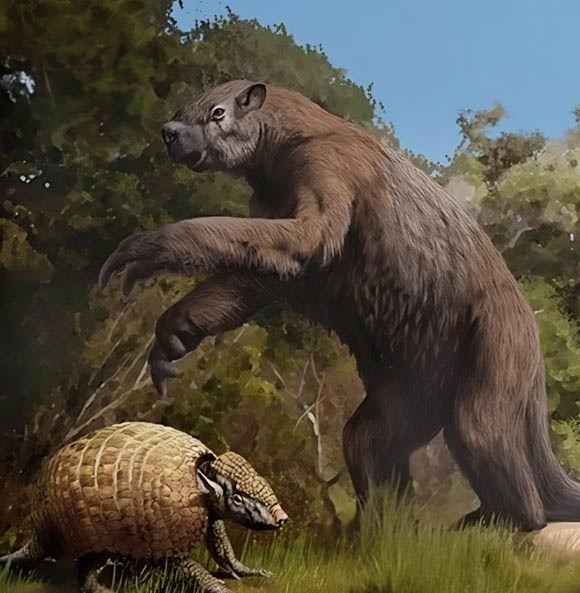
- Giant Ground Sloth (Megalonyx jeffersonii )
- Pampathere (Holmesina septentrionalis ), a lion-sized relative of the armadillo
- Scimitar-toothed Cat (Homotherium serum )
- Horses, Camels, and Mastodons
What makes this collection particularly significant is the uniformity of the fossils. The bones are polished, rounded, and exhibit a similar degree of rusty red mineralization. This consistency suggests that the animals were swept into the cave at approximately the same time, preserving a snapshot of a single, coherent ecosystem rather than a random accumulation of bones from different eras.
Why This Matters: A New Window into the Past
For nearly a century, paleontologists have extensively studied Central Texas. However, fossils dating to the last interglacial period (approximately 100,000 years ago) had never been found in the region. This gap in the record left scientists with an incomplete picture of how climate shifts affected local wildlife.
If confirmed as interglacial in age, these fossils provide critical data on:
1. Environmental Conditions: They reveal what the landscape and climate were like during a warm period prior to the last glaciation.
2. Biodiversity: They show which species coexisted in Central Texas during this specific window, highlighting a community that had not been observed before in this part of the state.
Dr. David Ledesma of St. Edwards University, who was not involved in the study, emphasized the significance of the find: “The research shows that even in an area as well documented as Central Texas, there are new things to find.”
Conclusion
The discovery at Bender’s Cave demonstrates that even in thoroughly studied regions, natural archives can hold surprises. By preserving a unique snapshot of a warm Ice Age ecosystem, these fossils offer scientists a new tool for understanding how past climate changes shaped the biodiversity of North America. The findings, published in the journal Quaternary Research, underscore the importance of exploring underground water systems in the hunt for historical ecological data.