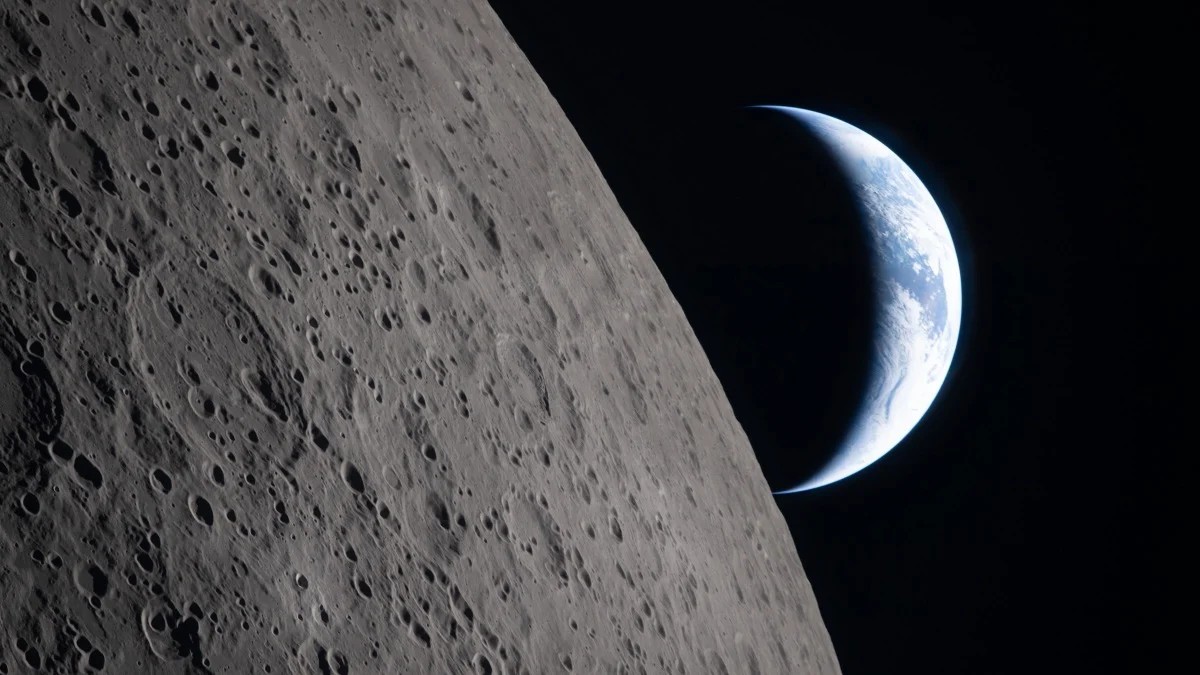
The Artemis II mission has provided humanity with a fresh, high-definition look at our celestial neighbor, capturing vistas that were previously impossible to document. As the Orion spacecraft orbited the Moon, the crew—Commander Reid Wiseman, pilot Victor Glover, and mission specialists Christina Koch and Jeremy Hansen—utilized advanced digital cameras to document a series of rare astronomical phenomena and geological details.
Beyond the Apollo Era: A Technological Leap
While the Apollo missions of the 20th century provided iconic imagery, Artemis II represents a significant evolution in space exploration. Unlike the brief lunar encounters of the past, this 10-day mission allows for extended observation. The crew’s ability to linger near the lunar surface—skimming within roughly 4,000 miles —has resulted in images with much higher resolution and detail than previous eras of spaceflight.
The astronauts noted that the Moon’s appearance differs from the monochromatic “gray” often depicted in textbooks. Instead, they described a more nuanced palette, including:
– Brownish hues across much of the terrain.
– Splotches of green and snowy white visible under specific lighting.
– Dramatic shadows cast by the “terminator”—the moving line between day and night—which transformed craters and valleys into deep, theatrical silhouettes.
Rare Celestial Alignments
The mission’s trajectory allowed the crew to witness several rare events that offer profound scientific and visual value:
1. The Total Solar Eclipse from Space
For nearly an hour, the astronauts experienced a total solar eclipse from their unique vantage point. As the Moon blocked the Sun, the solar corona became visible, stars appeared in the darkened sky, and the planet Venus was clearly seen glinting in the darkness.
2. Simultaneous Earth and Moon Views
In a rare moment of cosmic alignment, Commander Wiseman reported seeing both the Moon and the Earth through the spacecraft’s windows simultaneously. At that moment, the Moon appeared as a gibbous shape while the Earth appeared as a crescent, providing a unique perspective on how celestial bodies move in relation to one another.
3. The “Earthrise” and “Earthset”
As Orion transitioned behind the Moon, the crew captured the Earth sinking below the lunar horizon, leaving only a thin blue crescent visible. This was followed by a historic “Earthrise,” where the pale blue planet emerged from behind the rugged lunar surface, a view that serves as a stark reminder of Earth’s isolation in the void.
Why These Images Matter
The data captured by the Artemis II crew serves two primary purposes:
Scientific Insight: NASA intends to use these high-resolution images to study how massive asteroid impacts have shaped planetary surfaces over billions of years. The craters visible in these photos act as a historical record of the solar system’s violent evolution.
Human Perspective: Beyond the data, the mission provides a psychological “overview effect.” As mission specialist Christina Koch noted, seeing the Moon as a physical, three-dimensional body rather than a distant object creates a profound sense of connection to Earth.
“When we have that perspective, and we compare it to our home of the Earth, it just reminds us how much we have in common… everything we need, the Earth provides, and that, in and of itself, is somewhat of a miracle.” — Christina Koch
Conclusion: The Artemis II mission has transitioned from mere lunar transit to a sophisticated observational journey, providing the scientific community with vital geological data and offering humanity a renewed, awe-inspiring perspective on our place in the universe.