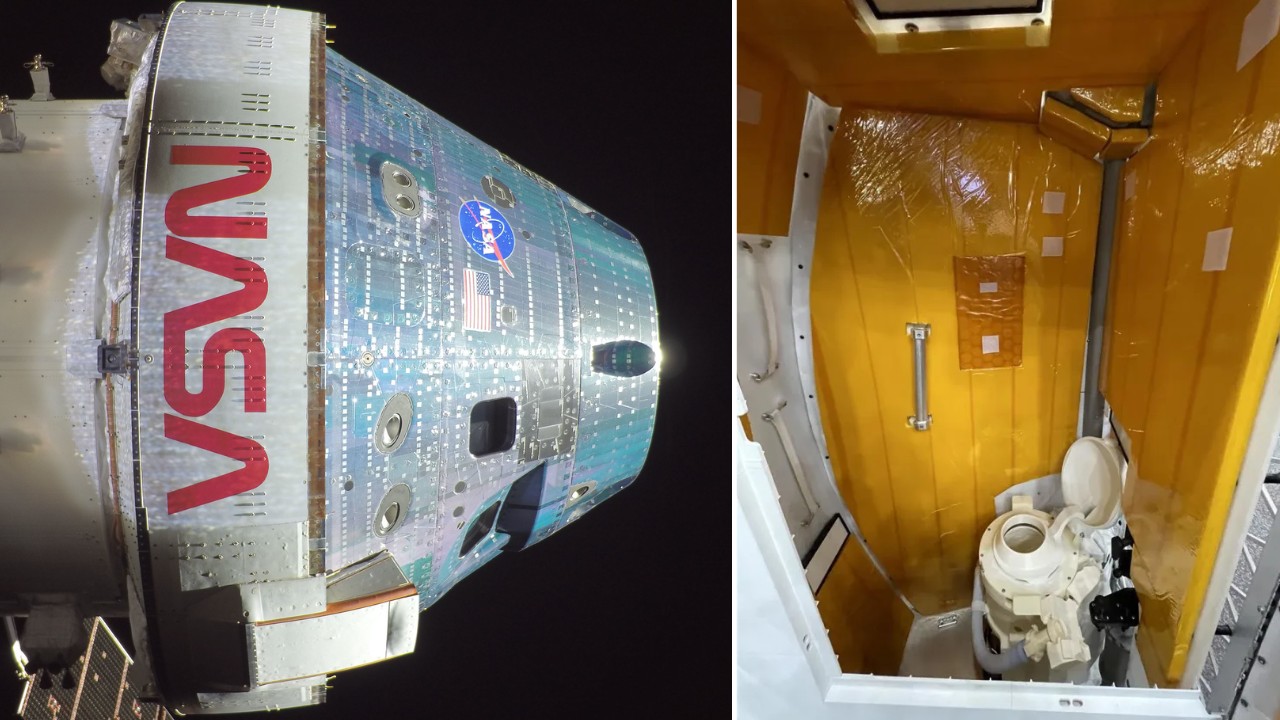
While the Artemis 2 mission aims to make history as the first crewed lunar flyby in over five decades,, the spotlight has shifted from the astronauts to a much more terrestrial concern: the spacecraft’s toilet.
As the four-person crew orbits the moon,, they are navigating technical hurdles that highlight a fundamental truth of space exploration—advanced propulsion and navigation mean little if basic human biological needs cannot be met.
A Series of Technical Setbacks
The Orion spacecraft’s hygiene bay,, a compact compartment designed for lunar travel,, has been at the center of several recent malfunctions. What began as a minor issue has evolved into a complex troubleshooting mission for NASA engineers.
- The “Space Plumber” Intervention: Mission specialist Christina Koch recently had to perform hands-on repairs to the urine function after it went offline. Koch noted that the toilet is perhaps the “most important piece of equipment on board,” emphasizing that mission success relies heavily on these life-support systems.
- The Mystery Odor: The crew reported a “burning smell” emanating from the hygiene bay. While engineers are still investigating, preliminary findings suggest it may be “off-gassing”—a process where materials like tapes or adhesives release gases—rather than a hazardous electrical fire.
- The Ice Blockage: The most pressing issue involved the urine storage tank. After failing to vent its contents, flight controllers suspected that ice had formed in the nozzle due to the extreme cold of space.
The “Bake Out” Strategy and Contingency Plans
To resolve the blockage, NASA engineers utilized a creative thermal solution. They maneuvered the Orion spacecraft to point its urine vent nozzle directly at the sun for several hours. This “bake out” was designed to thaw any ice buildup and allow the tank to clear.
While the maneuver successfully emptied about half of the tank, the crew cannot yet use the primary toilet. Until a permanent fix is implemented, the astronauts are relying on Contingency Collapsible Urinals (CCUs).
“When you are in cislunar space with a broken toilet, you need contingencies,” explained NASA astronaut Don Pettit. He noted that these specialized plastic containers are far more efficient than alternatives, replacing the need for roughly 25 pounds of diapers.
Why the Public is Obsessed with Space Plumbing
It may seem trivial to focus on waste management during a historic lunar mission, but experts argue this fascination is both logical and human. Unlike the Apollo missions of the 1960s, Artemis 2 utilizes highly sophisticated, compact technology designed for long-duration stays in deep space.
NASA officials point out two main reasons for the intense interest:
1. Relatability: Hygiene is a universal human experience that everyone understands, making it a tangible way for the public to connect with the rigors of spaceflight.
2. Complexity: Managing human waste in microgravity and extreme temperatures is a massive engineering challenge that is critical to crew health and spacecraft cleanliness.
Mission Overview
The Artemis 2 crew—consisting of Commander Reid Wiseman, pilot Victor Glover, and mission specialists Christina Koch and Jeremy Hansen—is currently on a 10-day mission. Their journey serves as a critical test of the Orion spacecraft’s ability to sustain human life in the lunar environment.
The technical struggles with the Orion toilet underscore the reality that deep-space exploration is as much about mastering basic human biology as it is about mastering celestial mechanics.